

Quick Summary:
Low-viscosity epoxy is generally better when stone processing requires deep penetration into pores and micro-cracks, while higher-body epoxy provides more control for wider gaps, vertical repairs, and applications where excessive runoff is a problem. However, viscosity alone should not decide the product. Stone type, defect width, temperature, pot life, cure profile, expansion, wetting, and final polishing requirements all matter. Choose the epoxy whose flow behavior matches the actual process rather than simply buying the lowest or highest CPS.
Low-viscosity epoxy sounds better.
It penetrates farther, spreads easily, wets fine cracks, and works well in vacuum-assisted processes. For stone factories trying to reinforce slabs before polishing, those advantages can be very attractive.
But then a different production problem appears.
The resin flows out of a wide defect. A vertical repair begins to sag. A seam absorbs more material than expected. A porous slab consumes too much resin. After cure, the repair remains recessed because most of the epoxy moved below the surface.
At that point, a thicker or more controlled-flow material starts to look better.
This is why the useful question is not:
“Is low-viscosity epoxy better than high-viscosity epoxy?”
The better question is:
“How much movement does the epoxy need before curing, and where do I need that resin to remain?”
Stone processing includes very different operations: micro-crack impregnation, marble surface repair, granite reinforcement, vacuum infusion, mesh backing, seam filling, vertical bonding, pore filling, and final surface leveling. Each application needs a different balance between penetration and retention.
Veropoxy’s current stone epoxy product range reflects this application-based approach, with dedicated systems for black granite, marble, white stone, mesh backing, vacuum infusion, semi-precious stone, and other specialized processes.
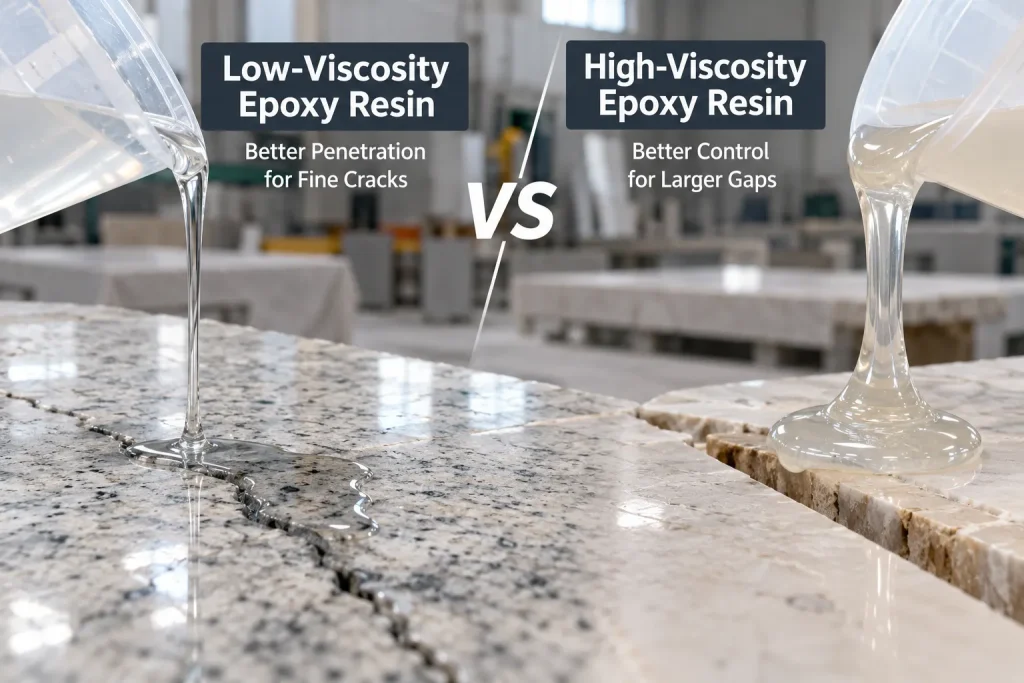
What Is Low-Viscosity Epoxy Resin?
Low-viscosity epoxy is an uncured resin-hardener system that offers relatively low resistance to flow under defined measurement conditions.
In practical stone processing, that means the mixed epoxy can generally spread easily, enter small cracks, wet pores, move through reinforcement structures, and travel farther before its viscosity rises during curing.
Why stone factories use low-viscosity epoxy
The main reason is penetration.
Many structural defects in natural stone are much smaller than they appear on the surface. A visible crack can narrow dramatically below the face of the slab. Dense granite can contain fine fissures that a thick resin cannot easily enter.
A lower-viscosity system reduces flow resistance and gives resin a better chance of reaching those internal pathways.
This is especially useful for:
- hairline cracks;
- micro-fissures;
- dense granite;
- fine marble cracks;
- vacuum impregnation;
- porous stone reinforcement;
- mesh wetting; and
- large-area surface treatment before polishing.
Veropoxy’s 2-Step Low-Viscosity AB Glue for Black Granite, for example, uses a low-viscosity, high-penetration base system to infiltrate dense granite pores and micro-fissures before the finishing stage.
What Is High-Viscosity or Higher-Body Epoxy?
Higher-viscosity epoxy resists flow more strongly.
Instead of quickly spreading across a surface or disappearing into fine pores, the material tends to remain closer to where it is applied.
This behavior can be valuable when the production goal is not deep penetration.
Where higher body becomes useful
Typical situations include:
- wider cracks;
- larger cavities;
- edge repair;
- vertical joints;
- seams that must remain full;
- applications where runoff needs to be minimized;
- repairs requiring surface build; and
- situations where excessive penetration would increase resin consumption.
The important distinction is that “higher viscosity” does not automatically mean “better filler.”
Gap-filling performance can also depend on thixotropy, fillers, resin chemistry, surface tension, curing speed, low-shrinkage behavior, expansion characteristics, and application thickness.
This is why professional product selection needs more than one CPS number.
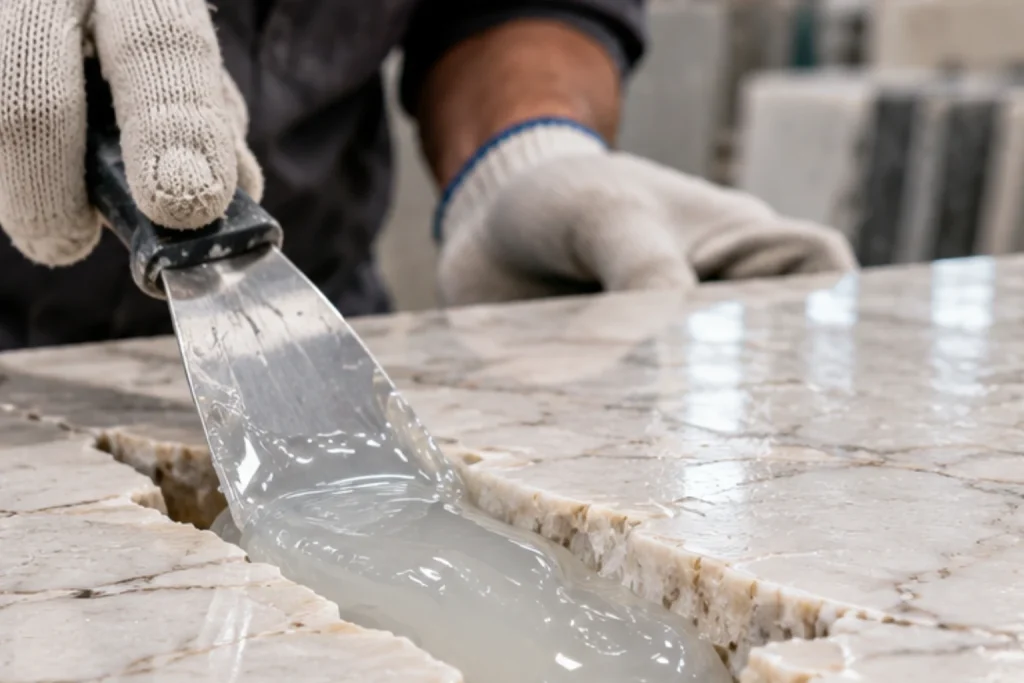
Low Viscosity vs High Viscosity: The Main Differences
| Performance Factor | Lower-Viscosity Epoxy | Higher-Viscosity / Higher-Body Epoxy |
|---|---|---|
| Micro-crack penetration | Generally better | More limited |
| Flow across large surfaces | Easy | Slower and more controlled |
| Vacuum infusion | Usually preferred | Can restrict resin movement |
| Wide-gap filling | May drain or sink into surrounding pores | Usually provides better retention |
| Vertical application | Greater runoff or sag risk | Usually easier to keep in position |
| Highly porous stone | May increase resin consumption | Can reduce unnecessary deep migration |
| Mesh wetting | Generally easier | May require more spreading effort |
| Surface build | Can leave thin coverage | Usually better |
| Air release | Often easier when correctly mixed | Entrapped air may move more slowly |
| Operator control | Can run quickly | Usually easier for local placement |
Why Lower Viscosity Improves Penetration
Fine stone defects create narrow pathways.
The smaller the pathway, the more difficult it becomes for a viscous liquid to move through it.
Lower viscosity reduces resistance to flow and improves the ability of resin to enter those small channels before curing progresses too far.
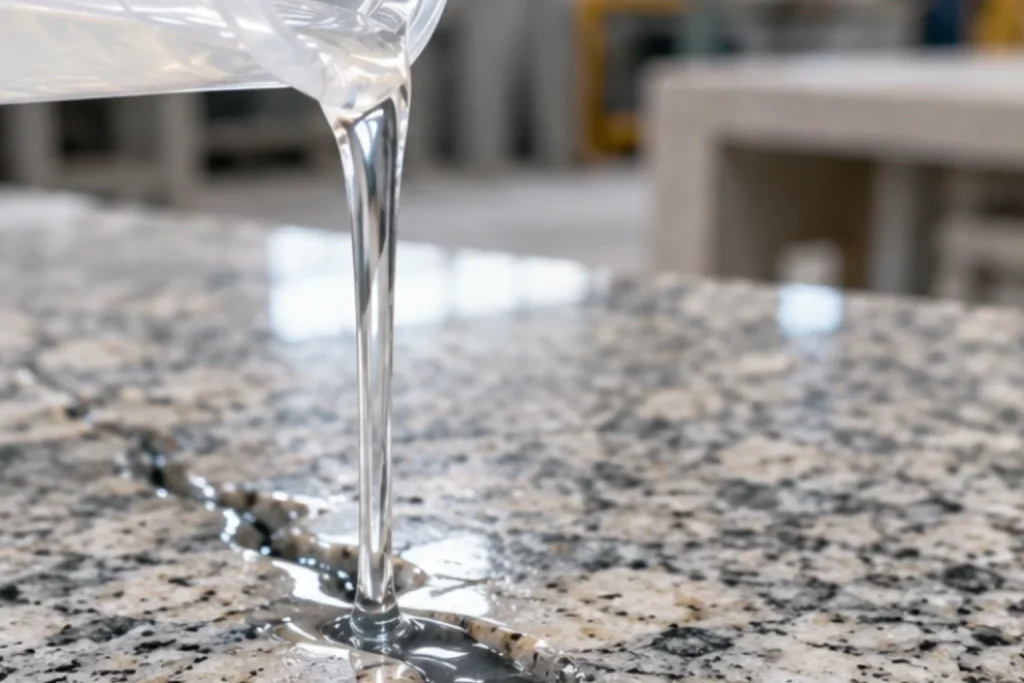
Dense black granite is a good example
Black granite may appear extremely solid, yet slabs can contain small fissures, natural pores, or processing-related micro-defects.
Because the stone is dense, simply applying a thick adhesive to the surface may not provide meaningful internal reinforcement.
Veropoxy’s black-granite system uses a low-viscosity penetration layer specifically to reach deeper into the stone before a separate color-enhancement and polishing layer is applied.
This two-stage logic is important.
The resin that performs best for penetration does not necessarily need to perform every other finishing function at the same time.
Why Low Viscosity Is Important for Vacuum Infusion
Vacuum infusion depends on resin movement.
Vacuum pressure assists the resin in entering pores, fissures, and internal defects, but the process still depends on the resin remaining mobile enough to travel through the stone.
A resin that becomes too viscous can slow the flow front, create uneven impregnation, or leave areas insufficiently reinforced.
Veropoxy’s Low-Viscosity Epoxy for Stone Vacuum Infusion – 5080 / B25Q-KG is published at approximately 400–600 CPS, with a 100:25 mixing ratio, approximately 24°C processing temperature, and 3–5 hour curing time.
Those specifications illustrate another important point:
Low viscosity needs enough working time.
A resin can begin extremely fluid, but if it reacts too quickly and thickens before the vacuum cycle is complete, its initial viscosity becomes much less useful.
For vacuum infusion, compare more than CPS
Buyers should also evaluate:
- mixed viscosity;
- viscosity rise over time;
- pot life;
- gel time;
- stone temperature;
- vacuum-cycle duration;
- air-release behavior; and
- actual penetration depth.
When Low Viscosity Becomes a Problem
The easiest mistake is to assume that if penetration is useful, even more penetration must be better.
That is not always true.
Excessive runoff
Very fluid resin can move away from the intended repair zone before curing.
This is particularly difficult on sloped surfaces, edges, vertical stone, and open cavities.
Higher resin consumption
Porous stone may absorb large quantities of low-viscosity resin.
Some of that penetration may improve reinforcement, but some may simply increase material consumption without improving the visible repair.
Factories should therefore measure resin usage per slab rather than judging products only by drum price.
Insufficient surface build
If most of the resin moves into the stone, not enough material may remain at the surface.
After grinding and polishing, cracks or pores can reopen visually because the upper part of the defect is under-filled.
Shadowing on light stone
On white or translucent marble, excessive penetration can change the optical appearance of the stone around the repair.
The result may look like staining or a watermark even if the cured epoxy itself remains clear.
This is why white-marble processing often requires tighter penetration control than dense dark granite.
When Higher-Body Epoxy Is the Better Direction
Wide cracks and open cavities
A wider defect often needs more material to remain inside the repair area.
If the resin is too fluid, it may drain downward, migrate into surrounding pores, or leave the top of the cavity under-filled.
Vertical repairs
Gravity matters.
A resin that levels beautifully on a horizontal slab may run down a vertical edge before curing.
For vertical bonding or edge filling, a more controlled or thixotropic formulation can be much easier to work with.
Surface leveling
Some processing operations need resin to remain near the surface so grinding and polishing can produce a continuous face.
In these cases, deep penetration is only part of the requirement.
The factory may use one material for internal impregnation and another for final filling or surface finishing.
Do Not Assume Seam-Filling Epoxy Must Have a Very High CPS
This is where simple viscosity rules start to break down.
Veropoxy’s Low Expansion Epoxy for Semi-Precious Stone Seam Filling – 5090 / D30M-BS is currently specified at approximately 400–600 CPS.
Numerically, that is similar to several Veropoxy penetration-oriented systems.
Yet the application is seam filling for agate, onyx, and composite semi-precious stone.
Why?
Because the product selection is not based on viscosity alone.
The system also emphasizes:
- low expansion;
- low internal stress;
- controlled flow;
- dimensional stability;
- uniform curing;
- very low yellowing; and
- a smooth seam after polishing.
This is a useful purchasing lesson.
Buyer takeaway: Do not create a rigid factory rule such as “400–600 CPS is only for penetration” or “seam filling always requires very high viscosity.” The formulation, substrate, gap geometry, application orientation, cure behavior, expansion, and thixotropy can change the result.
How Stone Type Changes the Viscosity Choice
Dense granite
Dense granite usually favors a penetration-oriented approach when the main problem is micro-cracking or internal reinforcement.
A lower-viscosity system can enter defects that thicker material may bridge over.
If the defect is a large open chip or edge break, however, a penetration resin alone may not provide sufficient build.
White marble
White marble requires additional caution.
Low viscosity can improve crack penetration, but excessive absorption can produce dark halos or optical shadowing.
For color-sensitive marble, viscosity should be evaluated together with non-staining behavior and yellowing resistance.
Colored marble
Colored marble may tolerate some visual penetration better than pure white material, but color enhancement still needs to remain consistent.
The correct resin should penetrate enough to repair micro-defects without creating irregular zones after polishing.
Travertine
Travertine contains pores and cavities ranging from fine capillaries to large open holes.
One resin may not be ideal for both conditions.
A low-viscosity system may be useful for internal reinforcement, while a more filling-oriented material may be required for larger surface cavities.
Onyx and semi-precious stone
These materials can be visually sensitive, translucent, and dimensionally delicate.
For seam filling, resin expansion, internal stress, clarity, yellowing resistance, and polishability can matter as much as viscosity.
This is why the semi-precious stone seam-filling system should be evaluated as a complete formulation rather than by CPS alone.
How Defect Size Should Influence Epoxy Selection
| Defect or Process | Preferred Flow Direction | Main Selection Goal |
|---|---|---|
| Hairline micro-cracks | Lower viscosity | Reach internal fissures before gelation |
| Fine pores | Low to controlled viscosity | Wet and reinforce without excessive resin loss |
| Vacuum infusion | Low viscosity | Maintain flow through the complete infusion cycle |
| Mesh backing | Controlled low viscosity | Wet fibers while preventing unnecessary runoff |
| Medium surface cracks | Balanced viscosity | Combine penetration with sufficient fill |
| Wide seams | Controlled-flow or higher-body system | Maintain fill depth and avoid drainage |
| Large cavities | Higher body or suitable filling formulation | Keep sufficient material inside the repair |
| Vertical repair | Higher body / thixotropic behavior | Reduce sagging and runoff |
Temperature Can Change a “Low-Viscosity” Epoxy Into a Much Thicker Material
Viscosity is highly temperature-sensitive.
The same epoxy that flows easily in a warm workshop may become noticeably thicker during winter.
This means product selection should not be based only on the viscosity number printed on the technical data sheet.
Cold production conditions
At lower temperatures:
- resin usually becomes thicker;
- spreading becomes harder;
- micro-crack penetration can decrease;
- air release can slow;
- mesh wetting can become more difficult; and
- curing generally becomes slower.
Warm production conditions
Higher temperature generally improves initial flow.
But it can also accelerate resin-hardener reaction and reduce the useful working window.
This creates an important trade-off:
The resin may penetrate very well during the first few minutes but become too reactive before the entire slab is treated.
For a deeper explanation of this relationship, see the Epoxy Resin Curing Time and Temperature Guide.
Working Time Can Matter More Than Initial Viscosity
A technical data sheet may give one viscosity value measured shortly after mixing.
Production does not happen at one instant.
The epoxy may be:
- mixed for several minutes;
- carried to another station;
- spread over a large slab;
- left under vacuum;
- rolled through mesh; or
- worked manually across multiple repairs.
During that time, curing progresses, and viscosity rises.
For this reason, a factory should ask not only:
“What is the starting CPS?”
but also:
“How long does the resin remain within a useful flow range?”
How to Match Epoxy Flow to Real Stone Processing Needs
If the main problem is hairline cracking inside dense granite, choose a low-viscosity penetration system with enough working time to reach internal defects.
If vacuum infusion is used, prioritize low mixed viscosity and stable flow throughout the vacuum cycle.
If fiberglass mesh must be wetted across a large slab, choose controlled low viscosity that spreads easily but does not run away before the mesh is uniformly covered.
If a wide seam repeatedly sinks after application, move toward a formulation with more retention or body rather than simply adding more of the same penetration resin.
If a vertical edge repair sags, evaluate a thixotropic or non-sag system.
If white marble develops dark halos around cracks, do not automatically select an even lower viscosity. Investigate excessive penetration and stone porosity first.
If the surface repair is recessed after polishing, consider a two-stage process: deep penetration first, followed by suitable surface filling.
Penetration vs Filling: Why Some Factories Need Two Steps
Trying to make one resin do everything creates compromises.
A product thin enough to reach the deepest micro-cracks may not remain at the surface.
A product thick enough to fill a wide defect may not reach fine internal fissures.
Step 1: Reinforce the structure
Use a penetration-oriented resin to enter pores and micro-cracks and stabilize the stone internally.
Step 2: rebuild the surface
After the penetration stage, apply a surface or filling system where necessary to restore defect depth, color, smoothness, and polishing readiness.
Veropoxy’s black-granite system already demonstrates this principle through a low-viscosity penetration base followed by a color-enhancement and polishing top coat.
The broader lesson is useful beyond black granite:
Deep reinforcement and final surface finishing are different jobs.
Why Thixotropy Matters for Vertical and Gap-Filling Applications
Viscosity is often treated as if it were one fixed property.
Real formulations can behave differently under movement and at rest.
A thixotropic adhesive can become easier to spread under shear but regain body after application.
This can be valuable in vertical joints and local repairs because the resin is workable during spreading but resists sagging after placement.
For buyers, this means a single rotational-viscosity number may not fully describe real application behavior.
Ask the supplier whether the material is:
- Newtonian or strongly shear-dependent;
- self-leveling;
- thixotropic;
- non-sag;
- designed for penetration; or
- designed for gap retention.
Common Mistakes When Choosing Epoxy by Viscosity
Choosing the lowest CPS because it sounds more advanced
Ultra-low viscosity is useful only when the application benefits from deeper flow.
For wide defects, vertical repairs, or highly porous stone, it can create unnecessary problems.
Calling every thicker resin “high viscosity”
Some products provide filling performance through controlled flow, fillers, thixotropy, low shrinkage, or low expansion rather than an extremely high CPS figure.
Ignoring the measurement temperature
A viscosity value without temperature context is incomplete.
Ignoring cure speed
Low initial viscosity is not useful if the resin thickens before application is complete.
Ignoring stone porosity
The same resin can behave very differently on dense granite and porous marble.
Using penetration epoxy for large cavities
The resin may simply disappear below the surface, increasing consumption and leaving the repair under-filled.
Using heavy filler for micro-cracks
The material can bridge the crack entrance while leaving the internal defect untreated.
Changing the mixing ratio to change viscosity
Do not reduce or increase hardener simply to make an epoxy thinner, thicker, faster, or slower.
The mixing ratio belongs to the chemistry of the system.
For more detail, see the Epoxy Resin Mixing Ratio Guide for Stone Processing.
How to Test Low- and Higher-Viscosity Epoxy Before Bulk Ordering
Step 1: Use the actual production stone
Do not rely only on glass, plastic, or generic laboratory panels.
Stone structure controls resin absorption and penetration.
Step 2: Control temperature
Bring both candidate systems to the same resin, stone, and workshop temperature.
Step 3: Use the specified mixing ratio
Incorrect mixing destroys the validity of the comparison.
Step 4: Apply the same resin quantity
Measure material consumption rather than pouring by eye.
Step 5: Observe penetration
Check whether the resin reaches the full depth of fine defects.
Step 6: Observe runoff and retention
For wider gaps, record whether the resin remains in position or sinks into the stone.
Step 7: Record working time
Note when flow becomes noticeably less useful.
Step 8: Cure and polish
The wet appearance does not tell you whether the process succeeded.
Inspect the slab after the real finishing sequence.
Step 9: Measure material consumption
A resin that requires 30% more material per slab may have a very different real production cost even if its purchase price is lower.
Stone Epoxy Viscosity Qualification Checklist
| Evaluation Item | What to Record | Why It Matters |
|---|---|---|
| Mixed viscosity | CPS and test temperature | Provides a comparable starting point |
| Stone type | Granite, marble, onyx, travertine, engineered stone | Porosity and structure change flow behavior |
| Defect width | Hairline, medium, wide cavity or seam | Determines penetration versus retention requirement |
| Application orientation | Horizontal, vertical, or inclined | Affects sagging and runoff |
| Working time | Minutes of useful flow | Initial viscosity alone is not enough |
| Penetration depth | Actual depth after application | Confirms structural treatment |
| Resin consumption | kg or g per slab / m² | Shows true production cost |
| Surface retention | Remaining fill after cure | Critical for polishing readiness |
| Final appearance | Color, gloss, shadowing, and visible repair lines | Confirms compatibility with finished stone |
| Batch consistency | Results across multiple lots | Important for continuous production |
Recommendation: Choose Flow Behavior, Not a Viscosity Label
Low-viscosity and high-viscosity epoxy are not competing product categories where one is inherently better than the other.
They solve different process problems.
If the resin needs to travel into micro-cracks, fine pores, or a vacuum-assisted stone structure, prioritize low viscosity and sufficient working time.
If the resin needs to remain in a wide gap, vertical repair, or surface cavity, prioritize retention, body, or thixotropic behavior.
If the application requires both internal reinforcement and a perfectly polished surface, consider a staged process rather than forcing one resin to perform both functions.
If two products publish similar CPS values but perform differently, compare the complete formulation: wetting, thixotropy, curing profile, expansion, shrinkage, pot life, temperature range, stone compatibility, and polishing result.
The correct viscosity is therefore not the lowest or highest number available.
It is the flow behavior that allows the epoxy to reach the right place—and remain there long enough to complete the job.
Frequently Asked Questions About Low- and High-Viscosity Epoxy
1. Is low-viscosity epoxy better for stone?
Low-viscosity epoxy is better when the main requirement is penetration into fine pores, micro-cracks, dense granite, or vacuum-infused stone. It is not automatically better for wide gaps, vertical repairs, or highly porous materials where excessive flow can increase runoff and resin consumption.
2. What viscosity epoxy should I use for stone cracks?
Fine hairline cracks generally benefit from lower-viscosity epoxy because the resin needs to penetrate internally. Wider cracks may require a balanced or higher-body system that combines penetration with enough retention to keep the defect fully filled after curing.
3. Is high-viscosity epoxy stronger than low-viscosity epoxy?
Not necessarily. Uncured viscosity does not directly determine final mechanical strength. Strength depends on resin chemistry, hardener chemistry, mixing ratio, cure conditions, adhesion, formulation design, and substrate interaction.
4. Why does low-viscosity epoxy use more resin on porous stone?
Low-viscosity resin can travel deeper into interconnected pores and voids. That may improve reinforcement, but it can also increase consumption if the stone absorbs resin beyond the area that needs treatment. Measure resin usage during production trials before bulk purchasing.
5. Can the same epoxy be used for penetration and seam filling?
Sometimes a controlled-flow formulation can perform both functions, but the answer depends on stone type, seam width, resin rheology, cure behavior, shrinkage or expansion, and final finishing requirements. For demanding processes, separate penetration and filling stages may produce more consistent results.
How to Match Epoxy Flow to Real Stone Processing
Epoxy selection should begin with where the resin needs to travel and where it must remain. Micro-cracks and vacuum infusion need mobility. Wide defects and vertical repairs need retention. Surface finishing often needs a balance between the two. CPS provides useful information, but it should always be interpreted together with stone porosity, defect geometry, temperature, cure profile, rheology, and final finishing requirements.
Start with the defect, not the viscosity label
A hairline crack, an open travertine cavity, a black-granite micro-fissure, a white-marble repair, and an onyx seam are not the same problem. Defect width, stone absorbency, orientation, and visual sensitivity should define the required flow behavior before a CPS range is selected.
Match the resin behavior to the process
Hairline granite cracks:
prioritize low-viscosity penetration and enough working time to reach internal fissures.
Vacuum infusion:
prioritize low resistance to flow, stable viscosity, and a cure window long enough to complete impregnation.
Mesh backing:
use controlled flow that wets fibers efficiently without excessive runoff.
Wide seams and cavities:
prioritize resin retention, surface build, and dimensional stability rather than maximum penetration.
Vertical repairs:
evaluate thixotropic or non-sag behavior instead of relying only on a static CPS value.
Similar CPS values can still produce different results
Products with similar published viscosity can behave differently because formulation chemistry, thixotropy, surface tension, cure speed, low-expansion characteristics, wetting, fillers, and stone interaction also influence application performance. Buyers should therefore compare complete product behavior rather than ranking suppliers by a single viscosity number.
What should buyers compare before bulk ordering?
Compare mixed viscosity at a defined temperature, working time, viscosity rise during application, penetration depth, runoff, resin consumption, cure profile, final surface retention, polishing behavior, color stability, and batch consistency. Then test the shortlisted system on the actual stone under normal factory conditions.
Practical Recommendation
If the resin cannot reach the defect, reduce flow resistance. If it penetrates too far or runs out of the repair, increase flow control or choose a more suitable filling formulation. If both internal reinforcement and surface finishing are critical, consider separate penetration and finishing stages. The best epoxy viscosity is not the thinnest or thickest option—it is the formulation that reaches the required depth, remains where it is needed, and produces a stable finished slab after curing and polishing.
Need to Match Epoxy Flow to Your Stone Application?
Stone type, crack width, porosity, processing temperature, application orientation, curing time, and finishing requirements all affect the right epoxy choice. Before bulk purchasing, test candidate systems on your actual marble, granite, onyx, semi-precious stone, mesh-backing process, or vacuum-infusion line.
References
- International Organization for Standardization.
ISO 2555:2018 — Plastics — Resins in the Liquid State or as Emulsions or Dispersions — Determination of Apparent Viscosity Using a Single Cylinder Type Rotational Viscometer Method.
ISO/TC 61.
International Organization for Standardization. - ASTM International.
ASTM D2196 — Standard Test Methods for Rheological Properties of Non-Newtonian Materials by Rotational Viscometer.
ASTM International.
ASTM Standards and Engineering Digital Library. - WEST SYSTEM Technical Staff.
WEST SYSTEM User Manual & Product Guide.
Gougeon Brothers, Inc.
WEST SYSTEM Technical Publications. - WEST SYSTEM Technical Staff.
Understanding Epoxy Cure and Temperature Effects.
Gougeon Brothers, Inc.
Epoxyworks / WEST SYSTEM Technical Resources. - Gurit Technical Department.
Epoxy Resin Systems: Processing, Viscosity and Cure Characteristics.
Gurit.
Technical Product Data and Composite Processing Guidance. - J. M. Dealy and K. F. Wissbrun.
Melt Rheology and Its Role in Plastics Processing: Theory and Applications.
Van Nostrand Reinhold.
Polymer Processing and Rheology Reference Literature. - Christopher W. Macosko.
Rheological Principles, Measurements, and Applications.
University of Minnesota.
Wiley-VCH, 1994. - Charles Selwitz.
Epoxy Resins in Stone Conservation.
Getty Conservation Institute.
Research in Conservation Series, Getty Publications, 1992.