

Quick Summary:
Stone mesh backing epoxy must wet the reinforcement mesh, bond reliably to the slab, and cure at a speed that matches the factory temperature. Winter production needs chemistry that still develops strength in cold conditions, while summer or drying-line production needs controlled reactivity so the epoxy does not gel too quickly. Choose the system by actual workshop temperature, mesh wetting, working time, curing behavior, stone condition, and line speed—not by viscosity or cure time alone.
Mesh backing looks simple from the outside.
A stone slab is turned over, fiberglass mesh is placed on the back, epoxy is applied, and after curing the slab returns to production.
In reality, this is one of those processes where a factory can repeat the same movement every day and still get very different results from January to August.
In winter, the resin may become thick and slow to cure. Mesh fibers remain visible because the epoxy does not wet them properly. Slabs occupy racks longer than expected, and operators start moving material before adequate strength has developed.
In summer, the opposite can happen. The epoxy flows well at first, but the working window becomes shorter. A large batch starts heating in the container, the resin thickens before the entire slab is covered, or one side of the mesh receives more resin than the other.
The obvious reaction is to blame the viscosity.
But viscosity is only one part of the answer.
The more important question is whether the complete resin-hardener system is designed to cure predictably at the temperature in which the backing line actually operates.
Veropoxy currently separates these conditions through dedicated stone epoxy systems for low-temperature and high-temperature mesh backing rather than treating one formulation as a universal year-round adhesive.
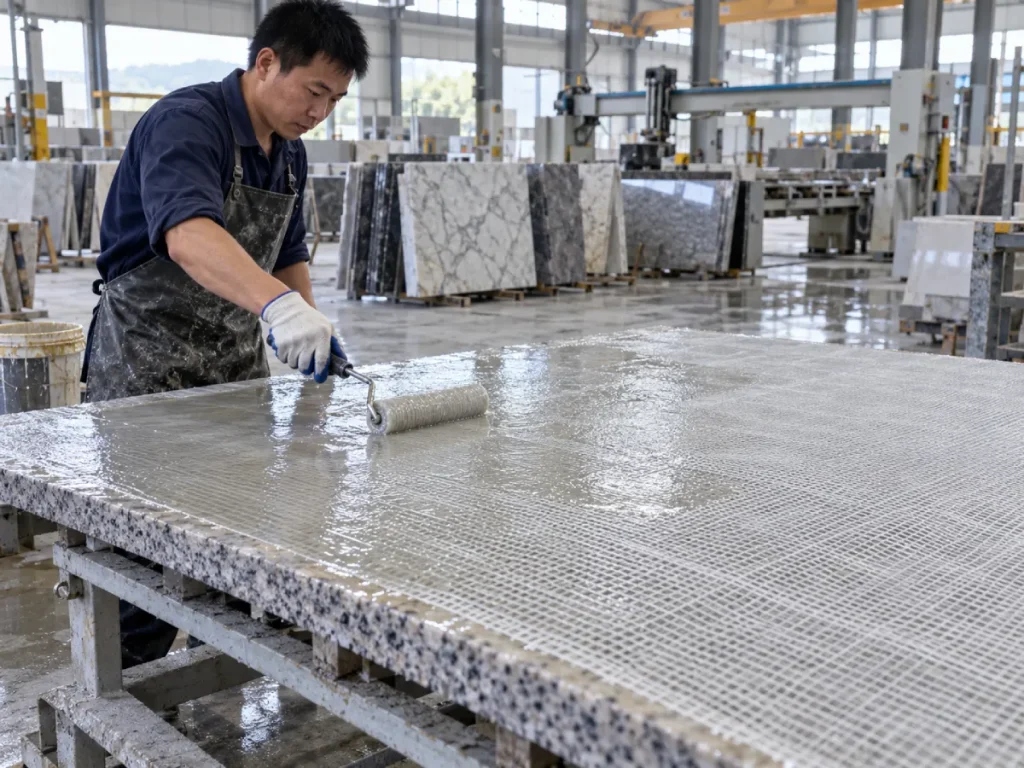
What Is Stone Mesh Backing?
Stone mesh backing is a reinforcement process in which fiberglass mesh or another reinforcing fabric is bonded to the rear surface of a natural or engineered stone slab.
The purpose is not to make every slab structurally identical.
The mesh and resin work together as a reinforcement layer that can help stabilize fragile material, reduce the risk of crack propagation, and improve handling reliability during later processing, transport, fabrication, and installation.
Why fragile slabs need reinforcement
Natural stone is heterogeneous.
Two slabs cut from the same block can have different mineral boundaries, veins, micro-cracks, pores, crystal sizes, and internal stresses.
Highly decorative materials can be especially challenging because the visual features buyers value—large crystals, dramatic veins, mineral transitions, and unusual patterns—may also create local weakness.
Research on coarse-grained and exotic building stones has shown that glass-fiber-reinforced epoxy systems can inhibit crack propagation and improve mechanical behavior, although reinforcement efficiency varies according to the stone, resin, fiber system, and application quality.
Mesh backing normally happens before polishing
For many slab-production lines, reinforcement is performed before final polishing.
The backing layer needs to cure sufficiently before the slab returns to handling, grinding, polishing, or downstream transport.
This makes cure timing a production issue, not merely a laboratory specification.
What Does a Good Mesh Backing Epoxy Need to Do?
A useful mesh-backing epoxy needs several characteristics at the same time.
Wet the fiberglass mesh
The resin must move through and around the mesh fibers rather than sitting on top of the fabric.
Proper wet-out creates contact between the fibers, epoxy, and stone substrate.
If large white or dry areas remain visible in the mesh, reinforcement will be inconsistent.
Bond to the stone surface
Good fiber wetting is not enough if the epoxy does not adhere properly to the slab.
Dust, moisture, slurry residue, oil, wax, release agents, and loose particles can all create a weak interface.
Remain workable long enough
The operator needs enough time to spread the epoxy across the entire slab and fully impregnate the mesh.
A system that gels halfway through a large slab can create strong and weak zones in the same reinforcement layer.
Cure fast enough for the line
Working time cannot be endless either.
Once the mesh is properly wetted and the resin is in place, the system must develop enough handling strength to move the slab through production at a practical speed.
Avoid excessive runoff
If the resin is too fluid under actual production conditions, it can migrate away from the mesh, accumulate at slab edges, or create uneven resin distribution.
Remain consistent through seasonal changes
This is often the hardest requirement.
A resin that performs perfectly at 22°C can behave very differently at 10°C or 32°C.
Why Summer and Winter Mesh Backing Need Different Strategies
Epoxy curing is temperature-sensitive.
When temperature drops, uncured epoxy generally becomes more viscous and the chemical reaction slows.
When temperature rises, the resin generally becomes easier to flow, but the cure reaction also accelerates.
This creates opposite production risks.
| Production Condition | Main Resin Behavior | Typical Risk | What the Factory Needs |
|---|---|---|---|
| Cold winter workshop | Higher viscosity and slower reaction | Poor wetting, delayed cure, early handling | Low-temperature curing chemistry |
| Moderate conditions | Balanced flow and reaction | Shift-to-shift temperature variation | Stable working window and repeatable cure |
| Hot summer workshop | Lower initial viscosity and faster reaction | Short working time, rapid thickening, uneven application | Controlled high-temperature reactivity |
| Heated drying line | Rapid heat input after application | Premature cure or uneven gel development | System designed for drying-line conditions |
The key point is simple:
Winter and summer require different cure control even when the target viscosity looks similar on paper.
Winter Mesh Backing: What Changes at Low Temperature?
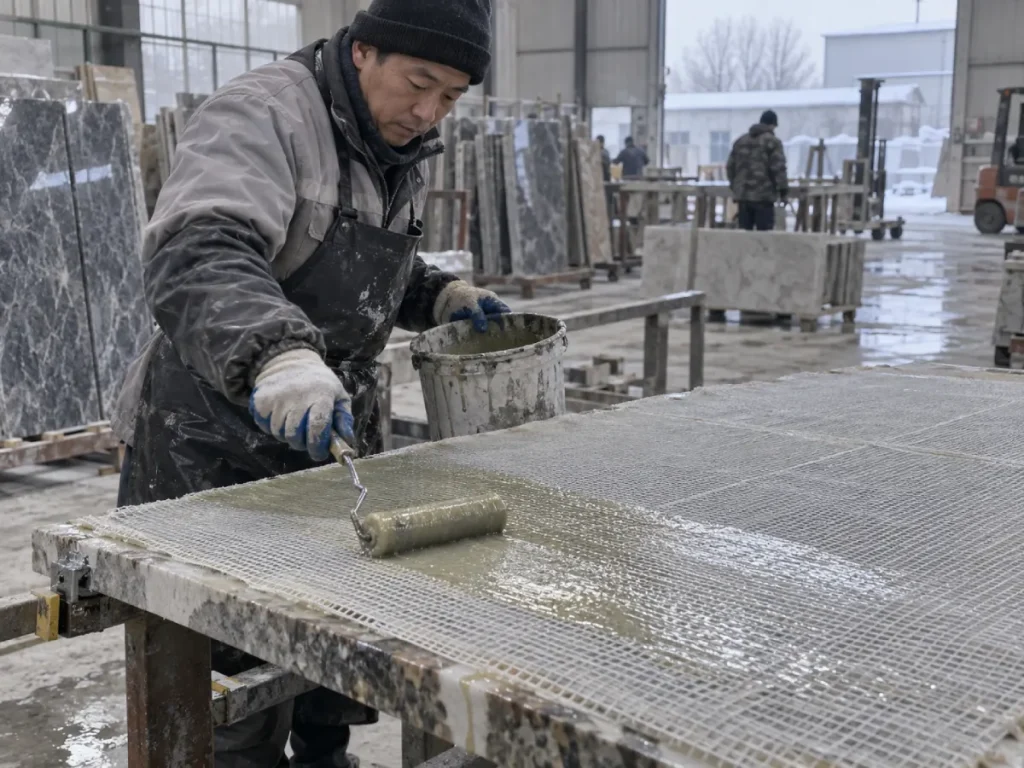
The resin becomes harder to spread
As uncured epoxy cools, viscosity usually rises.
The roller or spreader needs more effort. Resin moves through the fiberglass more slowly, and mesh fibers may remain partially dry.
This becomes especially obvious on large slabs where the operator needs to cover several square meters consistently.
Penetration into the stone can decrease
Mesh backing does not rely only on bonding to the fabric.
The resin also needs enough interaction with pores, roughness, and small defects on the rear surface of the slab.
If the resin becomes too thick, that wetting and surface penetration can become less effective.
Cure time becomes unpredictable
A standard room-temperature system may still eventually cure in cold conditions, but “eventually” is not a production specification.
If the slab needs twice as long before handling, the backing station becomes a bottleneck.
Factories then start making risky decisions such as:
- moving slabs while the resin is still green;
- stacking reinforced slabs too early;
- adding extra hardener;
- using uncontrolled heaters; or
- accepting partially cured mesh.
Those shortcuts usually create more variability.
When a Low-Temperature Mesh Backing Epoxy Makes Sense
A winter-grade epoxy should not simply be a standard formulation with more hardener added at the factory.
The curing chemistry itself should be designed to remain reactive under colder conditions.
Veropoxy’s Low Temperature Epoxy for Stone Mesh Backing – 4090 / WBA25Q is currently positioned for approximately 10°C production.
Its published system uses:
- 4090 / WBA25Q resin-hardener combination;
- 100:25 mixing ratio by weight;
- 400–600 CPS viscosity;
- approximately 50-minute curing time; and
- approximately 10°C recommended working temperature.
The important part is not that “50 minutes is better than 60 minutes.”
The useful point is that the system is formulated to develop curing performance under a colder condition where a conventional hardener may become impractically slow.
Who should consider a winter-grade system?
It makes sense when:
- workshop temperature regularly approaches 10°C;
- stone itself is cold after overnight storage;
- mesh backing occurs in unheated production areas;
- slabs must be moved shortly after reinforcement;
- winter cure delays are reducing line throughput; or
- operators are compensating manually for slow cure.
Summer Mesh Backing: Why Faster Is Not Always Better
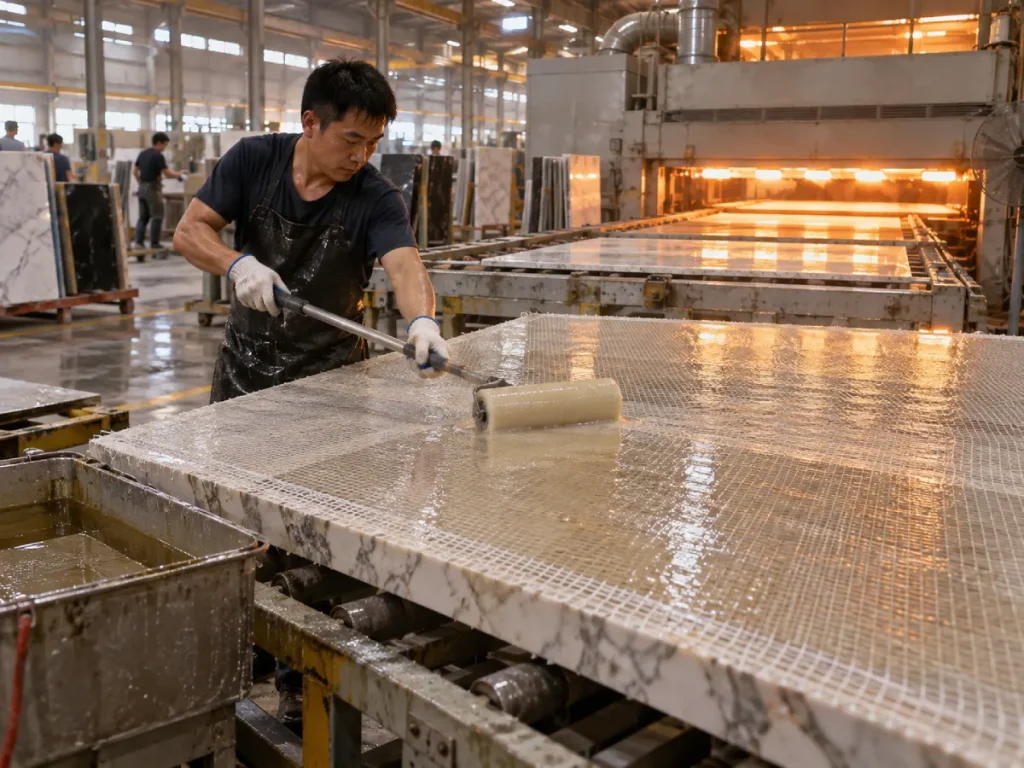
Hot weather looks easier at first.
The epoxy flows nicely. Fiberglass becomes transparent quickly. Operators can move the resin across the slab with less effort.
Then the clock starts working against them.
Working time becomes shorter
Higher temperature generally accelerates the epoxy reaction.
The resin may start at a very workable viscosity but thicken faster than expected.
On a large slab, the first area can be perfectly wetted while the final area receives resin that has already begun to build viscosity.
Large batches can heat even faster
Epoxy curing is exothermic.
A large mixed mass in a deep bucket retains heat.
More retained heat can accelerate the reaction further.
This is one reason summer operators sometimes see a bucket become hot while the resin already spread across the slab remains workable for longer.
Drying lines add another temperature variable
Factories using heated or oven-assisted lines need to consider not only room temperature but also the temperature introduced after application.
The curing system must tolerate that sequence without becoming uncontrollably fast.
When a High-Temperature Mesh Backing Epoxy Makes Sense
For warm workshops and drying-line production, the target is controlled reactivity.
The epoxy still needs good wetting and flow, but the cure system should preserve enough application time to finish the slab consistently.
Veropoxy’s High Temperature Odorless Epoxy for Stone Mesh Backing – 4090 / BCO25Q-14 is currently designed for 28°C+ and drying-line conditions.
Its published specifications include:
- 4090 / BCO25Q-14 system;
- 100:25 resin-to-hardener ratio by weight;
- 400–600 CPS viscosity;
- approximately 60-minute curing time;
- high-temperature / 28°C+ working conditions; and
- odorless operation for continuous production environments.
Who should consider a high-temperature system?
It makes sense when:
- summer workshop temperature regularly exceeds 28°C;
- mesh backing uses drying ovens or heated conveyors;
- standard epoxy begins thickening before application is complete;
- large slabs need longer wet-out time;
- operators mix several kilograms per batch;
- the factory runs continuous automatic lines; or
- working-time consistency matters more than maximum cure speed.
Why the Same 400–600 CPS Does Not Mean the Same Product
This is probably the most important buyer lesson in the article.
Both Veropoxy mesh-backing systems currently publish approximately 400–600 CPS viscosity.
Both also use a 100:25 ratio by weight.
Yet one is designed around approximately 10°C production and the other around 28°C+ or drying-line conditions.
That means the real difference is not simply the viscosity.
The hardener and complete curing chemistry are doing much of the seasonal work.
| Specification | Winter System | Summer / High-Temperature System |
|---|---|---|
| System | 4090 / WBA25Q | 4090 / BCO25Q-14 |
| Primary use | Low-temperature mesh backing | High-temperature / drying-line mesh backing |
| Recommended temperature | Approximately 10°C | 28°C+ / heated-line conditions |
| Mixing ratio | 100:25 by weight | 100:25 by weight |
| Published viscosity | 400–600 CPS | 400–600 CPS |
| Published curing time | Approximately 50 minutes | Approximately 60 minutes |
| Main selection reason | Reliable cure in cold conditions | Controlled cure in hot conditions |
Buyer takeaway: Do not select summer and winter mesh-backing epoxy by viscosity alone. Two systems can publish the same CPS and ratio yet behave very differently because their hardener chemistry and curing profile are designed for different temperature ranges.
Mesh Wet-Out Is More Important Than Simply Coating the Fabric
A mesh can look “covered” while still being poorly impregnated.
The goal is for resin to wet the fibers and create intimate contact between the reinforcing fabric and the stone surface.
What proper wet-out looks like
When fiberglass is properly wetted with a clear epoxy system, the fibers normally become more transparent and visually integrated with the resin layer.
Dry-looking white zones can indicate incomplete impregnation.
Industrial epoxy guidance for fiberglass application similarly emphasizes spreading resin from wetted areas into dry fabric and removing excess resin before gelation.
Too little resin creates dry mesh
If application quantity is too low:
- fibers remain partly dry;
- stone contact becomes inconsistent;
- voids remain beneath the mesh;
- local reinforcement becomes weaker; and
- peeling may begin from poorly bonded areas.
Too much resin is not automatically better
Excessive resin adds cost and weight without necessarily improving reinforcement.
Large puddles can also create uneven cure, resin-rich zones, and unnecessary heat build-up.
The objective is complete wet-out with controlled resin quantity.
Surface Preparation Can Decide Whether the Mesh Stays Attached
Even the best epoxy cannot bond reliably to contamination.
Remove dust and slurry
Stone cutting and calibration leave fine mineral dust and slurry residue.
If those particles remain on the slab, the epoxy may bond to the dust rather than the stone.
The result can look acceptable initially and then peel during handling.
Control moisture
Wet stone surfaces can interfere with many epoxy bonding systems.
If slabs leave a washing line before mesh backing, the factory should confirm that the rear surface has reached an acceptable dry condition before resin application.
Remove loose particles
Fragile stones can have weak grains or flaking mineral zones on the rear surface.
Bonding mesh onto material that is already detached from the slab does not solve the underlying problem.
Mixing Ratio Still Matters in Summer and Winter
A temperature problem should not be solved by changing the mixing ratio.
Both current Veropoxy mesh-backing systems specify 100:25 resin-to-hardener by weight.
That ratio should remain fixed unless the supplier provides a different approved formulation.
Do not add more hardener in winter
More hardener does not safely convert a normal epoxy into a low-temperature epoxy.
Off-ratio mixing can reduce cure quality and create inconsistent mechanical properties.
Do not reduce hardener in summer
Likewise, reducing hardener is not a proper way to create a slower summer system.
The correct approach is to use curing chemistry designed for high-temperature production.
For a deeper explanation, see the Epoxy Resin Mixing Ratio Guide for Stone Processing.
How Viscosity Affects Mesh Backing
Mesh backing needs a balance.
The resin must be thin enough to wet the fibers and spread across the slab, but controlled enough that it does not simply run away from the reinforcement layer.
If viscosity is too high
The operator may see:
- poor mesh impregnation;
- high roller resistance;
- dry fabric zones;
- more trapped air;
- higher labor effort; and
- uneven resin distribution.
If viscosity is too low
Possible problems include:
- runoff at slab edges;
- resin accumulation underneath the slab;
- excessive absorption into porous stone;
- lower surface build; and
- higher material consumption.
This is why “controlled low viscosity” is usually more useful language than “the lowest CPS possible.”
For more detail on this decision, see the Low-Viscosity vs High-Viscosity Epoxy Guide.
Manual Mesh Backing vs Automated Production Lines
Manual production needs operator-friendly working time
Manual workers need enough time to:
- position the mesh;
- mix epoxy;
- pour the resin;
- spread it across the slab;
- work resin into dry areas;
- remove excess material; and
- correct wrinkles or local dry spots.
If the epoxy becomes reactive too quickly, application quality depends too heavily on operator speed.
Automated lines need repeatability
Automatic or semi-automatic lines can apply resin more quickly, but they introduce a different requirement: repeatable cycle time.
One batch should not begin gelling several minutes earlier than the next simply because material temperature changed.
For automated systems, evaluate:
- metering accuracy;
- mixing consistency;
- resin temperature;
- line speed;
- roller pressure;
- mesh feed alignment;
- oven temperature; and
- handling time after cure.
Common Mesh Backing Failures and What They Usually Mean
| Observed Problem | Possible Cause | What to Check First |
|---|---|---|
| Mesh peels from stone | Contaminated surface, poor wetting, incomplete cure | Surface cleaning, moisture, resin coverage and cure condition |
| White dry mesh areas remain | Insufficient wet-out or resin too viscous | Application quantity, viscosity and roller technique |
| Epoxy stays soft in winter | Temperature below formulation range | Ambient, stone and resin temperatures |
| Epoxy gels too quickly in summer | High temperature or large exothermic batch | Batch size, material temperature and hardener system |
| Resin runs off slab edges | Excess material or overly fluid system | Application quantity and viscosity at production temperature |
| Bubbles or voids under mesh | Poor wet-out, trapped air or uneven rolling | Application technique and fabric contact |
| Different areas cure differently | Poor mixing or uneven temperature | Mixing uniformity, ratio and slab temperature |
| Slab breaks after backing | Reinforcement insufficient for stone defect structure | Stone condition, mesh specification, resin coverage and actual mechanical requirement |
Why “Dry to Touch” Is Not a Reliable Handling Standard
A slab can feel dry at the surface while the backing system has not developed sufficient mechanical performance for handling.
Research examining industrial stone reinforcement has specifically noted that factories sometimes return slabs to production based on empirical “dry touch” rather than the resin manufacturer’s curing requirements.
This creates unnecessary risk.
Define a real handling criterion
The factory should identify what the reinforced slab must survive next:
- lifting;
- turning;
- cart transport;
- stacking;
- calibration;
- polishing; or
- fabrication.
Then the cure qualification should match that actual load.
How to Choose Summer vs Winter Mesh Backing Epoxy
| If Your Production Condition Is… | Prioritize… | Why |
|---|---|---|
| Workshop near 10°C | Low-temperature curing chemistry | Standard systems may cure too slowly and wet mesh poorly |
| Cold stone from outdoor storage | Check stone temperature before application | The slab can remain colder than factory air |
| Summer workshop above 28°C | Controlled high-temperature reactivity | Preserves useful working time |
| Drying oven or heated line | High-temperature / line-compatible system | Avoids premature cure during heating |
| Manual large-slab backing | Long enough open time | Operators need time for complete wet-out |
| Automatic continuous line | Batch-to-batch cure consistency | Stable line speed depends on repeatable reaction behavior |
| Very porous stone | Controlled flow and resin consumption | Excess resin can disappear into the slab |
| Highly fragile exotic stone | Validate mesh density and full reinforcement system | Epoxy alone does not determine final strength |
How to Test Mesh Backing Epoxy Before Bulk Ordering
Step 1: Use actual production stone
Test the epoxy on the same granite, marble, engineered stone, or exotic slabs the factory processes.
Step 2: Use the actual mesh
Mesh density, fiber structure, and surface treatment can affect resin demand and wetting.
Step 3: Test at realistic seasonal temperature
A winter epoxy should be tested near the expected winter processing condition.
A summer product should be tested at the actual high-temperature line condition.
Step 4: Record application time
Measure the time from mixing until the entire slab is fully wetted.
Step 5: Record resin consumption
Track grams or kilograms per square meter or per slab.
This is critical for comparing true production cost.
Step 6: Check the mesh visually
Inspect for dry zones, bubbles, wrinkles, edge lifting, and uneven resin coverage.
Step 7: Allow the specified cure
Do not shorten cure time simply because the surface feels dry.
Step 8: Run the slab through real handling
Lift it, move it, turn it, and return it to production according to the normal factory sequence.
Step 9: Compare multiple slabs
One successful sample is not enough for bulk approval.
Stone variability means the system should be checked across several representative slabs.
Mesh Backing Epoxy Buyer Checklist
| Supplier Question | Why It Matters |
|---|---|
| What temperature range is this hardener designed for? | Determines seasonal cure suitability |
| What is the mixed viscosity at the stated test temperature? | Helps predict mesh wet-out and runoff |
| What is the resin-to-hardener ratio? | Required for repeatable curing |
| Is the ratio by weight or volume? | Prevents dosing errors |
| How long is the useful working window? | Determines whether a full slab can be completed |
| When can the slab be safely handled? | More useful than a vague “cure time” |
| Is the product suitable for manual or automated lines? | Application speed changes the required cure profile |
| Is it suitable for drying-line or oven curing? | Critical for heated production systems |
| Can we test a sample on our stone and mesh? | Real factory trials reveal compatibility |
| How consistent is performance between batches? | Continuous production depends on repeatability |
Common Mesh Backing Mistakes to Avoid
Using one epoxy all year without seasonal testing
If the factory temperature changes dramatically between winter and summer, one formulation may not provide the same process window all year.
Adding extra hardener in winter
This is not a controlled substitute for low-temperature curing chemistry.
Reducing hardener in summer
This is not a safe method for extending working time.
Applying mesh over dusty stone
The epoxy can bond to contamination instead of the slab.
Assuming visible coverage means full wet-out
The resin must impregnate the mesh and create reliable contact with the stone.
Moving slabs as soon as the surface feels dry
Touch-dry condition does not prove adequate handling strength.
Ignoring stone temperature
The slab itself can be significantly colder or warmer than workshop air.
Comparing epoxy only by price per kilogram
A cheaper product that consumes more resin, slows the line, or creates rework can be more expensive per finished slab.
Recommendation: Choose the Cure System Around the Production Season
The best mesh-backing epoxy is not simply the product with the fastest cure or lowest viscosity.
It is the system that lets the factory fully wet the mesh, maintain reliable bonding, and reach safe handling strength at the actual production temperature.
If the factory operates near 10°C in winter, prioritize low-temperature curing chemistry.
If production regularly runs above 28°C or uses a heated drying line, prioritize controlled high-temperature reactivity.
If the same viscosity number appears on both products, do not assume they are interchangeable.
Compare the complete resin-hardener formulation, useful working time, curing behavior, mesh wet-out, slab temperature, line speed, and actual handling result.
And if the stone is unusually fragile, highly cracked, or structurally heterogeneous, treat mesh backing as a complete reinforcement system—not simply an adhesive purchase.
Frequently Asked Questions About Stone Mesh Backing Epoxy
1. What epoxy is best for stone mesh backing?
The best epoxy depends on workshop temperature, stone condition, mesh type, production speed, and curing requirements. A winter factory may need a low-temperature curing system, while a hot summer workshop or drying line needs controlled high-temperature reactivity. Good mesh wetting, reliable stone adhesion, and sufficient working time are more important than choosing by viscosity alone.
2. Can the same mesh backing epoxy be used in summer and winter?
Sometimes, but it should not be assumed. Large seasonal temperature changes affect both epoxy viscosity and curing speed. Factories operating around 10°C in winter and above 28°C in summer may benefit from separate curing systems designed for those temperature ranges.
3. Why does mesh backing epoxy cure slowly in winter?
Low temperature generally increases uncured epoxy viscosity and slows resin-hardener reaction. If the formulation is not designed for cold conditions, mesh wetting and strength development may both become too slow for normal production.
4. Why does epoxy gel too fast during summer mesh backing?
Higher temperature accelerates epoxy curing. Large mixed batches can also retain exothermic heat, making the reaction faster inside the mixing container. Use temperature-appropriate chemistry, control batch size, and monitor resin and slab temperatures rather than changing the specified mixing ratio.
5. How should a stone factory test mesh backing epoxy before bulk ordering?
Use the actual production stone and mesh, test under representative seasonal temperatures, record resin consumption and useful working time, check complete fiber wet-out, allow the specified cure, and then handle the slab through the normal production sequence. Compare several slabs before approving bulk supply.
How to Keep Stone Mesh Backing Stable Through Summer and Winter
Reliable mesh reinforcement depends on matching resin flow and cure chemistry to the actual production environment. Winter conditions increase viscosity and slow reaction, while summer heat improves initial flow but shortens the working window. The right system should fully wet the mesh, bond to a clean stone surface, and develop predictable handling strength without forcing operators to compensate for temperature with off-ratio mixing or uncontrolled heating.
Choose the hardener around the real factory temperature
If winter production approaches 10°C, use chemistry designed to cure reliably at low temperature. If summer production exceeds 28°C or uses heated drying lines, use a high-temperature system that preserves enough working time for complete mesh impregnation.
Match the process to the production condition
Cold winter workshop:
prioritize low-temperature curing chemistry and verify wet-out on cold stone.
Hot summer production:
protect the useful working window and avoid oversized exothermic batches.
Drying-line production:
use a formulation designed for controlled cure under elevated temperature.
Manual mesh backing:
make sure operators have enough open time to fully impregnate the complete slab.
Fragile or exotic stone:
evaluate the mesh density, epoxy system, stone defects, and handling requirement together.
Do not judge reinforcement by touch-dry appearance
A surface that feels dry is not automatically ready for lifting, turning, polishing, or transport. Define the required handling milestone and validate it on real slabs. The correct cure time is the time needed to reach the next safe production step—not simply the moment when the surface stops feeling tacky.
What should buyers compare between suppliers?
Compare temperature range, mixed viscosity, working time, curing behavior, recommended batch size, mesh wetting, stone adhesion, odor profile, drying-line compatibility, resin consumption, and batch consistency. Then test shortlisted systems using your own stone, mesh, operators, and seasonal production conditions.
Practical Recommendation
If winter curing becomes too slow, switch to low-temperature chemistry rather than adding extra hardener. If summer resin gels before the slab is fully wetted, use a high-temperature system with controlled reactivity rather than reducing hardener. If mesh peels, inspect surface preparation, wet-out, and cure before blaming the fiberglass. And if a fragile slab still breaks after backing, evaluate the complete reinforcement design instead of assuming more epoxy alone will solve the problem.
Need a Mesh Backing Epoxy for Your Actual Production Temperature?
Stone type, fiberglass mesh, workshop temperature, slab temperature, line speed, curing method, and handling schedule all affect mesh-backing performance. Test the complete system under your real winter and summer conditions before approving bulk production.
References
- A. A. Pazeto, P. M. Amaral, J. R. Pinheiro and A. B. Paraguassú.
Effects of Glass Fiber-Reinforcement on the Mechanical Properties of Coarse Grained Building Stone.
Centre for Mineral Technology and University of Lisbon.
Construction and Building Materials, Vol. 155, 2017, pp. 79–87. - A. A. Pazeto, P. M. Amaral and R. L. Arcanjo.
A Performance Analysis of Conventional Reinforcement Methods for “Exotic” Building Stones According to the Current Technical Requirements.
Centre for Mineral Technology and IDMEC, University of Lisbon.
International Journal of Rock Mechanics and Mining Sciences, Vol. 135, 2020, Article 104507. - WEST SYSTEM Technical Staff.
Applying Fiberglass Cloth and Tape.
Gougeon Brothers, Inc.
WEST SYSTEM Epoxy Technical Resources. - WEST SYSTEM Technical Staff.
Epoxy Chemistry Basics: Understanding Cure Time and Temperature.
Gougeon Brothers, Inc.
WEST SYSTEM Epoxy Technical Resources. - WEST SYSTEM Technical Staff.
WEST SYSTEM User Manual & Product Guide.
Gougeon Brothers, Inc.
WEST SYSTEM Technical Publications. - ASTM International Committee C18 on Dimension Stone.
ASTM C880/C880M-25 — Standard Test Method for Flexural Strength of Dimension Stone.
ASTM International.
Annual Book of ASTM Standards, Vol. 04.07. - ASTM International Committee C18 on Dimension Stone.
ASTM C99/C99M — Standard Test Method for Modulus of Rupture of Dimension Stone.
ASTM International.
Annual Book of ASTM Standards, Vol. 04.07. - Charles Selwitz.
Epoxy Resins in Stone Conservation.
Getty Conservation Institute.
Research in Conservation Series, Getty Publications, 1992.