

Quick Summary:
Epoxy resin mixing ratio controls whether resin and hardener can develop the intended cured network. Too much or too little hardener does not reliably make epoxy cure faster or slower—it can leave the system under-cured or reduce final performance. Stone factories should follow the exact ratio stated for each formulation, distinguish weight ratio from volume ratio, measure accurately, and mix thoroughly. A 100:25 epoxy system is not interchangeable with a 100:30 system even when both products have similar viscosity or curing time.
Mixing epoxy looks simple: Component A goes into the container, Component B follows, the operator stirs, and the resin is ready for the stone.
Yet ratio errors are among the most avoidable causes of inconsistent epoxy performance in stone factories.
A slab may remain sticky. A repaired crack may feel soft during polishing. Mesh backing may peel unevenly. One section of a marble surface may cure correctly while another remains rubbery. Operators may blame temperature, product quality, humidity, or the supplier when the real problem started several minutes earlier at the weighing station.
The issue becomes more important when a factory uses several epoxy systems.
Veropoxy’s current stone epoxy product range, for example, includes formulations using both 100:25 and 100:30 resin-to-hardener ratios by weight. That difference may look small on paper, but it is part of the formulation design and should not be treated as optional.
A professional production line therefore needs to answer four questions every time epoxy is mixed:
- What is the specified resin-to-hardener ratio?
- Is that ratio by weight or by volume?
- Was each component measured accurately?
- Were the two components mixed completely before application?
If any one of those steps is wrong, the result can be an off-ratio or incompletely mixed epoxy system—even when the product itself is perfectly suitable for the application.
What Does Epoxy Resin Mixing Ratio Mean?
An epoxy mixing ratio defines how much resin and hardener must be combined to produce the formulation intended by the manufacturer.
For example, a ratio of:
100:25 by weight
means that for every 100 parts by weight of Component A resin, 25 parts by weight of Component B hardener should be added.
If the factory weighs 1,000 g of resin, the corresponding hardener quantity is:
1,000 g × 25 / 100 = 250 g hardener
A 100:30 system is different:
1,000 g resin × 30 / 100 = 300 g hardener
The difference is 50 g of hardener for every kilogram of resin.
That is not a rounding detail. It reflects a different formulation.
The ratio is part of the chemistry
Two-component epoxy systems rely on reactive groups in the resin and curing agent forming a crosslinked polymer network.
The recommended mix ratio is chosen so the formulation develops the intended combination of cure, adhesion, hardness, toughness, thermal behavior, chemical resistance, clarity, and processing performance.
That is why operators should not think of Component B as a simple “accelerator.”
Hardener is a reactive part of the final polymer system.
Why Different Epoxy Products Use Different Mixing Ratios
One of the most important lessons for purchasing teams is that there is no universal epoxy mixing ratio.
Some systems use 1:1. Others use 2:1, 3:1, 5:1, 100:25, 100:30, or another specified proportion.
The correct number depends on the chemistry and formulation of the specific resin and hardener.
Different hardeners have different chemical requirements
Hardener type, functionality, molecular structure, reactive hydrogen content, modifiers, accelerators, and other formulation variables affect the quantity required to react with a particular resin system.
This means two visually similar hardeners are not necessarily interchangeable.
Application requirements also change the formulation
A mesh-backing epoxy designed to cure reliably at 10°C may use different hardener chemistry from a non-yellowing white-marble system optimized around approximately 24°C.
A vacuum-infusion product requiring several hours of flow and penetration may also use a different curing strategy from an epoxy developed for faster mesh-backing production.
The mixing ratio therefore belongs to the complete application-specific formulation.
Real Veropoxy Examples: 100:25 vs 100:30
Veropoxy’s existing product portfolio illustrates why stone factories should check each product rather than assuming one factory-wide ratio.
| Epoxy System | Application | Recommended Ratio | Measurement Basis |
|---|---|---|---|
| 5099 / B25Q-KG | Marble repair and color enhancement | 100:25 | By weight |
| 4090 / WBA25Q | Low-temperature stone mesh backing | 100:25 | By weight |
| 4090 / BCO25Q-14 | High-temperature stone mesh backing | 100:25 | By weight |
| 5080 / B25Q-KG | Stone vacuum infusion | 100:25 | By weight |
| 5090 / D30M-BS | Hard white marble | 100:30 | By weight |
| Non-Staining / D30M-BS | Soft and white marble | 100:30 | By weight |
| 4099-BBS / D30M-BS | Light granite color enhancement and crack repair | 100:30 | By weight |
For example, Veropoxy’s Epoxy Resin for Marble Repair & Color Enhancement – 5099 / B25Q-KG uses a 100:25 ratio by weight.
The Low Temperature Epoxy for Stone Mesh Backing – 4090 / WBA25Q also uses a 100:25 ratio by weight, despite being formulated for a different application and temperature.a
By contrast, the Non-Yellowing Epoxy for Hard White Marble – 5090 / D30M-BS uses 100:30 by weight.
The Color Enhancing Epoxy for Light Granite – 4099-BBS / D30M-BS also uses 100:30.
So even within one stone-epoxy supplier’s portfolio, operators may need to switch ratios depending on the product being processed.
Production rule: Never write “Veropoxy epoxy ratio = 100:25” or “all stone epoxy = 100:30” into a general factory SOP. The ratio should be attached to the exact product code and hardener combination.
Weight Ratio vs Volume Ratio: Do Not Treat Them as the Same
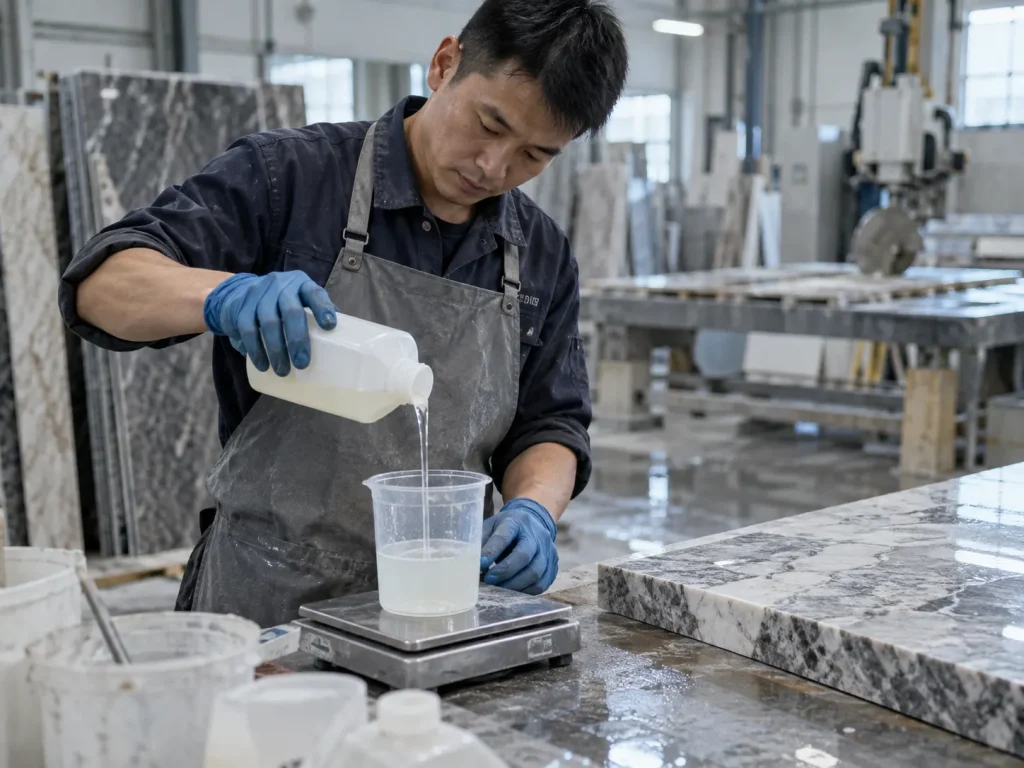
This is one of the easiest mistakes to make.
A ratio written by weight cannot automatically be measured with a graduated cup as if it were the same ratio by volume.
Why weight and volume can produce different quantities
Resin and hardener often have different densities.
One liter of resin may not weigh the same as one liter of hardener.
Because of that density difference, a formulation specified as 100:30 by weight may require a different numerical ratio if it is converted to volume.
The conversion should come from the manufacturer—not from operator estimation.
Use a scale when the TDS specifies a weight ratio
For industrial stone production, digital weighing is generally straightforward and repeatable for products specified by weight.
The operator can:
- place the clean mixing container on the scale;
- tare the scale to zero;
- add the required resin weight;
- calculate the matching hardener weight;
- add hardener until the correct total is reached; and
- record the batch if production traceability is required.
Do not assume a 100:25 weight ratio means four cups to one cup
Mathematically, 100:25 simplifies to 4:1.
But if the specified ratio is by weight, using four volumes of resin to one volume of hardener is only correct if the supplier explicitly confirms the corresponding volume ratio.
This distinction matters because densities differ.
How to Calculate the Correct Epoxy Mixing Ratio
For a 100:25 system
| Resin Weight | Hardener Weight | Total Mixed Epoxy |
|---|---|---|
| 100 g | 25 g | 125 g |
| 500 g | 125 g | 625 g |
| 1,000 g | 250 g | 1,250 g |
| 5,000 g | 1,250 g | 6,250 g |
| 10,000 g | 2,500 g | 12,500 g |
The formula is:
Hardener = Resin Weight × 0.25
For a 100:30 system
| Resin Weight | Hardener Weight | Total Mixed Epoxy |
|---|---|---|
| 100 g | 30 g | 130 g |
| 500 g | 150 g | 650 g |
| 1,000 g | 300 g | 1,300 g |
| 5,000 g | 1,500 g | 6,500 g |
| 10,000 g | 3,000 g | 13,000 g |
The formula is:
Hardener = Resin Weight × 0.30
When the target is total mixed weight
Sometimes the operator knows the total quantity needed rather than the resin quantity.
For a 100:25 system, the total ratio parts equal 125.
If 1,000 g total mixed epoxy is required:
Resin = 1,000 × 100 / 125 = 800 g
Hardener = 1,000 × 25 / 125 = 200 g
For a 100:30 system, total parts equal 130.
If 1,000 g total mixed epoxy is required:
Resin = 1,000 × 100 / 130 ≈ 769.2 g
Hardener = 1,000 × 30 / 130 ≈ 230.8 g
Factories using automatic dosing equipment can build these formulas into their metering system, but regular calibration is still necessary.
What Happens If You Add Too Much Hardener?
A common workshop belief is:
“It is cold today, so add more hardener and the epoxy will cure faster.”
For conventional two-component epoxy systems, this is generally the wrong approach.
Extra hardener does not act like extra catalyst
Epoxy resin and hardener react with each other according to the chemistry of the formulation.
Once available reactive sites have been consumed, excessive curing-agent components may remain outside the intended network structure.
That can reduce the properties the manufacturer designed into the cured system.
The cured epoxy may remain softer
Depending on the formulation and degree of error, excess hardener can contribute to a softer or less predictable cured material.
In stone processing, that may appear as:
- repair zones that smear during polishing;
- reduced hardness at crack lines;
- soft mesh-backing adhesive;
- lower resistance to handling stress;
- surface tack or unusual feel; and
- inconsistent performance between batches.
Visual performance may also change
For white marble or light granite, off-ratio mixing can be especially undesirable because hardener chemistry may affect color, clarity, surface appearance, and aging behavior.
If a formulation was designed around 100:30, intentionally changing it to 100:35 is not a controlled method for speeding production.
What Happens If You Add Too Little Hardener?
Too little hardener creates the opposite imbalance.
The resin may not develop the intended crosslinked structure.
The system may remain under-cured
Symptoms can include:
- soft resin after the expected curing time;
- sticky or tacky repair areas;
- low surface hardness;
- poor polishing behavior;
- weak reinforcement;
- poor resistance to handling;
- slow or incomplete strength development; and
- variation across the slab.
Waiting longer may not solve a severe ratio error
This is another important point.
If an epoxy is simply cold, additional curing time or correct temperature control may allow the reaction to continue.
If the mixture is substantially off-ratio, however, time alone cannot magically replace the missing quantity of reactive component.
The factory needs to distinguish a temperature-related slow cure from a true proportioning error.
Incorrect Ratio vs Poor Mixing: They Can Look Similar
Not every sticky epoxy is caused by the wrong ratio.
A correctly measured batch can still fail locally if it is not thoroughly mixed.
Incorrect ratio often affects the whole batch
If the resin and hardener quantities are wrong from the beginning, the entire mixed batch may show abnormal curing behavior.
Multiple slabs processed from the same batch may show similar symptoms.
Poor mixing often creates localized defects
If unmixed material remains along the sides or bottom of the container, some portions applied to the stone may contain the correct combination while others do not.
The slab can then show:
- one sticky patch surrounded by hard material;
- soft streaks;
- local discoloration;
- small areas that smear during polishing; or
- inconsistent mesh adhesion.
This pattern often points toward incomplete mixing rather than a uniform measuring error.
How to Mix Two-Component Epoxy Correctly
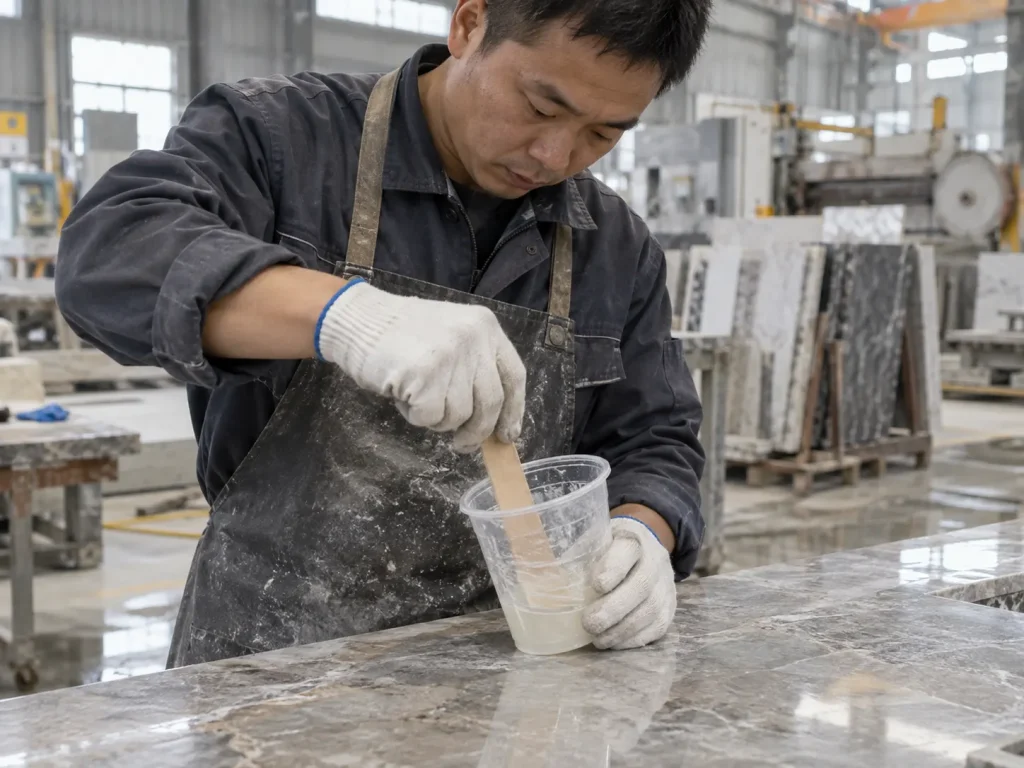
Step 1: Confirm the exact product code
Do not begin with the assumption that yesterday’s ratio applies today.
Verify the resin and hardener combination on the container, TDS, work order, or production instruction.
For example, 5099 / B25Q-KG and 5090 / D30M-BS use different ratios even though both are intended for marble-related processing.
Step 2: Confirm whether the ratio is by weight or volume
This should be written clearly on the operator instruction.
If Veropoxy specifies 100:25 or 100:30 by weight, use weighing equipment unless an approved alternative metering method has been established.
Step 3: Use a clean container
Residual cured or uncured material from a previous formulation can introduce contamination.
This is especially important when switching between different hardeners or color-sensitive white-marble products.
Step 4: Tare the scale
Place the empty container on the scale and return the display to zero before adding components.
Step 5: Measure carefully
Do not rely on visual estimation.
A difference that looks small in a bucket can become significant when repeated across dozens of batches per shift.
Step 6: Mix the sides and bottom
Stirring only the center creates a risk of unmixed material remaining at the container wall or base.
The operator should repeatedly scrape the sides and bottom while mixing.
Step 7: Mix until uniform
The mixture should show a consistent appearance without obvious streaks or unmixed regions.
Exact mixing time depends on batch size, viscosity, temperature, equipment, and supplier instructions.
Step 8: Consider a two-container method for critical work
For highly sensitive applications, one useful process-control method is to mix thoroughly in the first container, transfer the mixture into a second clean container, and mix again.
This reduces the chance of accidentally applying unmixed material scraped from the walls of the original container.
It can be especially useful when processing high-value white marble or other stone where a localized soft spot could create an expensive rejection.
Why Small Batches Can Be Harder to Measure Than They Look
A small batch uses less material, but that does not automatically make ratio control easier.
Scale resolution becomes important
Imagine a 100:25 system where only 20 g of resin is needed.
The required hardener amount is just 5 g.
A scale that reads only in 1 g increments gives relatively poor precision for such a small quantity.
If the hardener measurement is off by 1 g, the error represents 20% of the intended hardener quantity.
For a larger batch using 1,000 g resin and 250 g hardener, the same 1 g scale error is proportionally insignificant.
Choose the measuring method for the batch size
Small repair batches may require a higher-resolution scale or a manufacturer-approved metering pump.
Large production batches may need calibrated industrial dosing equipment.
The objective is not simply “use a scale.” It is to use measuring equipment accurate enough for the amount being dispensed.
Why Very Large Batches Create a Different Risk
Large batches make ratio measurement easier in percentage terms, but they introduce another issue: exothermic heat.
Epoxy curing releases heat.
A large mass left in a deep bucket retains more of that heat than a thin layer spread over stone.
Do not confuse faster heat build-up with a better ratio
An accurately mixed large batch may appear to cure faster in the container simply because more heat is being retained.
The solution is not to change the ratio.
The factory should instead adjust batch size, container geometry, workflow, or temperature conditions according to supplier recommendations.
How Mixing Ratio Errors Affect Different Stone Applications
Marble crack repair
Marble repair often requires the resin to penetrate fine cracks and then become hard enough for polishing.
An off-ratio mix can produce soft resin that pulls from cracks or smears under abrasives.
Veropoxy’s 5099 / B25Q-KG marble repair system specifies 100:25 by weight. That ratio should remain fixed even if workshop temperature changes.
White marble
White marble adds visual sensitivity.
Incorrect ratio or incomplete mixing can create differences in curing, clarity, yellowing behavior, or surface appearance.
The 5090 / D30M-BS hard white marble system specifies 100:30 by weight.
If production speed is unsatisfactory, change to a formulation designed for the required temperature rather than changing the ratio.
Stone mesh backing
Mesh backing requires even fiber wetting and consistent cured adhesion across a large slab.
If the batch contains regions with insufficient hardener or poor mixing, adhesion can vary across the mesh.
Both Veropoxy’s low-temperature and high-temperature stone mesh-backing systems specify 100:25 by weight even though their curing environments differ.
That is a useful example: temperature control is achieved through formulation—not by randomly changing the A:B ratio.
Vacuum infusion
Vacuum infusion can make mixing consistency even more important because the resin is pulled deep into internal stone defects.
If an off-ratio mixture is infused into the slab, removal or rework can become extremely difficult.
Veropoxy’s Low-Viscosity Epoxy for Stone Vacuum Infusion – 5080 / B25Q-KG uses a 100:25 ratio by weight and is designed around long penetration and controlled curing.
Accurate metering should therefore happen before the resin enters the vacuum system.
How to Diagnose Common Epoxy Mixing Problems
| Observed Problem | Possible Cause | What to Check |
|---|---|---|
| Whole batch remains soft | Incorrect ratio, low temperature or wrong product combination | Batch records, weighing data, resin/hardener codes and curing temperature |
| Only isolated spots remain sticky | Incomplete mixing or material scraped from container walls | Mixing method, container sides and bottom |
| Epoxy cures but feels unusually soft | Off-ratio mixture or unsuitable curing conditions | Hardener quantity, temperature and product specification |
| Cure is much slower than expected | Low temperature, too little hardener, wrong hardener or poor mixing | Temperature, ratio and component identification |
| Operator added extra hardener but cure is still poor | Stoichiometric imbalance | Return to specified ratio; do not use hardener quantity as a speed control |
| Mesh backing has weak areas | Incomplete mixing, surface contamination or poor wetting | Ratio, mixing uniformity, substrate preparation and application |
| White marble repair shows irregular appearance | Mix variation, excess penetration or contamination | Ratio, hardener distribution, viscosity, stone porosity and cleanliness |
| Different shifts get different results | Manual measurement inconsistency | Scale calibration, SOP, operator training and batch records |
How to Match the Correct Action to the Mixing Problem
If the whole batch remains unusually soft, check the resin-to-hardener quantities, product codes, and curing temperature before assuming the epoxy is defective.
If only small areas remain sticky, inspect the mixing method and whether unmixed material was scraped from the sides or bottom of the container.
If winter curing is too slow, choose a low-temperature epoxy rather than increasing the hardener quantity.
If summer curing becomes too fast, use a high-temperature formulation with controlled reactivity rather than reducing the amount of hardener.
If operators repeatedly make small-batch errors, use a higher-resolution scale or an approved metering system.
If an automated dosing line produces inconsistent results, verify pump calibration and actual output instead of relying only on machine settings.
If a ratio error is confirmed after application, isolate the affected material and follow the resin supplier’s approved rework procedure rather than applying additional hardener over the top and hoping it will correct the original mixture.
Common Epoxy Mixing Mistakes in Stone Factories
Using yesterday’s ratio for today’s product
This happens easily when several similar A/B systems are stored in the same production area.
Clear labeling and product-specific work instructions reduce the risk.
Confusing 100:25 with 100:30
The numbers look similar, especially during a busy shift.
But they represent different formulations.
Measuring a weight ratio by volume
If the manufacturer specifies weight, weighing is the safe default unless an approved volume conversion is provided.
Adding extra hardener in winter
This does not convert a standard formulation into a winter-grade epoxy.
Reducing hardener in summer
This does not safely create a slow hardener.
If the product reacts too quickly, use the correct temperature-specific system.
Mixing by eye
Experienced workers may feel they can estimate proportions visually, but industrial consistency should not depend on memory or bucket appearance.
Ignoring material left on the container walls
The center of a batch can be well mixed while thin layers of unmixed resin or hardener remain around the perimeter.
Using an inaccurate scale
A scale suitable for 10 kg batches may not be precise enough for 20 g repair batches.
Failing to calibrate automatic metering equipment
Automation improves consistency only when the pumps actually dispense the programmed quantities.
How to Build a Mixing Ratio SOP for a Stone Factory
A simple production SOP can prevent many epoxy failures.
| Control Point | Recommended Factory Practice |
|---|---|
| Product identification | Record exact resin and hardener codes before dispensing |
| Ratio | Display the approved weight or volume ratio at the mixing station |
| Scale | Select appropriate capacity and resolution for the batch size |
| Calibration | Verify weighing or metering equipment on a scheduled basis |
| Container | Use clean, compatible containers free from previous material |
| Mixing | Scrape sides and bottom and mix until uniform |
| Temperature | Record relevant ambient and material temperatures for critical batches |
| Batch size | Keep within the supplier-approved processing range |
| Traceability | Record batch codes for high-value or continuous production |
| Acceptance | Confirm curing and final stone performance before full-scale use |
How to Test Mixing Accuracy Before Bulk Production
Run a controlled gel or cure comparison
Prepare a small accurately measured batch according to the technical data sheet.
Record the starting temperature and time.
Compare its curing behavior with normal production batches.
If the controlled sample cures correctly but factory batches repeatedly do not, investigate measuring, mixing, equipment, or application conditions.
Use real stone rather than cup tests alone
A cup test confirms basic cure behavior, but it does not show whether the epoxy performs correctly during crack penetration, mesh backing, polishing, or vacuum infusion.
Apply the correctly proportioned material to representative stone and run it through the real production cycle.
Compare multiple operators
If one operator consistently achieves good results and another does not, the issue may be process technique rather than formulation.
A standardized weighing and mixing procedure reduces operator-to-operator variation.
Verify automatic pumps by actual output
Collect resin and hardener separately for a controlled number of pump cycles and weigh the output.
Compare the measured result with the programmed ratio.
This is more reliable than assuming the dosing system remains accurate indefinitely.
Recommendation: Control the Ratio Instead of Trying to Adjust the Chemistry
Epoxy ratio should be treated as a fixed formulation requirement, not as an operator adjustment knob.
If curing is too slow because the workshop is cold, select a low-temperature hardener system.
If working time is too short in summer, use a high-temperature formulation.
If viscosity is unsuitable, choose an epoxy designed for the required penetration or filling behavior.
If color stability is critical on white marble, choose the appropriate low-yellowing or non-staining system.
Do not try to create these performance changes by adding more or less hardener than specified.
For stone factories operating several epoxy systems, the safest method is to tie each ratio to the exact resin/hardener product code, measure by the specified method, and maintain basic batch traceability.
A few extra seconds at the weighing station can prevent hours of polishing rework, rejected slabs, weak reinforcement, or disputes over whether the epoxy itself was defective.
Frequently Asked Questions About Epoxy Resin Mixing Ratio
1. What is the correct epoxy resin mixing ratio?
There is no universal epoxy mixing ratio. The correct ratio depends on the specific resin and hardener formulation. Veropoxy stone systems, for example, include both 100:25 and 100:30 resin-to-hardener ratios by weight. Always follow the ratio stated for the exact product combination rather than applying one ratio to every epoxy.
2. What happens if I put too much hardener in epoxy?
Adding excess hardener does not reliably make conventional epoxy cure faster. It can create an off-ratio system with unreacted or improperly incorporated components, potentially producing softer cure, reduced physical performance, surface problems, or inconsistent results. Use the specified ratio and select a different hardener formulation if faster curing is required.
3. What happens if there is not enough hardener in epoxy?
Too little hardener can prevent the resin system from developing the intended crosslinked structure. Depending on the degree of error and formulation, the epoxy may remain soft, tacky, under-cured, weak, or unsuitable for polishing and handling. Severe proportioning errors may not be solved simply by waiting longer.
4. Is epoxy mixing ratio measured by weight or volume?
It can be specified either way, depending on the product. Weight and volume ratios are not automatically interchangeable because resin and hardener can have different densities. If the technical data sheet specifies a ratio by weight, use that weight ratio unless the manufacturer provides an approved volume conversion.
5. Can I add extra hardener to make epoxy cure faster in winter?
No. Do not change the specified A:B ratio to control curing speed. If winter temperatures make curing too slow, use a low-temperature formulation designed for those conditions. For example, Veropoxy’s 4090 / WBA25Q mesh-backing system is formulated for approximately 10°C production while maintaining its specified 100:25 weight ratio.
How to Keep Epoxy Mixing Consistent in Real Stone Production
Reliable epoxy curing starts before the resin reaches the stone. The mixing ratio, measurement method, component identification, weighing accuracy, mixing uniformity, batch size, and production temperature all influence whether the system performs as designed. For a stone factory, ratio control should therefore be treated as a quality-control step rather than a simple operator habit.
Follow the product-specific ratio
A 100:25 system and a 100:30 system are different formulations. Similar viscosity, appearance, packaging, or curing time does not make their hardener quantities interchangeable. Tie every factory instruction to the exact resin and hardener code.
Diagnose the problem before changing the process
Whole batch is soft:
verify ratio, component identity and curing temperature.
Only isolated areas are sticky:
investigate incomplete mixing or unmixed material from the container walls.
Winter cure is too slow:
switch to low-temperature chemistry rather than adding extra hardener.
Summer working time is too short:
use a temperature-appropriate formulation rather than reducing the specified hardener quantity.
Results vary between shifts:
check scale accuracy, metering calibration, operator technique and batch records.
Measure using the specified basis
Weight ratios and volume ratios should not be mixed casually. When a product is specified as 100:25 or 100:30 by weight, use suitable weighing equipment or a validated dosing system. For very small batches, scale resolution becomes especially important because a small absolute error can represent a large percentage of the hardener quantity.
What should professional buyers evaluate?
Supplier evaluation should include the recommended A:B ratio, whether the ratio is specified by weight or volume, allowable processing temperature, working time, mixing instructions, batch-size limitations, metering requirements, and the supplier’s ability to troubleshoot off-ratio or incomplete-cure problems. A reliable industrial epoxy supplier should make these parameters clear enough for production teams to reproduce the same result shift after shift.
Practical Recommendation
If cure speed is wrong, change the curing system—not the specified mixing ratio. If viscosity is wrong, choose a different formulation—not a different hardener quantity. If only part of the slab stays soft, investigate mixing uniformity before blaming the product. And if several epoxy products are used in the same factory, display the exact product code, ratio, measurement basis, and working temperature at every mixing station. Correct proportioning is inexpensive; reworking an under-cured stone slab is not.
Need to Confirm the Right Epoxy Ratio for Your Stone Process?
Before bulk production, confirm the exact resin and hardener combination, mixing ratio, measurement method, workshop temperature, batch size, and curing requirements. Veropoxy offers different epoxy systems for marble, granite, mesh backing, vacuum infusion, and color-sensitive stone applications, so the correct ratio should always follow the specific formulation.
References
- System Three Resins Technical Staff.
Section IV – Measuring and Mixing.
System Three Resins, Inc.
The Epoxy Book / Epoxy Technical Resources. - System Three Resins Technical Support.
Why Didn’t the Epoxy Cure?
System Three Resins, Inc.
Technical Support Knowledge Base. - WEST SYSTEM Technical Staff.
The Basics of WEST SYSTEM Epoxy Resin and Hardener.
Gougeon Brothers, Inc.
Epoxyworks Technical Publications. - WEST SYSTEM Technical Staff.
Testing Epoxy to Determine Physical Properties.
Gougeon Brothers, Inc.
Epoxyworks Technical Publications. - WEST SYSTEM Technical Staff.
Getting the Most out of Mini Pumps.
Gougeon Brothers, Inc.
Epoxyworks Technical Publications. - Fred Meyer, Genoveva Sanz, Arantxa Eceiza, Iñaki Mondragon and Jovan Mijović.
The Effect of Stoichiometry and Thermal History During Cure on Structure and Properties of Epoxy Networks.
University and Polymer Research Institutions.
Polymer, Vol. 36, No. 7, 1995, pp. 1407–1414. - M. R. VanLandingham, R. F. Eduljee and J. W. Gillespie Jr.
Relationships Between Stoichiometry, Microstructure, and Properties for Amine-Cured Epoxies.
Center for Composite Materials, University of Delaware.
Journal of Applied Polymer Science, Vol. 71, 1999, pp. 699–712. - Satoru Yamamoto, Nguyen Thao Phan, Kouki Kihara, Atsuomi Shundo and Keiji Tanaka.
Off-Stoichiometry Effect on the Physical Properties of Epoxy Resins.
Kyushu University and Collaborating Research Institutions.
Polymer Journal, Vol. 57, 2025, pp. 357–366.