

Quick Summary:
Vacuum infusion uses a pressure difference to help low-viscosity epoxy move into stone pores, micro-cracks, and internal defects before curing. A successful process needs more than strong vacuum: resin viscosity, working time, stone temperature, leak control, air removal, flow uniformity, and cure stability must work together. If resin flows too slowly, penetration can remain incomplete; if it reacts too quickly, distant areas may stay untreated. Always validate the complete process on the actual stone before bulk production.
Vacuum infusion can solve a problem that ordinary surface coating often cannot.
A slab may look sound from the outside but still contain fine fissures, interconnected pores, weak mineral boundaries, or internal defects that are difficult to reach with a roller or scraper.
Pouring more epoxy onto the surface does not automatically solve that problem. If the resin cannot move into the stone before curing, most of the material remains near the face while the deeper weakness stays largely untreated.
Vacuum-assisted impregnation changes the driving force.
Instead of relying only on gravity and capillary action, the process creates a pressure difference that helps move resin into accessible voids and pathways inside the material.
That sounds simple. In production, it is not.
A strong vacuum cannot compensate for epoxy that is too viscous. Low viscosity cannot compensate for a major leak. Long pot life does not help if the stone is wet or contaminated. And a perfectly sealed system can still produce inconsistent reinforcement if resin reaches one region much faster than another.
That is why stone factories should treat vacuum infusion as a controlled process rather than as “put the slab under vacuum and add resin.”
Veropoxy’s existing Vacuum Infusion Solutions position epoxy impregnation as a method for filling micro-pores and structural imperfections, while the dedicated 5080 / B25Q-KG Low-Viscosity Epoxy for Stone Vacuum Infusion is formulated specifically around flow, penetration, stable cure, and long-term stone reinforcement.
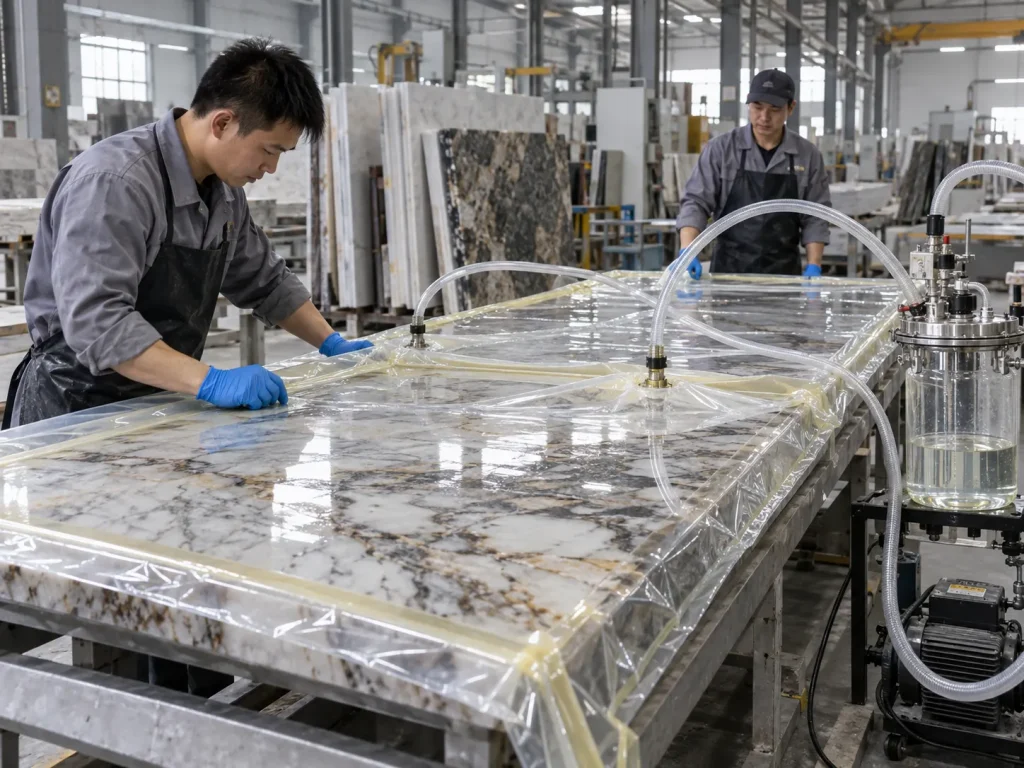
What Is Vacuum Infusion for Stone Slabs?
In stone processing, vacuum infusion or vacuum impregnation generally refers to using reduced pressure to assist liquid resin in entering accessible pores, cracks, fissures, and weak internal zones of a slab.
The exact equipment differs between factories.
Some production systems use vacuum chambers. Others use sealed treatment zones or specialized industrial equipment designed around the slab dimensions and production line.
The common principle is pressure difference.
Why pressure difference helps
Air naturally occupies pores and cracks inside stone.
Reducing pressure can help remove part of that air from accessible pathways. When resin is introduced and the pressure condition is controlled, liquid epoxy can move into spaces that would be difficult to fill through ordinary surface application alone.
The objective is not to make the entire slab “full of resin.”
The practical goal is to reinforce vulnerable pathways that are connected strongly enough to the surface or treatment network for resin to reach them.
Vacuum infusion is not the same as a surface coating
A surface coating mainly remains on or near the stone face.
Vacuum impregnation is intended to move resin deeper into the accessible internal structure.
This distinction matters because the acceptance criteria are different.
A coating is often judged by coverage, gloss, thickness, or appearance.
Vacuum impregnation should be judged by:
- penetration consistency;
- internal defect filling;
- reduced crack reopening;
- handling performance;
- polishing result;
- visual stability; and
- repeatability across slabs.
Why Stone Factories Use Vacuum Infusion
To reinforce micro-cracked slabs
Hairline cracks can extend below the visible surface.
A low-viscosity surface treatment may penetrate partway, but vacuum assistance can improve the driving force available for deeper impregnation.
To stabilize porous or structurally inconsistent stone
Some natural stones contain interconnected pores, mineral boundaries, voids, or fragile zones.
Epoxy entering those accessible pathways can create additional internal bonding after cure.
To reduce breakage during downstream processing
Weak slabs may fail during:
- calibration;
- grinding;
- polishing;
- cutting;
- lifting;
- transport; or
- installation.
Effective impregnation can improve the slab’s ability to survive those operations when internal defects are suitable for resin reinforcement.
To improve repair continuity
When epoxy reaches the full connected crack network rather than only the surface opening, the repaired zone can behave more consistently during later finishing.
How Vacuum Infusion Works Step by Step
Equipment and SOPs vary between factories, but the process logic can be described in a practical sequence.
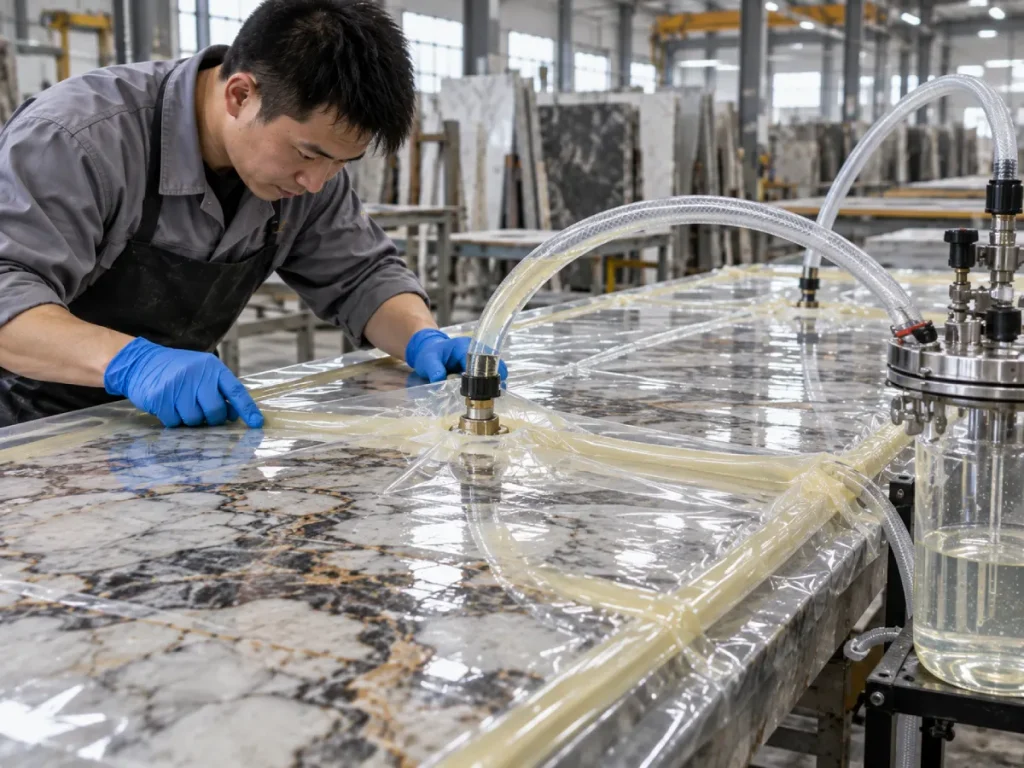
Step 1: Inspect and classify the stone
Before vacuum treatment, determine what problem you are trying to solve.
Is the slab:
- dense but micro-cracked;
- highly porous;
- structurally fragile;
- translucent and visually sensitive;
- already reinforced with mesh; or
- showing isolated large cavities rather than a fine defect network?
Vacuum infusion is not equally useful for every defect.
A large open cavity may need direct filling rather than a process optimized for micro-scale penetration.
Step 2: Clean and dry the slab
Dust, slurry, water, oil, polishing residue, and loose mineral particles can interfere with resin movement and adhesion.
Moisture is especially important.
Water inside pores can occupy the same pathways the epoxy needs to enter.
Factories should therefore establish a suitable drying condition before infusion rather than relying on visual surface dryness alone.
Step 3: Stabilize stone and resin temperature
Temperature changes epoxy viscosity and cure rate.
A resin qualified at 24°C can behave differently if the drum is at 15°C and the slab is at 10°C.
Conversely, very warm material may flow easily but lose usable working time more quickly.
Step 4: Prepare the vacuum system
Check seals, hoses, valves, chamber condition, ports, and vacuum equipment before resin is mixed.
Finding a leak after the working-time clock has started is an expensive way to troubleshoot.
Step 5: Mix the epoxy accurately
Use the product-specific A:B ratio.
Veropoxy’s current 5080 / B25Q-KG system specifies a resin-to-hardener ratio of 100:25.
Do not change that ratio to make the material thinner, slower, or faster.
Step 6: Minimize unnecessary air introduction
Aggressive mixing can entrain air into the resin.
Vacuum infusion research in composite processing has shown that dissolved gas, micro-bubbles, leaks, and flow conditions can all contribute to void formation.
Stone is a different porous medium from a fiber laminate, but the lesson remains useful: do not introduce avoidable air before asking the vacuum system to remove it.
Step 7: Establish controlled vacuum
Apply the process according to the equipment supplier’s validated procedure.
More vacuum is not automatically better in every stage.
The useful goal is stable pressure control and repeatable resin movement—not simply achieving the largest possible number on a gauge.
Step 8: Introduce the resin
Observe how the epoxy enters the treatment zone and how quickly it moves.
Do not rely on elapsed time alone.
The flow behavior itself provides useful diagnostic information.
Step 9: Maintain the required process window
The resin needs enough time to reach the target areas before viscosity rises significantly.
If the product begins gelling while important parts of the slab are still being impregnated, the process is no longer uniform.
Step 10: Cure before downstream processing
Allow the resin to reach the required cure milestone before moving, polishing, or machining the slab.
Surface dryness alone is not a reliable indication that deep resin has developed sufficient properties.
Why Low Viscosity Is So Important for Vacuum Infusion
Resin moving through small internal pathways experiences flow resistance.
As viscosity increases, movement generally becomes more difficult.
That is why vacuum-infusion systems normally emphasize relatively low mixed viscosity.
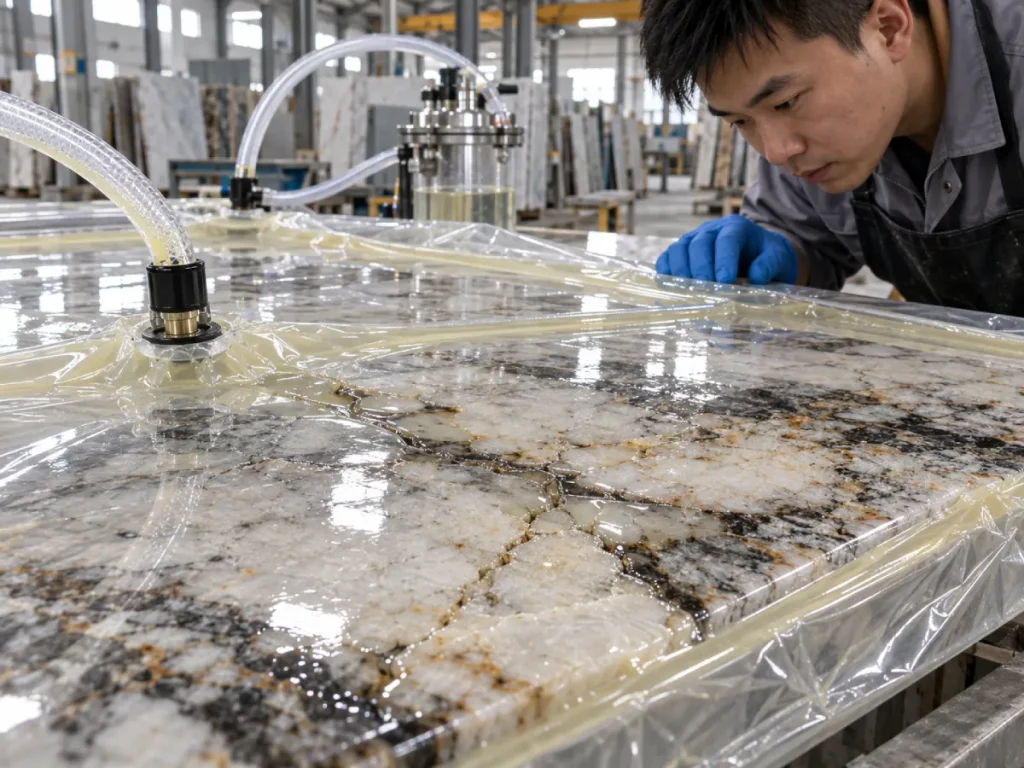
Low viscosity reduces resistance to flow
A lower-viscosity liquid can move more readily through fine connected pathways under the same driving pressure.
This can help the epoxy reach micro-cracks and small pores before cure advances too far.
But the lowest viscosity is not automatically the best resin
A useful infusion system still needs:
- adequate mechanical properties after cure;
- appropriate adhesion;
- suitable yellowing resistance;
- predictable cure;
- reasonable pot life;
- controlled shrinkage or dimensional behavior;
- compatibility with the stone; and
- batch consistency.
For a broader comparison, Veropoxy’s stone epoxy product portfolio separates vacuum-infusion resin from products intended for seam filling, white marble, mesh backing, and other applications.
Veropoxy 5080 / B25Q-KG: What the Published Numbers Mean
The current Veropoxy vacuum-infusion product page publishes the following specifications for the 5080 / B25Q-KG system:
| Specification | Published Value | Why It Matters |
|---|---|---|
| Application | Natural and engineered stone vacuum infusion | Defines the intended process rather than treating it as a general-purpose adhesive |
| Epoxy System | 5080 / B25Q-KG | Identifies the specific resin-hardener combination |
| Mixing Ratio | 100:25 | Must be followed for repeatable cure |
| Viscosity | 400–600 CPS | Supports controlled flow and penetration |
| Recommended Temperature | Approximately 24°C | Provides context for viscosity and cure performance |
| Curing Time | Approximately 3–5 hours | Allows time for impregnation before final cure develops |
| Yellowing Resistance | High | Important for visible or light-colored stone |
The useful way to read this table is as a system.
Do not isolate 400–600 CPS and assume any epoxy with the same number will work equally well.
The resin also needs enough useful flow time, stable curing, stone compatibility, and appropriate appearance after treatment.
Buyer takeaway: A vacuum-infusion epoxy should be evaluated as a time-dependent flow system. Initial CPS matters, but so does how quickly viscosity rises during the actual infusion cycle.
Working Time Can Matter More Than the Starting CPS
A resin can begin at a very attractive viscosity and still perform poorly if it thickens too soon.
The process takes time
Between mixing and final impregnation, workers may need time to:
- transfer resin;
- connect lines;
- stabilize vacuum;
- start the flow;
- allow resin to migrate through the slab;
- correct local process issues; and
- complete the treatment before gelation.
During every minute of that sequence, epoxy chemistry continues reacting.
Viscosity rise can create an uneven slab
If resin reaches the inlet-side region while still thin but arrives at a distant zone after significant viscosity growth, penetration can become uneven.
This is one reason a longer, stable processing window can be more valuable than an extremely fast cure.
How Temperature Changes Vacuum Infusion Performance
Cold resin flows more slowly
Lower temperature generally raises uncured epoxy viscosity.
In vacuum infusion, that means:
- slower resin movement;
- longer fill time;
- reduced access to very fine cracks;
- more pressure drop through narrow pathways; and
- greater risk that cure progresses before full impregnation.
Warm resin flows more easily—but reacts faster
Increasing temperature generally reduces initial viscosity.
That sounds helpful until curing accelerates.
If the system loses working time faster than infusion speed improves, the factory gains nothing.
The slab temperature matters too
A resin drum at 24°C does not guarantee that resin remains at the same temperature once it contacts a slab stored overnight in a cold warehouse.
Likewise, stone leaving a heated drying process can locally accelerate cure.
Record both resin temperature and slab temperature during qualification.
Vacuum Level: More Is Not Always the Entire Answer
A common production instinct is to treat stronger vacuum as the solution to poor penetration.
That approach is incomplete.
Flow depends on the combination of:
- pressure difference;
- resin viscosity;
- path geometry;
- stone permeability;
- temperature;
- air leakage;
- resin working time; and
- the connectivity of internal defects.
A strong vacuum cannot open a closed crack network
If internal pores or fissures are not connected to the treatment pathway, resin may not reach them regardless of vacuum level.
This is a limitation of the material structure, not necessarily an epoxy failure.
Excessively aggressive pressure reduction can create other problems
Vacuum-processing literature has documented void formation associated with dissolved gases, volatile components, leaks, and pressure conditions.
That does not mean a single vacuum setting from composite manufacturing should be copied into stone processing.
It means the pressure profile should be validated as part of the complete stone process.
Why Vacuum Leaks Cause So Many Problems
A leak changes the process from controlled evacuation to continuous air entry.
Air can compete with resin movement
If outside air is entering the system while resin is trying to move into internal pathways, bubbles and poorly impregnated regions become more likely.
Vacuum readings can be misleading
A pump can run continuously and still fail to produce a stable sealed condition.
Factories should distinguish:
- pump capability;
- initial vacuum level;
- vacuum hold performance; and
- leak rate.
Leak checking should happen before epoxy is mixed
This sounds obvious, but it is one of the cheapest ways to protect working time.
Once Part A and Part B are combined, the chemical clock has started.
Air Bubbles and Voids: Where Do They Come From?
Air introduced during mixing
Fast or careless mixing can fold air into the epoxy.
Air remaining inside stone pores
Incomplete evacuation can leave trapped air in accessible cavities.
Vacuum system leaks
External air can enter during treatment.
Uneven resin flow
Fast-moving resin can bypass slower regions, potentially trapping air in poorly connected zones.
Dissolved gases
Research on composite vacuum infusion has shown that gases dissolved in resin can nucleate under reduced pressure and contribute to micro-bubbles.
Factories seeing persistent bubble problems should therefore investigate the entire process rather than assuming every void originates from poor mixing.
Should Vacuum Infusion Epoxy Be Degassed First?
There is no universal answer for every stone process or epoxy formulation.
Pre-degassing can be useful when entrained or dissolved air is causing visible voids, but it adds equipment, time, and process complexity.
Before adding a degassing stage, verify:
- mixing technique;
- vacuum leak rate;
- resin temperature;
- container depth;
- stone moisture;
- resin foaming behavior; and
- whether bubbles are actually reducing finished quality.
If the product supplier recommends a specific degassing method, follow that system-specific guidance rather than copying a generic composite-production procedure.
How Stone Porosity Changes the Infusion Process
Dense stone
Dense granite may have low overall porosity but still contain fine fissures.
Successful impregnation depends on whether those cracks form connected pathways accessible to the resin.
Veropoxy’s Black Granite Solutions similarly emphasize deep penetration for fine pores and micro-cracks where ordinary surface treatments may not reach sufficiently far.
Porous marble or limestone-like structures
More porous materials can absorb resin rapidly.
That may improve reinforcement, but uncontrolled absorption can also increase consumption and create visible darkening or color variation.
Engineered stone
Engineered or composite stone presents different pore structures and resin compatibility considerations.
Do not assume a process qualified on natural granite automatically transfers to engineered material without testing.
Common Vacuum Infusion Problems and What They Usually Mean
| Observed Problem | Possible Cause | What to Check First |
|---|---|---|
| Resin barely moves | High viscosity, cold material, restricted flow path | Resin temperature, mixed viscosity, stone structure |
| One area fills while another remains dry | Uneven flow paths or disconnected porosity | Stone structure, resin entry path, pressure distribution |
| Infusion stops before completion | Viscosity rise or early gelation | Working time, temperature, mixing-to-infusion delay |
| Many bubbles remain | Leakage, mixing air, dissolved gas, moisture | Vacuum hold, mixing method, resin and slab condition |
| Vacuum cannot stabilize | System leak | Seals, valves, hoses, chamber and connections |
| Resin consumption is unexpectedly high | Highly porous stone or uncontrolled flow | Stone absorption, defect network and application quantity |
| Slab still cracks after treatment | Defects not connected to infusion pathways or reinforcement insufficient | Stone structure, penetration depth and treatment suitability |
| Light stone develops dark areas | Excessive penetration or optical change | Stone absorbency, resin chemistry and visual compatibility |
| Cured resin remains soft | Ratio error, low temperature, poor mixing | A:B ratio, cure temperature and mixing quality |
| Finished surface shows pinholes | Residual air, incomplete filling or polishing exposure | Infusion quality, degassing, cure and finishing sequence |
How to Troubleshoot Slow Resin Flow
Check resin and stone temperature
This should be one of the first steps.
A resin expected to run at 400–600 CPS under its stated test condition may become substantially more viscous when cold.
Check elapsed time after mixing
If the first slab of a batch infuses correctly and the next one does not, the resin may simply have advanced too far in its cure cycle.
Check the flow pathway
Poor movement is not always a resin problem.
The stone may contain fewer connected pores than expected, or equipment geometry may restrict distribution.
Do not change the mixing ratio
Adding extra hardener or reducing hardener to manipulate flow is not a valid viscosity-control method.
Use the specified 100:25 ratio for the 5080 / B25Q-KG system.
How to Troubleshoot Incomplete Penetration
If resin appears on the surface but reinforcement remains shallow, consider four major causes.
The resin is too viscous
Check temperature and formulation suitability.
The working window is too short
The material may be thickening before it reaches deeper defects.
The vacuum system leaks
Pressure difference may be insufficient or unstable.
The defect network is not connected
Some cracks are isolated.
Vacuum cannot transport resin through solid stone into a closed cavity with no accessible pathway.
How to Troubleshoot Excessive Resin Consumption
Measure consumption instead of guessing
Record grams or kilograms used per slab or per square meter.
Without that number, it is difficult to compare resin systems objectively.
Separate useful penetration from wasted migration
Deep resin movement can be desirable.
But if the finished mechanical result does not improve while consumption rises sharply, the factory needs to reconsider the process window.
Check stone classification
Highly porous material may need a different treatment strategy from dense granite.
How to Match Vacuum Infusion Settings to the Production Problem
| If Your Production Problem Is… | Prioritize… | Why |
|---|---|---|
| Fine internal micro-cracks | Low viscosity + adequate working time | Resin must remain mobile long enough to penetrate |
| Cold factory | Temperature control before infusion | Cold epoxy can become too viscous |
| Infusion stops halfway | Longer useful flow window | Gelation may be occurring before completion |
| Persistent bubbles | Leak testing + mixing review + possible degassing | Air can enter from several sources |
| Uneven slab treatment | Flow-path and pressure distribution review | Resin may be bypassing low-permeability areas |
| Very porous stone | Controlled resin consumption | Deep absorption can become excessive |
| Light or translucent stone | Color stability and penetration control | Deep impregnation can alter appearance |
| Continuous industrial line | Batch consistency and repeatable cycle time | Stable production matters more than one successful slab |
Why Cure Time Must Match the Infusion Cycle
Fast cure is not automatically an advantage.
Vacuum infusion needs time.
The resin must stay fluid while it moves through the targeted defect network.
Only after adequate impregnation has occurred does faster strength development become useful.
If cure is too fast
You may see:
- short penetration depth;
- uneven impregnation;
- resin thickening in lines or containers;
- higher waste; and
- poor repeatability across large slabs.
If cure is too slow
The slab may occupy equipment too long and create a production bottleneck.
The right target is not maximum cure speed.
It is enough infusion time followed by predictable handling strength.
Why Mixing Accuracy Is Critical Before Vacuum Infusion
Once off-ratio epoxy enters internal stone pores, rework becomes difficult.
That makes upstream QC especially important.
Verify:
- correct resin and hardener codes;
- 100:25 ratio where specified;
- accurate weighing;
- complete mixing;
- clean container;
- recorded temperature; and
- batch identification.
If you need a deeper explanation of proportioning errors, use Veropoxy’s Knowledge Center alongside the product-specific technical data.
How to Test Vacuum Infusion Epoxy Before Bulk Ordering
Step 1: Select representative slabs
Include different defect levels, porosity, and stone types found in normal production.
Step 2: Record baseline condition
Document cracks, visible pores, slab strength problems, and initial appearance.
Step 3: Condition resin and stone
Test under the temperature the factory actually expects to use.
Step 4: Verify equipment integrity
Run a leak test before mixing the resin.
Step 5: Measure accurately
Follow the specified A:B ratio.
Step 6: Record the full timeline
Track:
- mixing start;
- vacuum start;
- resin introduction;
- visible flow progression;
- completion time;
- viscosity change; and
- handling cure.
Step 7: Measure resin consumption
Record the actual quantity used for every slab.
Step 8: Cure fully
Do not judge the treatment only while the resin is wet.
Step 9: Run normal downstream processing
Polish, cut, move, and handle the slab using the real factory sequence.
Step 10: Compare multiple slabs
A reliable system should produce repeatable results rather than one impressive test sample.
Vacuum Infusion Epoxy Buyer Checklist
| Question to Ask | Why It Matters |
|---|---|
| What is the mixed viscosity? | Determines initial flow resistance |
| At what temperature is viscosity specified? | Viscosity changes strongly with temperature |
| What is the A:B ratio? | Essential for proper cure |
| How long is the useful infusion window? | More valuable than headline cure time alone |
| What stone types have been tested? | Porosity and crack structure vary significantly |
| What is the recommended process temperature? | Controls both flow and reaction rate |
| How stable is viscosity after mixing? | Long processes require controlled viscosity rise |
| What is the yellowing resistance? | Important for light and visible stone |
| Can samples be tested on our slabs? | Real-stone qualification is essential |
| How consistent are production batches? | Industrial lines depend on repeatability |
Common Vacuum Infusion Mistakes to Avoid
Choosing epoxy only by the lowest CPS
Low viscosity is important, but the resin also needs sufficient working time, curing stability, and final performance.
Mixing epoxy before checking for leaks
This wastes valuable working time.
Using cold resin because the room feels warm enough
Drums and stone slabs can remain colder than the air.
Assuming maximum vacuum always gives maximum quality
Process stability matters more than chasing one pressure number.
Ignoring air introduced during mixing
Do not create bubbles unnecessarily and then expect vacuum to solve all of them.
Changing the hardener ratio to control flow
Use temperature and formulation selection to control process behavior—not off-ratio chemistry.
Judging success only from the surface
The purpose of infusion is internal reinforcement.
A glossy slab surface tells you very little about penetration depth.
Testing only one perfect slab
Real factories process stone with natural variability.
Qualification should reflect that reality.
Recommendation: Control the Whole Infusion Window, Not Just Vacuum Pressure
A reliable vacuum-infusion process is a balance between pressure, viscosity, time, temperature, stone permeability, air control, and cure.
If the resin moves too slowly, check temperature and mixed viscosity before increasing pressure.
If the resin stops before reaching deeper defects, evaluate working time and viscosity rise.
If bubbles remain, check mixing, moisture, leakage, resin condition, and pressure control rather than blaming one variable.
If consumption becomes excessive, determine whether deeper penetration is actually improving slab performance.
If a light-colored slab develops dark regions, evaluate resin penetration and optical compatibility.
And if a slab still breaks after vacuum treatment, consider whether the defect network was accessible to the resin in the first place.
The best vacuum-infusion epoxy is therefore not simply the thinnest resin.
It is the formulation that stays mobile long enough to reach the targeted internal structure, cures predictably afterward, and produces repeatable reinforcement without unacceptable visual or production side effects.
Frequently Asked Questions About Vacuum Infusion Epoxy for Stone
1. What viscosity epoxy is best for stone vacuum infusion?
Stone vacuum infusion generally benefits from relatively low-viscosity epoxy because lower flow resistance helps resin enter accessible micro-cracks and pores. However, there is no universal CPS value for every stone. Veropoxy’s 5080 / B25Q-KG system is currently specified at approximately 400–600 CPS, but buyers should also evaluate working time, temperature, cure behavior, and actual penetration on their own stone.
2. Why does resin stop flowing during vacuum infusion?
Common causes include resin that is too cold or viscous, excessive delay after mixing, viscosity increase during curing, restricted internal flow pathways, equipment problems, or insufficient pressure difference. Check the full process rather than increasing vacuum automatically.
3. Why are bubbles still visible after vacuum infusion?
Bubbles can come from air introduced during mixing, leaks in the vacuum system, moisture, trapped air in the stone, or dissolved gases released under reduced pressure. Persistent voids should trigger a review of mixing, sealing, pressure control, resin condition, and possibly degassing.
4. Does stronger vacuum always improve epoxy penetration?
No. Vacuum is only one variable. Penetration also depends on resin viscosity, stone permeability, connected crack structure, temperature, working time, and system leakage. Closed or disconnected internal defects cannot be filled simply by increasing vacuum.
5. How should a factory test vacuum infusion epoxy before bulk ordering?
Use representative production slabs, control stone and resin temperature, verify the vacuum system is leak-free, follow the specified mixing ratio, record infusion time and resin consumption, allow full cure, and then run the slab through normal handling and polishing. Test multiple slabs before approving bulk supply.
How to Build a More Reliable Stone Vacuum Infusion Process
Successful vacuum infusion depends on the complete process window rather than one headline parameter. Resin must remain fluid enough to move into accessible internal defects, the vacuum system must stay stable, air must be controlled, and curing must begin slowly enough to permit impregnation but predictably enough for practical production. Stone structure determines the final limit: vacuum can improve resin movement through connected pathways, but it cannot force epoxy through solid mineral into completely isolated defects.
Start with flow and connectivity
Before changing vacuum pressure, confirm that the epoxy has suitable mixed viscosity and enough useful working time, and that the stone contains connected pathways the resin can actually reach. Slow flow can be a resin-temperature problem, while zero flow into an isolated defect may be a stone-structure limitation.
Match the response to the actual production problem
Resin moves too slowly:
check temperature, mixed viscosity, elapsed time after mixing, and internal flow resistance.
Infusion stops before completion:
evaluate viscosity rise and working time before simply increasing vacuum.
Persistent bubbles:
inspect system leakage, mixing technique, moisture, dissolved gas, and pressure control.
Resin consumption is too high:
determine whether the stone is highly porous and whether extra penetration creates useful reinforcement.
Slab still breaks after treatment:
check whether the critical cracks were connected to the infusion pathway and whether epoxy impregnation is the right reinforcement method for that stone.
What should buyers compare between epoxy suppliers?
Compare mixed viscosity at a defined temperature, viscosity stability during the infusion window, A:B ratio, working time, cure profile, yellowing resistance, compatibility with natural and engineered stone, batch consistency, and technical support for sample testing. A low initial CPS is useful, but it does not guarantee successful industrial impregnation by itself.
Where is professional vacuum processing moving?
Across vacuum-assisted resin processing, the trend is moving toward tighter control of resin rheology, pressure, flow progression, temperature, void formation, and real-time process monitoring. Stone factories do not need aerospace-level complexity for every slab, but the same direction is valuable: replace operator guesswork with measurable process windows, repeatable recipes, leak checks, temperature records, consumption data, and real-stone qualification.
Practical Recommendation
If you need deeper penetration, first protect resin flow: use the correct low-viscosity system, control temperature, minimize mixing-to-infusion delay, and confirm the equipment is leak-free. If bubbles remain, investigate air sources before increasing vacuum. If infusion is uneven, examine the stone and flow path instead of assuming the epoxy is defective. The most reliable process is the one that repeatedly gets resin into the right internal defects before gelation—and then cures strongly enough for the slab to survive the next production step.
Need to Test Vacuum Infusion Epoxy on Your Stone Slabs?
Stone porosity, crack structure, resin viscosity, working temperature, vacuum equipment, cycle time, and finishing requirements all affect infusion performance. Test the complete process on representative marble, granite, or engineered stone before bulk ordering.
References
- C. D. Rudd, A. C. Long, K. N. Kendall and C. G. E. Mangin.
Liquid Moulding Technologies: Resin Transfer Moulding, Structural Reaction Injection Moulding and Related Processing Techniques.
University of Nottingham.
Woodhead Publishing, Cambridge. - P. Simacek and S. G. Advani.
Modeling Resin Flow and Flow-Front Development in Vacuum-Assisted Resin Transfer Molding.
Center for Composite Materials, University of Delaware.
Composites Science and Technology. - B. K. Fink.
Flow Front Measurements and Model Validation in the Vacuum Assisted Resin Transfer Molding Process.
U.S. Army Research Laboratory.
Polymer Composites. - L. K. Grimsley, R. J. Cano, N. J. Johnston, A. C. Loos and W. M. McMahon.
Hybrid Processing of Composite Structures Using Vacuum Assisted Resin Transfer Molding.
NASA Langley Research Center.
NASA Technical Publications. - Dingding Chen, Kazuo Arakawa and Changheng Xu.
Reduction of Void Content of Vacuum-Assisted Resin Transfer Molded Composites by Infusion Pressure Control.
Kyushu University.
Polymer Composites. - M. A. Kedari, B. I. Farah and K. T. Hsiao.
Effects of Vacuum Pressure, Resin Viscosity, and Permeability on Fiber Wetting and Void Formation in Vacuum Infusion.
Composite Manufacturing Research Literature.
Composites Part A: Applied Science and Manufacturing. - P. Olivier and J. P. Cottu.
Bubble-Free Resin for Infusion Process.
Composite Materials Research Authors.
Composites Part A: Applied Science and Manufacturing, Vol. 36, Issue 6, 2005, pp. 739–746. - Charles Selwitz.
Epoxy Resins in Stone Conservation.
Getty Conservation Institute.
Research in Conservation Series, Getty Publications, 1992.