

Quick Summary:
Epoxy resin viscosity determines how easily a resin flows across a stone surface, penetrates micro-cracks, wets reinforcement mesh, fills pores, or remains inside wider defects. Lower viscosity generally improves penetration, but the lowest CPS is not automatically the best choice. Stone processors should select epoxy viscosity according to stone type, crack size, application method, workshop temperature, working time, curing behavior, and required finishing performance rather than comparing CPS values alone.
Viscosity sounds like a small line on an epoxy technical data sheet, but for a stone factory it can decide whether resin reaches the bottom of a micro-crack or simply sits on the surface. It can affect resin consumption, mesh wetting, air release, surface leveling, penetration depth, polishing appearance, process speed, and ultimately the consistency of finished slabs.
This becomes especially important when processing dense black granite, light granite, white or colored marble, fragile slabs, mesh-backed material, or stone treated by vacuum-assisted impregnation. A resin that feels “thin” in one workshop may behave very differently in another because ambient temperature, stone temperature, shear, resin-hardener chemistry, and cure progression all change flow behavior.
That is why professional buyers should not ask only, “What is the viscosity?” The better question is: “What viscosity does this epoxy have under defined test conditions, and is that rheology suitable for my stone, defect, temperature, and production process?” Veropoxy’s current stone epoxy product range illustrates this clearly: multiple systems can sit within similar viscosity ranges while being optimized for different applications.
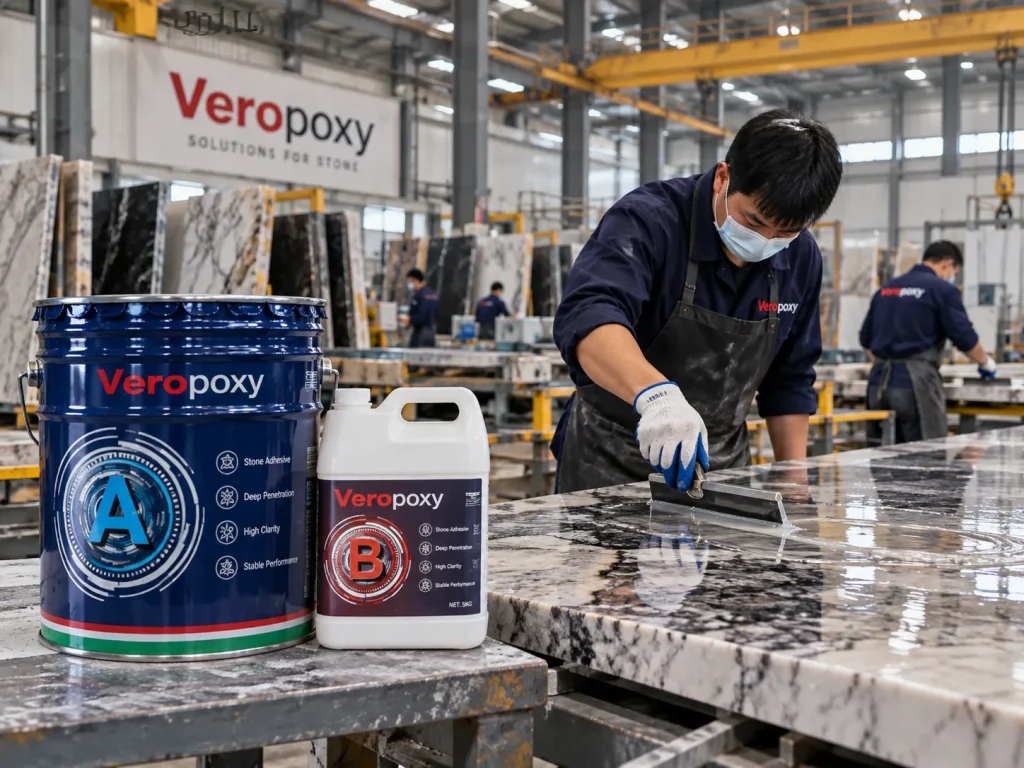
What Does Epoxy Resin Viscosity Mean in Stone Processing?
Viscosity describes a liquid’s resistance to flow. A lower-viscosity resin flows more easily, while a higher-viscosity material resists movement and tends to remain where it is placed.
In epoxy resin specifications, viscosity is commonly reported in centipoise, written as cP. Some commercial stone-industry technical sheets also write the unit as “CPS.” In SI terminology, 1 cP is numerically equivalent to 1 mPa·s.
For a stone processor, however, viscosity is not just a laboratory number. It directly influences how the mixed resin behaves when it encounters pores, capillary cracks, saw marks, fiberglass mesh, uneven surfaces, vertical edges, or large cavities.
Low viscosity favors movement and penetration
When viscosity is reduced, resin can generally move more easily into fine voids. This is useful when the objective is internal impregnation rather than simply covering the surface.
A good example is dense black granite containing micro-fissures that are difficult to reach with a thick adhesive. Veropoxy’s Ultra-Low Viscosity Epoxy for Black Granite Deep Penetration is positioned specifically for infiltration into fine pores and cracks before polishing. Its published product data places the system in a very low viscosity range intended to improve internal penetration.
Higher body favors staying power and gap filling
Flow is not always the goal. If the defect is wide, the application is vertical, or resin must remain in a seam rather than disappear into surrounding pores, a higher-viscosity or thixotropic formulation may be more appropriate.
This is why using a penetration resin as if it were a gap-filling mastic can create disappointing results. The resin may drain too far into the stone, run out of the repair zone, or leave insufficient material near the surface.
Conversely, using a heavy gap-filling adhesive for hairline fissures may create the opposite problem: it bridges the crack entrance without reaching its internal depth.
Why CPS Alone Is Not Enough
One of the most common purchasing mistakes is comparing two epoxy products purely by their published CPS values.
That comparison can be misleading unless both numbers were measured under comparable conditions.
Measurement temperature matters
Epoxy viscosity is highly temperature-sensitive. Cold resin becomes thicker and harder to pump, mix, spread, and wet into a substrate. Warmer resin generally flows more easily.
This matters enormously for international stone factories. A resin used in a 10°C winter workshop can behave very differently from the same product handled in a 30°C production area.
Temperature also creates a second effect: while warming generally lowers viscosity, higher temperature can accelerate epoxy reaction and shorten usable working time. In practice, a factory cannot simply heat resin indefinitely to obtain better flow. Flow, pot life, curing speed, and production rhythm must be balanced together.
Mixed viscosity is more useful than resin-only viscosity
Component A may have one viscosity and Component B another. Once resin and hardener are combined, the mixed system can behave differently again.
For real production decisions, ask whether the published viscosity refers to:
- resin component only;
- hardener component only;
- fully mixed A+B system;
- the mixture immediately after mixing; or
- the mixture after a specified period of reaction.
For stone processing, mixed-system behavior is usually the most relevant because that is what actually enters the crack, wets the mesh, or spreads across the slab.
Shear rate and test method matter
Many liquid resins are evaluated with rotational viscometers. For non-Newtonian materials, apparent viscosity can change depending on spindle speed or shear conditions. This is why a professional specification should ideally state the measurement method and test conditions rather than presenting a naked number.
ISO 2555 describes apparent-viscosity measurement for liquid resins using a rotational viscometer, while ASTM D2196 addresses apparent viscosity and rheological behavior of non-Newtonian materials measured under defined rotational conditions.
A practical purchasing rule: if Supplier A says “400 cP” and Supplier B says “550 cP,” do not immediately assume Supplier A penetrates better. First compare test temperature, instrument or method, spindle/speed conditions, A/B mixing state, and application-specific formulation.
How Viscosity Affects Stone Processing Performance
Penetration into micro-cracks
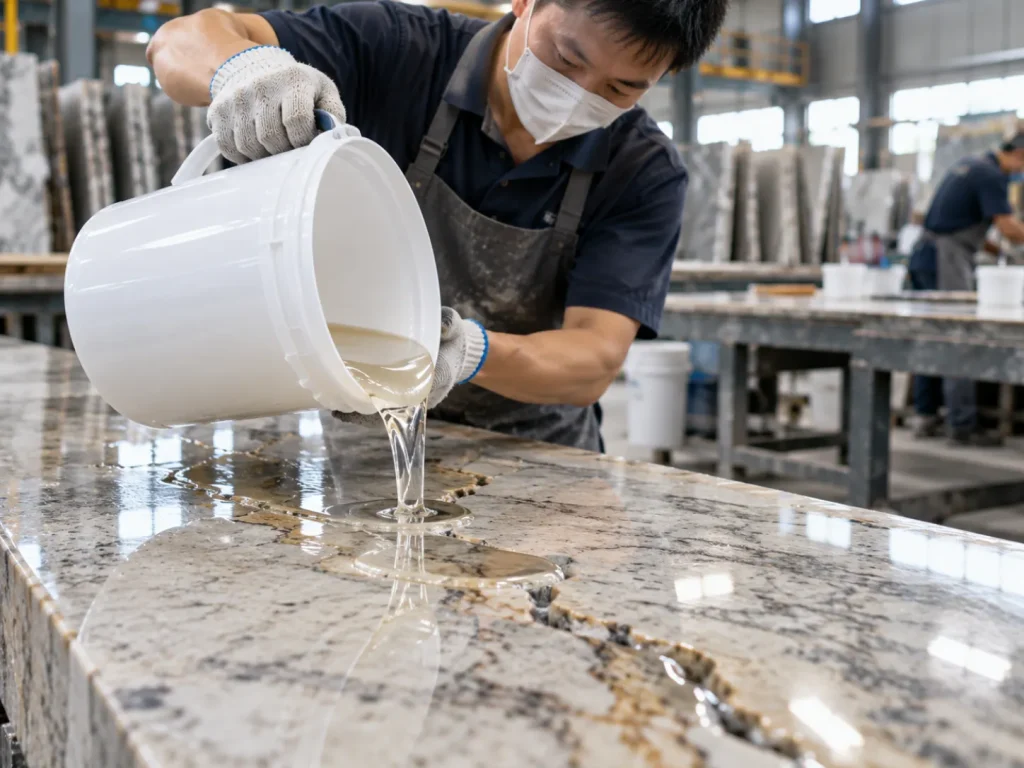
Hairline cracks and internal fissures are among the clearest cases where low-viscosity resin has an advantage. Dense granite may contain cracks that are visible under inspection but extremely narrow. A resin must wet the opening and continue moving through capillary pathways before gelation progresses too far.
For this reason, Veropoxy’s Black Granite Solution range includes several deep-penetration and high-flow epoxy systems intended for micro-crack treatment and reinforcement.
If penetration is insufficient, the repair can look acceptable immediately after coating while internal defects remain untreated. Problems may appear later during calibration, polishing, cutting, transport, or installation.
Wetting of pores and stone surfaces
Good wetting helps resin contact the internal surface of cracks and pores instead of remaining as isolated droplets. Lower viscosity generally supports easier spreading, but chemistry and surface condition also matter.
Dust, moisture, oil, polishing residue, or excessive stone temperature can interfere with wetting even when viscosity appears appropriate. Therefore, a low CPS figure cannot compensate for poor surface preparation.
Air release and bubble behavior
A very thick system can make trapped air harder to escape, particularly during impregnation or mesh wetting. Lower-viscosity resin can improve mobility around fibers and pores, but aggressive mixing can still introduce air.
Factories using vacuum-assisted processing should pay particular attention to this balance. Veropoxy’s Vacuum Infusion Solutions are based on promoting resin movement into micro-pores and internal defects under vacuum-assisted conditions.
Resin consumption
More fluid resin can penetrate deeply, which is often desirable. But that can also increase consumption on highly porous stone if application quantity is not controlled.
This is particularly relevant with travertine, porous marble, weathered stone, and slabs containing interconnected voids. An operator may continue applying resin because the surface appears dry while a significant amount has already migrated below the surface.
Higher consumption is not automatically waste if the objective is deep reinforcement. The issue is whether the additional resin creates useful internal bonding or simply disappears into voids where it adds little value.
Surface leveling and polishing preparation
After crack repair, many stone lines move to grinding or polishing. Resin viscosity affects whether defects remain fully filled after cure and whether the surface can be processed without revealing pinholes or recessed repair lines.
A penetration resin that flows beautifully into the stone may still require a second treatment when the top surface needs body or leveling. This is one reason some professional processing systems separate deep impregnation from final surface filling or finishing.
What CPS Range Should You Choose for Stone?
There is no universal industry rule saying that one fixed CPS range is correct for every marble, granite, mesh backing, or vacuum process. Classification terms such as “low viscosity,” “ultra-low viscosity,” and “high flow” depend on the formulation, supplier, test conditions, and intended application.
Still, current Veropoxy products provide useful real-world examples of how relatively low-viscosity systems are applied within professional stone production.
| Stone Processing Need | Viscosity Direction | What the Buyer Is Trying to Achieve | Veropoxy Application Example |
|---|---|---|---|
| Dense black granite with micro-fissures | Very low viscosity | Deep internal penetration before polishing | CP83-60 / B25Q-KG deep-penetration system |
| Light granite crack repair and color enhancement | Low viscosity, controlled flow | Reach fine defects while maintaining surface coverage | 4099-BBS / D30M-BS |
| Warm-climate marble repair | Low-to-controlled viscosity | Good wetting, crack repair, leveling and color enhancement | 5099 / B25Q-KG |
| Stone mesh backing | Controlled low viscosity | Wet reinforcement mesh without excessive runoff | 4090 mesh-backing systems |
| Vacuum impregnation | Low viscosity with sufficient working time | Move resin through pores and micro-cracks before gelation | Vacuum Infusion Solutions |
| Wide gaps or seam filling | Higher body or thixotropic behavior | Keep resin inside the repair area instead of excessive drainage | Use an application-specific filling system rather than choosing only by lowest CPS |
For example, Veropoxy publishes approximately 400–600 cP for several stone products including its Color Enhancing Epoxy for Light Granite and warm-climate Marble Repair & Color Enhancement system. Meanwhile, its black-granite deep-penetration product is positioned even lower for fine internal defects.
The important takeaway is not that “400–600 cP is the correct stone viscosity.” It is that similar numeric viscosity ranges can serve different functions because cure speed, temperature stability, surface interaction, hardener chemistry, yellowing resistance, and application method differ.
How to Choose Viscosity by Stone Type
Dense black granite
Dense black granite often benefits from a high-penetration approach when micro-cracks or internal fissures are the main defect. The stone itself may have low overall porosity, yet fine structural cracks can still require reinforcement.
If the resin is too viscous, it may remain near the crack entrance. If it is too fluid without sufficient control, however, it can migrate excessively and increase consumption.
If your process involves impregnation before polishing, prioritize deep penetration, adequate working time, strong internal bonding, and stable visual results after polishing.
Light granite
Light-colored granite creates an additional challenge: repair quality must be structural without creating obvious darkening, staining, or visual contrast.
Viscosity should therefore be evaluated together with transparency, color enhancement behavior, yellowing resistance, and the final polished appearance.
The Veropoxy light granite system combines a published 400–600 cP range with color-enhancement and penetration functions, showing why viscosity should never be isolated from optical performance.
White and colored marble
Marble can vary considerably in porosity, micro-crack structure, mineral composition, translucency, and color sensitivity. A resin that penetrates effectively may also alter the visual appearance of light marble if chemistry and optical properties are not suitable.
For white and colored marble, evaluate viscosity together with non-staining behavior, yellowing resistance, water-mark risk, working temperature, and polishability.
Veropoxy’s broader Epoxy for Marble application section provides context for marble reinforcement and repair, while specific warm-temperature products address more defined processing conditions.
Travertine and highly porous stone
Travertine behaves differently because open pores and cavities can absorb large amounts of low-viscosity resin. Deep flow may be desirable for stabilization, but a pure penetration strategy is not always suitable when large surface cavities must be filled flush.
In that case, the processor may need a staged approach: penetration or sealing first, followed by a higher-body filling material.
Veropoxy’s Epoxy for Travertine section discusses the role of epoxy in pore treatment, crack repair, and stone protection.
How Temperature Changes the Viscosity Decision
Temperature is one of the most underestimated variables in epoxy purchasing.
Cold resin becomes more viscous. It takes longer to flow, may be harder to dispense accurately, may wet reinforcement more slowly, and can trap air more easily during processing.
Warm resin generally flows more readily, but the chemical reaction between resin and hardener also accelerates as temperature rises. A factory therefore needs both flow and cure behavior to remain compatible with its cycle time.
This is why two products with the same nominal viscosity can perform differently in winter and summer.
Veropoxy’s mesh-backing range is a useful example. Its High Temperature Odorless Epoxy for Stone Mesh Backing publishes a 400–600 cP viscosity range and is formulated for elevated-temperature production. The company’s low-temperature mesh-backing system also uses a controlled low-viscosity range but is formulated around colder processing conditions.
The lesson for buyers is simple: viscosity and curing chemistry must be selected together.
If your factory operates near 10°C in winter, do not assume that an epoxy performing well at 25°C will behave identically.
If your workshop regularly exceeds 30°C, do not solve flow problems simply by choosing the thinnest resin. Pot life and premature cure can become the bigger risks.
Low Viscosity vs High Viscosity Epoxy for Stone
| Decision Factor | Lower-Viscosity Epoxy | Higher-Viscosity / Higher-Body Epoxy |
|---|---|---|
| Micro-crack penetration | Usually better | May remain near the surface |
| Vacuum impregnation | Generally preferred | May restrict flow |
| Mesh wetting | Can improve fiber impregnation | May be harder to spread uniformly |
| Wide gap filling | Can drain or sink too far | Usually better at remaining in the gap |
| Vertical repair | Higher sag/runoff risk | Usually easier to control |
| Porous stone consumption | Can penetrate deeply and increase usage | Less deep migration |
| Air release | Generally easier when properly mixed | Air can be harder to release |
Neither side is universally better. The correct viscosity is the one that creates the required flow profile during the available working window.
How to Match Epoxy Viscosity to Different Stone Processing Needs
| If Your Production Situation Is… | Choose or Check… | Why |
|---|---|---|
| Dense granite with hairline micro-cracks | Lower-viscosity deep-penetration system | Resin must enter fine internal fissures before curing |
| Large surface cavity or open seam | Higher-body or gap-filling system | Excessively thin resin may drain away |
| Vacuum infusion | Low viscosity plus sufficient pot life | Flow must continue through pores during the infusion cycle |
| Fiberglass mesh is not fully wetted | Check mixed viscosity, temperature, application amount and spreading method | Poor wetting is not always a resin-strength problem |
| Epoxy becomes difficult to spread in winter | Check material temperature and cold-condition formulation | Lower temperature increases viscosity |
| Epoxy flows well but cures too quickly in summer | Check hardener system and temperature-specific formulation | Warm conditions can increase flow while shortening working time |
| Resin penetrates but repair remains recessed after polishing | Consider staged penetration plus surface filling | Deep flow alone may not provide sufficient surface build |
| Two suppliers quote similar CPS values but results differ | Compare test method, temperature, mix ratio, cure profile and substrate | CPS alone does not describe the complete formulation |
How to Read an Epoxy Viscosity Specification Like a Professional Buyer
Before approving a resin, request more than one number.
1. Confirm the test temperature
A viscosity figure without temperature has limited purchasing value. Ask whether the measurement was taken at 20°C, 23°C, 25°C, or another condition.
2. Confirm whether the number is resin-only or mixed A+B
The production line uses the mixed system. Make sure the specification you compare reflects the condition relevant to application.
3. Confirm the measurement method
Ask whether a rotational viscometer method was used and whether spindle/speed conditions are available. This becomes especially important when comparing products from different suppliers.
4. Check the mixing ratio
Changing the resin-to-hardener ratio to make epoxy “thinner” is not an acceptable production shortcut. Epoxy systems are designed around specified stoichiometry and formulation balance. Incorrect ratios can cause incomplete cure, soft surfaces, brittleness, or inconsistent mechanical properties.
5. Check working time and cure profile
A highly fluid epoxy that begins gelling before it reaches the desired crack depth is not a successful penetration system.
For deep treatment, viscosity must remain useful during the time needed for spreading, infiltration, vacuum processing, or mesh impregnation.
6. Check viscosity tolerance between batches
Stone factories running continuous production need repeatability. If viscosity varies significantly from batch to batch, application quantity, penetration depth, operator technique, and line speed may all need adjustment.
This is why supplier evaluation should include batch consistency, not just a good result from one sample drum.
How to Test Epoxy Viscosity Before Bulk Ordering
A laboratory number should always be connected to a real slab test.
Step 1: Condition the materials
Bring resin, hardener, and representative stone samples to a controlled and recorded temperature. Testing one supplier at 15°C and another at 25°C makes comparison unreliable.
Step 2: Mix according to the specified ratio
Use accurate weighing or metering. Do not modify the ratio to adjust flow.
Step 3: Record initial handling behavior
Observe pouring, mixing, spreading, wetting, and bubble release. The resin should behave consistently enough for operators or automatic equipment to control.
Step 4: Apply it to actual production stone
Use representative granite, marble, travertine, or reinforced slab material rather than a generic test panel.
For penetration applications, examine whether the resin reaches the defect rather than simply coating the surface.
Step 5: Record resin consumption
Measure how much material is required per slab or per square meter under controlled conditions. A cheaper resin that consumes significantly more material may not be cheaper in production.
Step 6: Observe the full working window
Track how quickly viscosity increases after mixing. Operators need to know when flow begins to fall and when the system becomes unsuitable for further application.
Step 7: Cure and finish the slab
Do not judge only from wet appearance. Grind, polish, cut, or handle the slab as the real production process requires.
Check for:
- remaining micro-cracks;
- pinholes;
- visible repair edges;
- color change;
- yellowing;
- poor adhesion;
- recessed filling;
- surface tackiness;
- unexpected brittleness; and
- polishing inconsistencies.
Common Epoxy Viscosity Mistakes in Stone Factories
Choosing the lowest CPS because it sounds more advanced
Lower is not automatically better. Very fluid resin may penetrate deeply but create excessive consumption, runoff, or insufficient surface build.
Comparing numbers measured at different temperatures
This can make one resin appear dramatically thinner even though the difference comes mainly from test conditions.
Ignoring the stone itself
A dense black granite micro-crack and an open travertine cavity are not the same repair problem. They should not automatically use the same resin.
Using one epoxy for every season
Seasonal workshop temperature can alter both flow and cure speed. Factories with strong winter/summer variation should test products across realistic temperature conditions.
Ignoring pot life
Excellent initial flow is useless if viscosity rises too quickly during the actual application window.
Using penetration resin as a universal gap filler
The resin may disappear into the stone and leave the surface under-filled.
Changing the mixing ratio to adjust viscosity
This is one of the most dangerous shortcuts. Flow should be controlled through the correct formulation and processing conditions, not by randomly changing the specified A:B ratio.
Stone Epoxy Buyer Checklist
| Question to Ask the Supplier | Why It Matters |
|---|---|
| What is the mixed viscosity? | This represents real application behavior better than resin-only data. |
| At what temperature was viscosity measured? | Epoxy flow changes significantly with temperature. |
| Which viscosity test method was used? | Different measurement conditions can produce different apparent values. |
| What stone and process was the resin designed for? | Application-specific formulation matters more than a generic CPS target. |
| What is the resin-to-hardener ratio? | Required for repeatable curing and performance. |
| What is the pot life or working window? | Determines how long useful flow remains available. |
| How does the product behave at our summer and winter temperatures? | Important for stable year-round production. |
| Can we test the resin on our own stone? | Real slab testing reveals penetration, color and polishing performance. |
| What is the expected batch-to-batch viscosity tolerance? | Critical for automated and continuous production. |
Recommendation: Select the Process First, Then the CPS
The best way to choose an epoxy resin for stone processing is to start with the process problem rather than the viscosity number.
If the goal is deep reinforcement of micro-fissured granite, prioritize a low-viscosity system with sufficient working time and strong internal bonding.
If the goal is mesh reinforcement, select a resin that can wet the fibers evenly without uncontrolled runoff and that cures reliably at your workshop temperature.
If the process uses vacuum impregnation, prioritize low flow resistance, stable mixed viscosity, air release, and a working window long enough for complete infusion.
If the repair involves wide cavities or seams, a higher-body or thixotropic system may provide better control than an ultra-low-viscosity penetration resin.
If you are unsure where to start, review Veropoxy’s stone epoxy product portfolio together with the company’s stone epoxy Knowledge section, then compare candidate systems using your actual stone, workshop temperature, application method, curing cycle, and polishing process.
Frequently Asked Questions About Epoxy Resin Viscosity
1. What viscosity epoxy is best for stone processing?
There is no single best viscosity for every stone process. Fine granite micro-cracks generally benefit from lower-viscosity penetration resin, while larger cavities and vertical repairs often require more body. Mesh backing and vacuum infusion also need good flow, but cure speed, temperature, and working time must be considered at the same time.
2. Is 400–600 cP considered low viscosity for stone epoxy?
In several current Veropoxy stone-processing formulations, approximately 400–600 cP is used for low-viscosity or high-flow applications such as granite repair, marble repair, and mesh backing. However, “low viscosity” is not a universal classification. Always compare the test conditions and intended application before treating a numeric range as an industry standard.
3. Does temperature affect epoxy resin viscosity?
Yes. Lower temperatures generally increase the viscosity of uncured epoxy, making it harder to pour, mix, spread, and penetrate. Higher temperatures generally reduce viscosity but can also accelerate curing. For industrial stone processing, resin temperature, stone temperature, and workshop temperature should all be considered.
4. Is lower-viscosity epoxy stronger?
Not necessarily. Viscosity describes flow behavior before cure; it does not by itself define final mechanical strength. A low-viscosity resin can provide better penetration into micro-cracks, but final performance also depends on resin chemistry, hardener chemistry, mix ratio, cure conditions, adhesion, and the structure of the stone.
5. How should a stone factory compare epoxy viscosity before bulk ordering?
Compare mixed viscosity at the same temperature and, ideally, using comparable test methods. Then run controlled trials on your own stone. Record penetration, resin consumption, working time, cure, polishing appearance, color change, defect filling, and production consistency. The product that performs best on the real production line is more valuable than the one with the most attractive CPS number on paper.
How to Choose the Right Epoxy Viscosity for Real Stone Processing
The right epoxy viscosity is not a universal CPS target. It is a balance between resin flow, stone structure, defect size, workshop temperature, working time, curing behavior, and the required finished surface. For stone factories, viscosity should be treated as a production parameter rather than an isolated number on a technical data sheet.
Start with the processing problem
Fine pores and micro-cracks need enough flow for the resin to penetrate before gelation begins. Wider gaps need more body so the material remains inside the repair area. Mesh backing requires controlled wetting and manageable runoff, while vacuum infusion depends on low flow resistance and enough working time for resin to move through internal pores and fissures.
Lower CPS is not always better
Very low-viscosity epoxy can improve penetration, but it can also increase runoff, resin consumption, or material loss into large pores. It may also leave insufficient material near the surface when the application requires gap filling or surface build. The better choice is the lowest viscosity that provides the required penetration without sacrificing process control or finishing quality.
Match viscosity to the application
Micro-cracks in dense granite:
prioritize low-viscosity deep penetration so the resin can reach fine internal fissures before curing.
Marble repair:
balance viscosity with color stability, penetration, yellowing resistance, and the expected polished appearance.
Stone mesh backing:
balance wetting ability, flow control, adhesion, sag resistance, and curing performance at the actual workshop temperature.
Vacuum infusion:
prioritize low viscosity, sufficient pot life, stable flow, and good air release so the resin can move through pores and micro-cracks before gelation.
Wide seams or cavities:
consider higher-body or thixotropic systems rather than assuming an ultra-low-viscosity penetration resin will provide enough filling capacity.
Do not compare CPS without the test conditions
Measurement temperature, mixed versus unmixed viscosity, rotational test conditions, A:B ratio, elapsed time after mixing, stone temperature, workshop season, production speed, and batch consistency can all affect real-world behavior. A purchasing specification that records only “500 CPS” does not provide enough information for a reliable supplier comparison.
What is changing in professional stone processing?
Professional stone processors are increasingly moving away from one universal adhesive for every application. More factories are using application-specific systems for black granite penetration, light-stone color control, white-marble non-staining performance, low-temperature mesh backing, high-temperature production, vacuum infusion, and other clearly defined processing conditions.
This also changes how buyers should evaluate suppliers. Technical data, sample testing, temperature-specific recommendations, batch consistency, and application support are becoming more important than generic claims such as “high strength,” “fast curing,” or “low viscosity.”
Practical Recommendation
If micro-cracks are the problem, start with penetration. If runoff is the problem, increase body or flow control. If seasonal temperature changes performance, evaluate viscosity and curing chemistry together. If two epoxy systems have similar CPS values but produce different results, compare working time, wetting, rheology, stone interaction, and curing behavior. The right epoxy is not simply the product with the lowest viscosity—it is the system whose flow remains useful throughout your actual production cycle.
Before bulk ordering, test the resin on your own granite, marble, travertine, mesh-backed slab, or vacuum-infusion process. Share the stone type, crack condition, workshop temperature, application method, required curing time, and current production problem so the epoxy system can be evaluated around real processing conditions rather than a generic CPS target.
References
- ISO 2555:2018 – Plastics — Resins in the Liquid State — Determination of Apparent Viscosity Using a Rotational Viscometer
- ASTM D2196 – Standard Test Methods for Rheological Properties of Non-Newtonian Materials by Rotational Viscometer
- WEST SYSTEM – Epoxy User Manual & Product Guide
- Gurit – GR110 Structural Epoxy Resin System Product Data Sheet
- Veropoxy – Ultra-Low Viscosity Epoxy for Black Granite Deep Penetration
- Veropoxy – Color Enhancing Epoxy for Light Granite
- Veropoxy – Epoxy Resin for Marble Repair & Color Enhancement
- Veropoxy – High Temperature Odorless Epoxy for Stone Mesh Backing
- Veropoxy – Vacuum Infusion Solutions