

Quick Summary:
Before bulk ordering epoxy resin, a stone factory should test the product on its actual marble, granite, onyx, or engineered stone under real production conditions. Check mixing behavior, viscosity, working time, curing, penetration, adhesion, color change, polishing performance, resin consumption, and batch consistency. Do not approve an epoxy because one sample “looks good.” Define pass/fail criteria first, test several representative slabs, compare against your current production baseline, and verify performance at realistic summer and winter temperatures.
Buying industrial epoxy resin is different from buying a finished component.
A supplier can send a technically correct product, but that product can still be wrong for your stone, your production temperature, your polishing sequence, your operators, or your cycle time.
This is why a stone factory should never treat a sample as a small promotional gift.
A sample is a qualification tool.
The objective is not simply to answer:
“Does this epoxy work?”
The better question is:
“Can this epoxy repeatedly produce an acceptable finished slab under our actual production conditions at a commercially acceptable cost?”
That distinction matters.
A resin may penetrate beautifully but consume too much material. Another may cure quickly but leave operators too little working time. A very clear system may still create dark halos on porous white marble. A strong adhesive may be difficult to polish. A sample may perform perfectly at 24°C but become too slow in winter or too reactive in summer.
Veropoxy’s current stone epoxy product portfolio reflects this application-specific approach, with separate systems for granite, marble, white stone, mesh backing, vacuum infusion, semi-precious stone, and other processing conditions.
Many Veropoxy product pages also offer samples specifically so factories can evaluate performance before bulk purchasing. That is exactly how professional procurement should use them.
Why Sample Testing Matters Before a Bulk Epoxy Order
An epoxy technical data sheet tells you how a product behaves under defined conditions.
Your factory may not operate under those conditions.
Stone is naturally variable
Natural stone is not a standardized plastic panel.
Two marble slabs from the same quarry can differ in:
- porosity;
- micro-crack density;
- mineral structure;
- water absorption;
- translucency;
- surface roughness;
- color sensitivity; and
- internal weakness.
An epoxy that performs well on one stone can produce a different result on another.
Your production process changes the result
Performance can also change with:
- workshop temperature;
- stone temperature;
- mixing equipment;
- batch size;
- manual or automatic application;
- vacuum pressure;
- mesh specification;
- curing time;
- grinding sequence; and
- polishing abrasives.
This is why supplier laboratory data should shortlist a resin—not replace your factory trial.
Buyer takeaway: The most useful epoxy sample test is not the most complicated laboratory test. It is the test that reproduces the conditions that will determine whether the product succeeds or fails on your production line.
Define Pass/Fail Criteria Before the Sample Arrives
This is one of the biggest differences between professional qualification and casual testing.
Do not apply the epoxy first and decide afterward whether you “like it.”
Define the acceptance criteria before testing.
Start with your current production baseline
If your factory already uses an approved epoxy, record how that product performs.
For example:
- resin consumption per square meter;
- average working time;
- curing time;
- number of slabs repaired per batch;
- reject rate;
- polishing result;
- repair visibility;
- mesh-backing handling time; and
- cost per finished slab.
A new epoxy should be compared against this baseline rather than evaluated in isolation.
Decide which failures are unacceptable
For white marble, a visible yellow halo may be an automatic rejection.
For black granite, incomplete crack penetration may be more important.
For mesh backing, peeling after handling may be unacceptable.
For vacuum infusion, insufficient penetration depth can make the entire trial meaningless.
Test 1: Review the Technical Documents Before Opening the Sample
A sample should arrive with enough information to use it correctly.
Review the TDS
The Technical Data Sheet should clarify the parameters relevant to production, such as:
- product identity;
- recommended application;
- A:B mixing ratio;
- whether the ratio is by weight or volume;
- viscosity;
- recommended temperature;
- working or curing time;
- storage conditions; and
- application instructions.
Review the SDS
The Safety Data Sheet is not a performance document.
It provides information related to hazards, handling, storage, exposure controls, PPE, first aid, transport, and disposal.
A serious industrial buyer should expect both technical and safety documentation.
Check whether test conditions are defined
A viscosity value such as “500 CPS” means much less if the supplier does not state or control the relevant measurement condition.
Similarly, “60-minute cure” is incomplete unless you understand the temperature and what cure milestone the supplier means.
Test 2: Confirm Product Identity and Condition
Before mixing anything, inspect the sample itself.
Check the labels
Confirm:
- resin code;
- hardener code;
- batch number;
- manufacturing or expiry information where provided;
- mixing ratio; and
- storage instructions.
Inspect appearance
Look for:
- unexpected sediment;
- crystallization;
- severe discoloration;
- phase separation;
- leaking containers; or
- contamination.
Do not assume that every visual change means the product is defective, because some resin systems can crystallize or settle under certain conditions.
If the appearance differs from supplier instructions, stop and ask before testing.
Test 3: Check Mixing Behavior
A production-friendly epoxy should be reasonably easy to proportion and mix consistently.
Use the exact specified ratio
Veropoxy’s stone epoxy systems do not all use the same ratio.
For example, its Marble Repair & Color Enhancement system uses 100:25 by weight, while the Color Enhancing Epoxy for Light Granite uses 100:30 by weight.
Never reuse one ratio simply because two products look similar.
Observe mixing uniformity
Record whether:
- the two components combine easily;
- streaks remain;
- large quantities of air are introduced;
- the mixture heats rapidly; or
- viscosity changes abnormally during mixing.
For critical production, use a standardized mixing method so each supplier is compared fairly.
Test 4: Measure or Compare Viscosity and Flow
Viscosity is one of the most useful process-control parameters in stone epoxy.
But it should not be treated as a universal quality score.
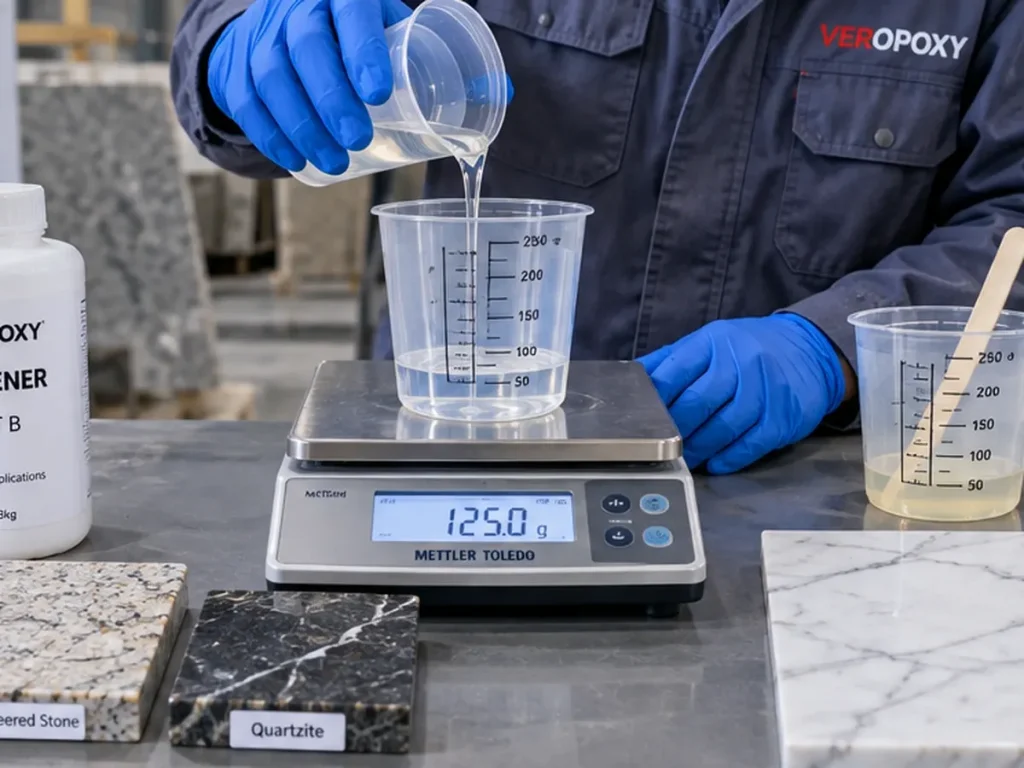
Why viscosity matters
It affects:
- micro-crack penetration;
- surface spreading;
- mesh wetting;
- vacuum infusion;
- resin consumption;
- runoff; and
- gap retention.
Compare under the same temperature
Viscosity changes strongly with temperature.
If Supplier A is tested at 15°C and Supplier B at 25°C, your comparison is weak.
Condition samples to the same temperature before making a judgment.
Use formal testing when viscosity is a contractual specification
ISO 2555 provides a standardized rotational method for determining apparent viscosity of liquid resins.
ASTM D2196 provides methods for characterizing rotational viscosity and rheological behavior of non-Newtonian materials.
For everyday factory screening, however, a controlled comparative flow test can still be useful when the same temperature, quantity, substrate, and timing are maintained.
Test 5: Measure Pot Life and Useful Working Time
Do not confuse pot life with production working time.
Pot life tells only part of the story
A mixed epoxy can remain liquid in the container while already becoming too thick for micro-crack penetration.
For stone processing, useful working time should be defined by the application.
For example:
- When does crack penetration noticeably decrease?
- When does mesh become difficult to wet?
- When does vacuum flow become too slow?
- When does surface spreading become uneven?
Use realistic batch sizes
A 100 g laboratory cup may behave differently from a 5 kg production batch because curing epoxy releases heat.
Large masses can retain more exothermic heat and shorten practical pot life.
Test 6: Evaluate the Cure Profile
“It became hard” is not enough.
A factory should understand when the epoxy reaches different production milestones.
Record handling time
When can the slab safely be:
- lifted;
- turned;
- stacked;
- moved to a cart;
- sent to calibration; or
- sent to polishing?
Check for incomplete cure
Warning signs include:
- tackiness;
- rubbery repair areas;
- soft material under pressure;
- smearing during polishing;
- unusual odor after expected cure; or
- different hardness between sections.
Laboratory cure testing can go deeper
For advanced supplier qualification, Differential Scanning Calorimetry can be used to characterize reaction behavior and degree of conversion under defined conditions.
ISO 11357-5 provides a standardized DSC framework for determining reaction temperatures, reaction times, enthalpy, and degree of conversion.
This type of laboratory work is useful for deeper technical validation but is not necessary for every routine factory sample.
Test 7: Evaluate Penetration on the Actual Stone
This is one of the most important tests for stone epoxy and one of the hardest to replace with generic laboratory data.
Use representative defects
Test on actual:
- micro-cracks;
- natural fissures;
- open pores;
- dense granite;
- soft marble; or
- vacuum-infusion slabs.
Do not judge penetration from the wet surface
A glossy wet slab tells you almost nothing about internal penetration.
After curing, inspect cut sections, edge regions, representative fractures where appropriate, or other approved internal examination methods.
Watch for over-penetration too
More penetration is not always better.
On porous white marble, excessive penetration can create dark halos or wet-looking optical changes.
For that application, controlled penetration may matter more than maximum depth.
Test 8: Check Color Change, Yellowing and Optical Effects
This test is essential for white marble, light granite, onyx, and translucent stone.
Photograph before and after under controlled light
Use the same lighting, camera angle, and surface condition.
Phone photos taken in different rooms are poor evidence.
Distinguish true yellowing from shadowing
A dark zone around a crack may come from resin penetration rather than chemical yellowing.
This matters because changing to a clearer epoxy will not necessarily solve an over-penetration problem.
Veropoxy’s Non-Yellowing Epoxy for Hard White Marble is specifically positioned around controlled penetration and very low yellowing for color-sensitive stone.
Consider aging for premium projects
If the stone will be installed near strong sunlight or if long-term visual purity is critical, accelerated UV or heat comparison testing can help rank candidate systems.
Do not interpret accelerated aging as an exact prediction of service life unless the test methodology supports that conclusion.
Test 9: Evaluate Adhesion and Failure Mode
“Strong bonding” is one of the most common epoxy marketing claims.
A professional factory should look at how the bond actually fails.
Adhesive failure
If epoxy cleanly separates from the stone surface, the interface may be weak.
Cohesive failure
If failure occurs inside the cured resin layer, the bond to the substrate may be stronger than the resin’s internal strength at that condition.
Stone failure
If the stone breaks while the adhesive remains attached, the substrate may be the weakest part of the assembly.
This distinction can be more informative than one raw strength number.
Formal adhesive tests have limited direct transfer
ISO 4587 defines lap-shear testing for rigid bonded assemblies.
ASTM C882 evaluates epoxy bond strength in a concrete slant-shear configuration.
These methods can inform laboratory thinking, but neither should automatically be treated as a universal pass/fail standard for marble or granite epoxy without confirming applicability.
For natural stone, test design should reflect the real substrate and load condition.
Test 10: Check Hardness—But Do Not Use Hardness as a Shortcut for Everything
A cured epoxy that remains unexpectedly soft can cause polishing or durability problems.
Durometer testing can provide a repeatable production-control indicator.
ISO 868 describes Shore hardness testing for plastics using durometer methods.
But hardness alone does not prove good adhesion, toughness, penetration, or long-term durability.
A very hard epoxy can still bond poorly to stone.
Use hardness as one QC metric, not the final verdict.
Test 11: Run the Real Grinding and Polishing Sequence
This is where many laboratory-perfect samples fail.
A stone epoxy is part of a production system.
If the slab will ultimately be polished, the qualification trial needs polishing.
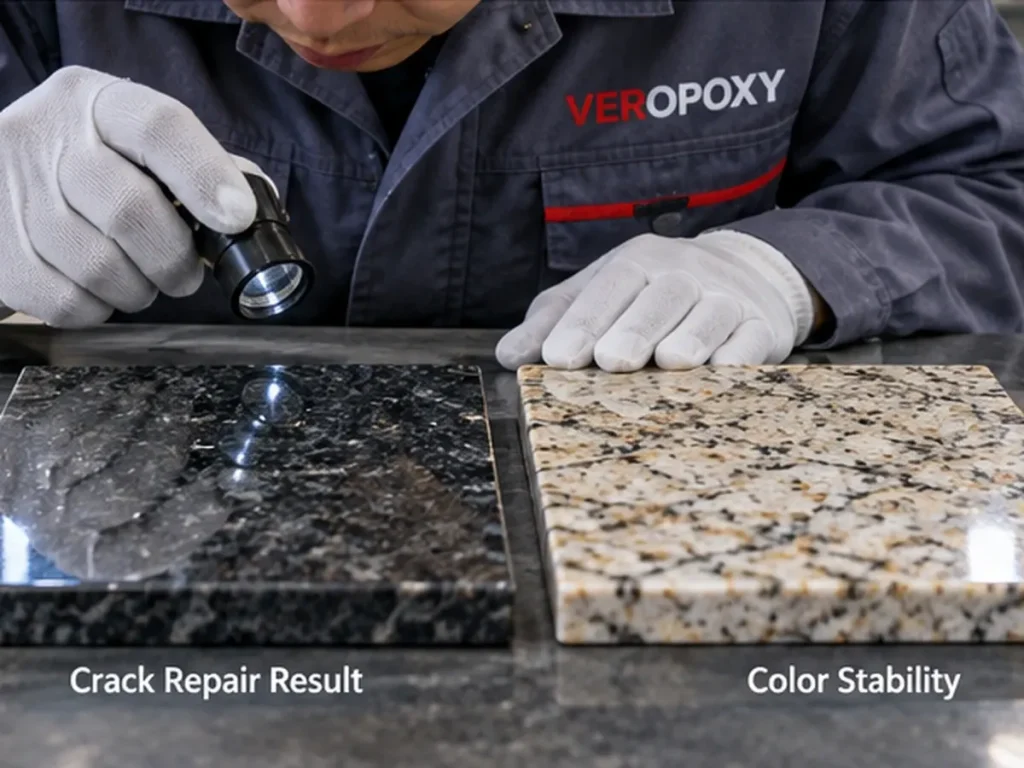
Watch for resin pull-out
Soft or poorly bonded resin can be removed from cracks during grinding.
Watch for smearing
Under-cured material may smear over the stone surface.
Check gloss consistency
The repaired zone should not create an obvious dull patch, raised ridge, or different reflective appearance unless the intended application allows it.
Check pinholes after polishing
Surface treatment can look complete before grinding and reveal pinholes only after material is removed.
This is why the final polished slab—not the wet epoxy—is the real product.
Test 12: Measure Resin Consumption
This is one of the most commercially important tests and one of the most frequently ignored.
Purchase price per kilogram does not tell you cost per finished slab.
Record grams or kilograms per slab
Use a scale.
Do not estimate from the amount remaining in a bucket.
Compare cost per square meter
If Epoxy A costs 10% less per kilogram but consumes 25% more material, it may be the more expensive production choice.
Include rework cost
The real cost should consider:
- epoxy consumption;
- labor;
- curing delay;
- rejects;
- re-polishing;
- broken slabs; and
- lost production time.
Test 13: Repeat the Trial at Summer and Winter Temperatures
A sample approved at one comfortable room temperature may fail seasonally.
Cold conditions
Lower temperatures generally:
- increase uncured viscosity;
- reduce flow;
- slow penetration;
- extend curing; and
- change handling time.
Hot conditions
Higher temperatures generally:
- reduce initial viscosity;
- increase flow;
- accelerate reaction;
- shorten working time; and
- increase exothermic risk in large batches.
For factories with large seasonal variation, a supplier may need to recommend different hardener systems.
Veropoxy, for example, currently offers separate low-temperature and high-temperature mesh-backing systems.
Test 14: Evaluate Batch-to-Batch Consistency
One perfect sample does not qualify a supplier.
Bulk production depends on repeatability.
Why consistency matters
Variation between batches can change:
- viscosity;
- working time;
- cure speed;
- color;
- penetration;
- resin consumption; and
- polishing behavior.
Do not approve a supplier based on one hand-prepared sample
Ideally, qualification should progress through stages:
Laboratory or small sample → factory trial → trial order → bulk order.
This gives the buyer a chance to see whether commercial production batches reproduce the sample result.
How Many Slabs Should You Test?
There is no universal number because the risk depends on application, stone value, process variability, and order size.
But one slab is rarely enough.
Use multiple representative samples
A practical qualification set should include variation such as:
- dense slabs;
- more porous slabs;
- slabs with micro-cracks;
- slabs with wider defects;
- different colors or veining; and
- typical production-quality material, not only perfect samples.
The higher the cost of failure, the stronger the qualification program should be.
Epoxy Resin Factory Qualification Scorecard
| Test Area | What to Record | Suggested Factory Decision |
|---|---|---|
| Documentation | TDS, SDS, product codes, batch data | Reject if basic technical identity is unclear |
| Mixing | Ratio accuracy, uniformity, air introduction | Must be repeatable by normal operators |
| Viscosity / Flow | Flow at controlled temperature | Must match penetration or filling application |
| Working Time | Useful application window | Must exceed actual process time with safety margin |
| Cure | Handling and polishing readiness | Must fit production cycle |
| Penetration | Depth and uniformity | Must reach required defects without excessive migration |
| Color Stability | Yellowing, staining, shadowing | Must meet stone-specific appearance requirements |
| Adhesion | Bond strength and failure mode | No unacceptable interface failure |
| Hardness | Comparative cured hardness | No soft or inconsistent regions |
| Polishing | Gloss, pinholes, smear, pull-out | Finished repair must be commercially acceptable |
| Consumption | kg/slab or g/m² | Must meet cost target |
| Seasonal Stability | Cold and hot trials | Must remain controllable year-round |
| Batch Consistency | Multiple lots or trial order | Results must be repeatable |
Red Flags During Epoxy Supplier Qualification
The supplier cannot provide a clear mixing ratio
This is a basic technical requirement for two-component systems.
Viscosity is given without useful context
A naked CPS number is not enough for a serious comparison.
Every stone is recommended to use the same epoxy
Dense black granite, soft white marble, mesh backing, and vacuum infusion do not have identical processing requirements.
The supplier discourages sample testing
For bulk industrial purchases, this should raise questions.
The sample performs well only under supplier-controlled conditions
The material needs to work in your factory, not only in the supplier’s laboratory.
The supplier solves every problem by changing the A:B ratio
Temperature, viscosity, curing speed, and penetration should be controlled through suitable formulation and process conditions—not casual ratio changes.
No one can explain a failed sample
Technical support matters most when something goes wrong.
A capable supplier should help distinguish product failure from incorrect ratio, temperature, contamination, application error, or unsuitable stone.
How to Compare Two Epoxy Suppliers Fairly
Do not test Supplier A on one slab in the morning and Supplier B on a different stone three days later.
Use matched stone samples
Where practical, cut comparison specimens from the same slab or closely matched material.
Control temperature
Keep resin, hardener, and stone in the same test environment.
Use the correct ratio for each product
Fair comparison does not mean forcing both products to use the same mixing ratio.
Each product should be prepared according to its own specification.
Use equal application objectives
If the test is penetration, compare penetration.
If the test is mesh backing, compare mesh performance.
Do not rank a penetration epoxy against a seam-filling resin using one generic score.
Build a Trial Order Between Sample and Full Bulk Purchase
For meaningful industrial orders, there is often a useful middle step between a small free sample and a container-scale purchase.
That step is the trial order.
Why a trial order matters
It helps the buyer evaluate:
- commercial packaging;
- batch consistency;
- warehouse handling;
- operator learning curve;
- production throughput;
- actual resin consumption;
- quality variation across more slabs; and
- supplier logistics.
A 1 kg laboratory sample can prove compatibility.
It cannot fully prove mass-production reliability.
Recommendation: Approve the Process, Not Just the Product
The best epoxy qualification programs do not ask only whether the resin meets a technical data sheet.
They ask whether the entire production process is repeatable.
If viscosity is correct but operators cannot finish a slab before gelation, the system is not qualified.
If adhesion is strong but white marble develops visible halos, the system is not qualified for that stone.
If the resin performs perfectly in summer but stalls the line in winter, the year-round process is not qualified.
If a cheap epoxy requires substantially more material per square meter, compare finished-slab cost rather than purchase price.
If one sample works but commercial batches vary, investigate supplier consistency before committing to volume.
And if the epoxy passes laboratory tests but fails during actual polishing, trust the finished slab.
Your customer buys the finished stone—not the epoxy data sheet.
Frequently Asked Questions About Testing Epoxy Before Bulk Ordering
1. What should a stone factory test before buying epoxy resin in bulk?
A stone factory should evaluate documentation, mixing behavior, viscosity, working time, curing, penetration, adhesion, color stability, polishing performance, resin consumption, seasonal temperature performance, and batch consistency. Tests should use the actual production stone and process whenever possible.
2. Is a supplier’s TDS enough to approve an epoxy?
No. A TDS is essential for understanding the intended formulation and test conditions, but it cannot fully predict performance on every marble, granite, onyx, or engineered stone. Use technical data to shortlist the product, then confirm performance through controlled factory trials.
3. How many stone slabs should be tested before a bulk order?
There is no universal number. One slab is usually insufficient because natural stone varies. Test multiple representative slabs covering normal differences in porosity, cracks, color, and structure. The higher the cost of failure or the larger the planned order, the more robust the qualification program should be.
4. What is the most important epoxy test for stone processing?
There is no single most important test for every application. For granite crack repair, penetration may be critical. For white marble, color stability and controlled penetration may dominate. For mesh backing, wetting and handling cure matter. For vacuum infusion, viscosity stability and working time are essential. Test according to the actual production risk.
5. Should a factory place a trial order before a full bulk epoxy purchase?
For meaningful industrial volumes, a trial order is often a smart intermediate step. It allows the factory to evaluate commercial batches, packaging, operator consistency, actual consumption, production throughput, seasonal behavior, and supplier reliability before committing to a larger purchase.
How to Turn an Epoxy Sample Into a Reliable Purchasing Decision
A good epoxy sample test should reproduce the conditions that determine success in your factory. Technical data is the starting point, but the final decision should be based on real stone, real temperatures, real application times, real finishing processes, and measurable production costs. The objective is not to find a resin that works once—it is to qualify a repeatable process that can be scaled safely into commercial production.
Test according to the application risk
Granite micro-crack repair:
prioritize penetration depth, working time, cure, and polishing result.
White marble:
prioritize yellowing, staining, shadowing, penetration control, and final polished appearance.
Mesh backing:
prioritize fiber wetting, stone adhesion, working time, handling cure, and seasonal temperature performance.
Vacuum infusion:
prioritize low-viscosity stability, infusion window, bubbles, leak sensitivity, penetration, and resin consumption.
Seam and cavity filling:
prioritize flow control, dimensional stability, surface retention, polishing behavior, and visual match.
Do not approve a sample without numbers
“Looks good” is difficult to reproduce. Record resin and hardener batch numbers, A:B ratio, temperature, batch size, working time, cure time, resin consumption, rejection observations, and polishing result. Even a simple factory test becomes far more useful when another operator can repeat it using the same conditions.
Compare total production value, not only price per kilogram
A higher-priced epoxy can be cheaper in production if it reduces consumption, curing delays, broken slabs, re-polishing, or rejects. Conversely, an impressive technical product may still be commercially unsuitable if its cycle time or operator requirements do not fit the factory. Evaluate cost per acceptable finished slab rather than drum price alone.
What separates a useful supplier from a product seller?
A useful supplier should help define the correct resin-hardener system, explain technical parameters, support sample testing, investigate failed trials, recommend seasonal adjustments where necessary, and maintain consistent commercial batches. For industrial buyers, technical support after a failed test can be more valuable than a perfect sales sample.
Practical Recommendation
Define the failure risks first, then build the sample test around them. Use your own stone, measure the process, polish or handle the slab exactly as production requires, repeat the trial across several representative pieces, and compare total material consumption and reject risk. If the sample passes, move to a controlled trial order before committing to a major bulk purchase. The safest epoxy purchase is not based on the best brochure—it is based on a repeatable factory result.
Ready to Test Epoxy on Your Own Stone Before Bulk Ordering?
Share your stone type, defect condition, workshop temperature, current epoxy problem, application method, and required production cycle. A factory trial using representative slabs can help evaluate penetration, curing, color stability, polishing, consumption, and process compatibility before a larger purchase.
References
- International Organization for Standardization.
ISO 2555:2018 — Plastics — Resins in the Liquid State or as Emulsions or Dispersions — Determination of Apparent Viscosity Using a Single Cylinder Type Rotational Viscometer Method.
ISO/TC 61.
International Organization for Standardization. - ASTM International.
ASTM D2196-20(2026) — Standard Test Methods for Rheological Properties of Non-Newtonian Materials by Rotational Viscometer.
ASTM Committee D01.
ASTM International, 2026. - International Organization for Standardization.
ISO 11357-5:2025 — Plastics — Differential Scanning Calorimetry — Part 5: Determination of Characteristic Reaction-Curve Temperatures and Times, Enthalpy of Reaction and Degree of Conversion.
ISO/TC 61/SC 5.
International Organization for Standardization, 2025. - International Organization for Standardization.
ISO 868:2003 — Plastics and Ebonite — Determination of Indentation Hardness by Means of a Durometer.
ISO/TC 61.
International Organization for Standardization. - International Organization for Standardization.
ISO 4587:2003 — Adhesives — Determination of Tensile Lap-Shear Strength of Rigid-to-Rigid Bonded Assemblies.
ISO/TC 61/SC 11.
International Organization for Standardization. - ASTM International.
ASTM C882/C882M-23 — Standard Test Method for Bond Strength of Epoxy-Resin Systems Used With Concrete by Slant Shear.
ASTM Committee C09.
ASTM International. - WEST SYSTEM Technical Staff.
WEST SYSTEM User Manual & Product Guide.
Gougeon Brothers, Inc.
WEST SYSTEM Technical Publications. - Charles Selwitz.
Epoxy Resins in Stone Conservation.
Getty Conservation Institute.
Research in Conservation Series, Getty Publications, 1992.