

Quick Summary:
Preventing epoxy yellowing on white marble requires both color-stable chemistry and controlled penetration. UV, heat, incorrect mixing, excessive resin absorption, and unsuitable curing conditions can all affect the final appearance. Hard white marble usually needs very-low-yellowing epoxy with controlled penetration, while softer marble needs stronger non-staining and water-mark control. Always test the complete resin-hardener system on the actual marble after curing and polishing before bulk production.
A professional stone factory also needs to ask whether the epoxy changes the marble’s brightness, creates a wet-looking shadow around the repair, penetrates too deeply into soft stone, develops color during heat exposure, remains visually stable after UV exposure, and produces the same appearance after polishing as it did during the initial trial.
Veropoxy currently separates these requirements within its White Marble Solution. The range includes a very-low-yellowing system developed for hard white marble and a separate non-staining system designed around controlled penetration and water-mark reduction for softer white marble.
That distinction is important because preventing yellowing is not the same problem as preventing staining.
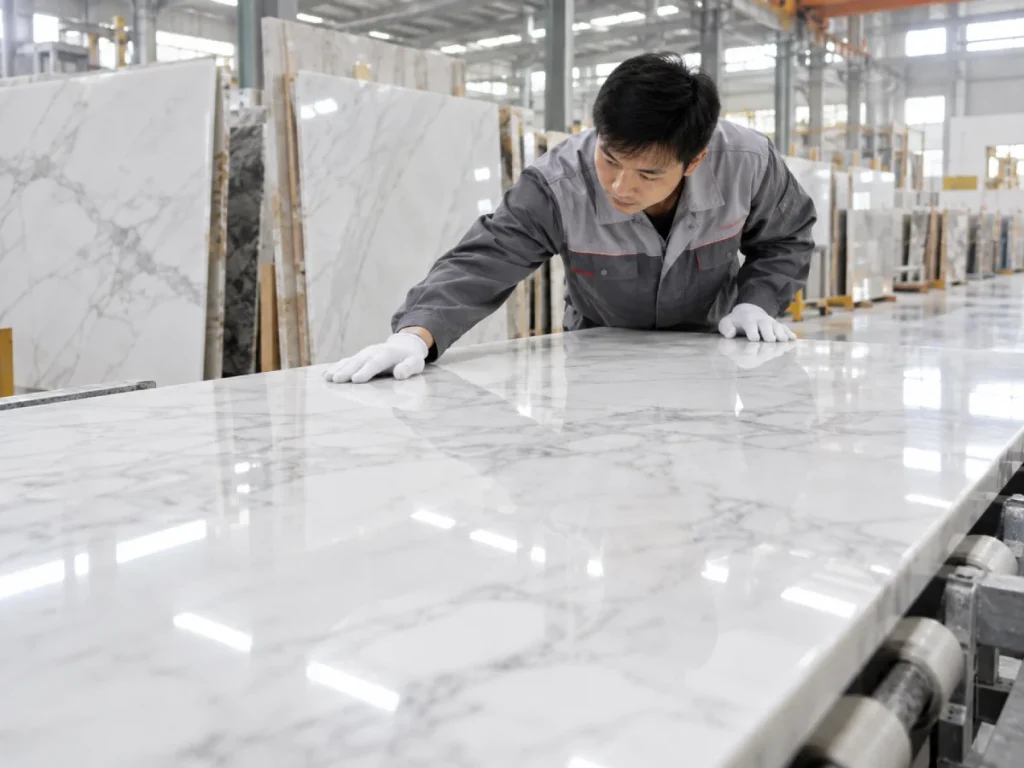
Why White Marble Makes Epoxy Color Problems So Visible
White marble acts almost like a visual background for the resin applied to it. Small color differences that would disappear inside dark granite can become easy to see against a bright, translucent or lightly veined surface.
Low contrast tolerance
White marble has very little tolerance for amber, brown, gray, or dark repair zones.
An epoxy does not need to become strongly yellow before a buyer notices a difference. A small shift may be enough to create a visible line around a crack, seam, filled pore, or repaired edge.
This is especially important in premium architectural slabs where a large polished surface will be viewed under bright interior lighting.
Translucency can amplify penetration differences
Many white marbles have some degree of translucency. When resin enters the stone, it changes how light travels through the treated area.
This can create a darker or “wet” appearance even if the resin itself has not chemically yellowed.
For this reason, buyers should not automatically diagnose every darker repair mark as epoxy yellowing.
Porosity varies between marble types
Some white marbles are dense and crystalline. Others are softer, more porous, or contain open micro-fissures.
A low-viscosity epoxy that performs well on a hard marble may penetrate too far into a more absorbent slab, producing visible shadowing around the repair.
This is one reason the same resin should not automatically be used on every white marble variety.
What Is Epoxy Yellowing?
True epoxy yellowing is a chemical color change within the polymer system itself.
During aging, UV exposure, elevated temperature, oxygen exposure, or other environmental stresses, chemical changes can occur in the cured polymer. Research on epoxy degradation has associated yellowing with oxidative reactions and the formation of chromophoric structures that absorb visible light differently from the original resin.
The practical result is a cured material that gradually changes from clear or nearly colorless toward yellow, amber, or brown.
This can be particularly damaging on white marble because the resin may be visible inside cracks, pores, seams, or surface-treated zones.
Yellowing can happen during processing or later in service
Some color changes are visible soon after mixing or curing.
Others develop after exposure to heat, light, oxygen, humidity, or extended service conditions.
For a stone factory, this means a 30-minute sample inspection is not enough to evaluate color stability.
“Non-yellowing” should not be interpreted as zero change forever
Commercial product names often use terms such as non-yellowing, UV stable, or very low yellowing.
From a technical purchasing perspective, these terms should be understood as improved resistance to color change under defined conditions rather than a guarantee that a polymer can never age.
The better question is:
How much color change occurs under the temperatures, lighting conditions, thicknesses, and exposure period relevant to the intended project?
Buyer takeaway: For premium white marble, ask for yellowing-resistance data or representative aging tests rather than relying only on the word “clear.” A resin can look transparent on day one and still be unsuitable for a highly color-sensitive application.
Yellowing, Staining and Water Marks Are Not the Same Problem
White marble processors often use the word “yellowing” to describe several different visual defects. Correct diagnosis matters because the solution changes depending on the cause.
| Visible Problem | Likely Mechanism | Typical Appearance | What to Check First |
|---|---|---|---|
| True epoxy yellowing | Polymer discoloration during cure or aging | Clear resin gradually becomes yellow or amber | Resin/hardener chemistry, UV exposure, heat and aging performance |
| Staining | Contamination or chemical interaction near the stone surface | Localized color mark around treated area | Surface cleanliness, resin compatibility and contaminants |
| Shadowing | Resin penetration changes optical appearance of the marble | Dark or wet-looking zone around cracks or pores | Penetration depth, viscosity and stone porosity |
| Water-mark effect | Uneven absorption or optical change around porous zones | Halo-like or irregular darker pattern | Marble absorbency and penetration control |
| Surface residue | Too much resin remains on the marble face | Gloss, amber film or uneven patch after cure | Application quantity, scraping and finishing process |
| Processing discoloration | Heat, contamination, moisture or incorrect cure conditions | Uneven coloration after factory processing | Temperature, mix ratio, tools and curing conditions |
This distinction is especially important for soft white marble.
A very clear epoxy can still create an unacceptable dark halo if it penetrates too deeply. In that case, buying an even clearer resin does not solve the real problem. The factory needs better control of penetration.
What Causes Epoxy to Yellow on White Marble?
UV exposure and photo-oxidation
Ultraviolet radiation is one of the best-known aging stresses for epoxy materials.
Studies of epoxy under UV exposure have documented progressive color deepening, surface degradation, and chemical changes associated with photo-oxidation.
The effect is often strongest near the exposed surface because UV energy does not penetrate an infinitely deep polymer section.
For stone processing, this matters most when epoxy remains close to the exposed marble surface or when the finished installation receives significant natural or artificial UV exposure.
Heat and thermal oxidation
Elevated temperature can accelerate chemical reactions associated with polymer aging.
A resin that remains visually acceptable under moderate indoor conditions may behave differently when exposed to higher processing temperatures, heated production lines, direct sunlight, or high-temperature service environments.
This is why yellowing resistance should be assessed together with the factory’s curing temperature.
Veropoxy’s Epoxy Resin for Marble Repair & Color Enhancement, for example, is positioned for approximately 28–38°C marble processing and lists high yellowing resistance as part of the formulation requirements.
Resin and hardener chemistry
The epoxy resin itself is only one part of the system.
The hardener can strongly influence initial color, curing behavior, oxidation resistance, and long-term appearance.
This is why buyers should evaluate the complete A+B formulation rather than comparing resin component clarity while ignoring the curing agent.
A perfectly clear resin mixed with a strongly colored or poorly matched hardener does not produce a visually neutral system.
Incorrect mixing ratio
Changing the specified ratio can affect cure quality and leave an imbalanced system.
This may lead to incomplete cure, tackiness, uneven hardness, or inconsistent optical behavior.
Adding extra hardener to “make the epoxy cure faster” is therefore a poor method for controlling production speed, especially when working with premium white marble.
Excessive heat during cure
Large mixed batches can generate more exothermic heat than thin applications.
If the resin becomes excessively hot in the container or repair zone, the combination of higher temperature and accelerated reaction can alter handling behavior and potentially increase discoloration risk.
Factories should therefore follow the recommended batch size, mixing method, and temperature range rather than assuming that all epoxy behaves the same at any volume.
Long-term aging
A resin can initially appear water-clear and still change over time.
This is why accelerated aging studies are useful when visual purity is critical. Published research on epoxy-treated stone has shown that appearance change, including yellowing or darkening, can become a limiting factor when selecting consolidants or repair materials.
Why Excessive Penetration Can Look Like Yellowing
On white marble, the resin does not have to become yellow to create a visible defect.
When clear liquid penetrates a porous material, it can change the refractive behavior of the stone. A treated region may become darker, more saturated, or more translucent.
That optical change can remain after cure.
Hard white marble and soft white marble behave differently
Dense crystalline white marble may tolerate a penetration-focused system because the resin primarily follows fine cracks and structural discontinuities.
Softer or more porous marble can absorb resin into a wider zone.
The result can be a dark halo that appears similar to a water mark.
Veropoxy’s Non-Staining Epoxy for White Marble addresses this specific problem through controlled penetration rather than simply relying on resin transparency. The current published specification lists 400–600 CPS viscosity, approximately 80-minute curing, very low yellowing, and a recommended working temperature around 24°C.
More penetration is not automatically better
Deep penetration is valuable when the goal is structural reinforcement.
But when the visual requirement is an almost invisible repair on a sensitive white marble, uncontrolled penetration can become a defect.
This is why the “lowest possible viscosity” strategy does not automatically work for white stone.
How to Choose Epoxy for Hard White Marble
Hard white marble generally has a denser structure than softer, highly absorbent varieties.
The epoxy still needs sufficient penetration to reinforce micro-cracks, but the purchasing focus should remain strongly on color stability.
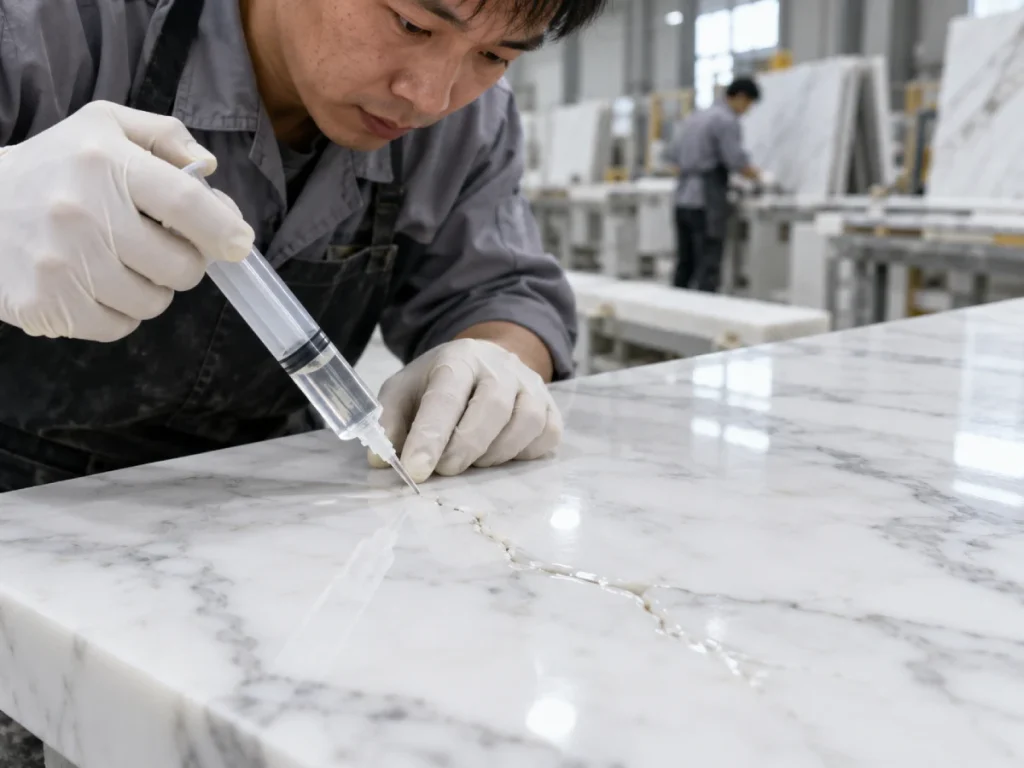
Prioritize very low yellowing
For high-end white slabs, visual stability should be treated as a core specification rather than an optional marketing benefit.
Veropoxy’s Non-Yellowing Epoxy for Hard White Marble – 5090 / D30M-BS is specifically positioned around this requirement.
The current product specification lists:
- hard white marble as the target substrate;
- very low yellowing;
- controlled penetration;
- 100:30 resin-to-hardener ratio;
- approximately 80-minute cure time;
- approximately 24°C recommended working temperature; and
- 400–600 CPS viscosity.
These numbers should be treated as a system, not as independent selling points.
A buyer should confirm whether the combination provides enough penetration for the actual slab while preserving the required appearance after cure and polishing.
How to Choose Epoxy for Soft or Porous White Marble
For soft white marble, the risk profile changes.
The buyer still needs good yellowing resistance, but penetration control becomes just as important.
Prioritize non-staining behavior
If resin spreads far beyond the crack or treated pore, the resulting optical shadow can be more visible than the original defect.
For this situation, a system specifically designed around controlled penetration is more appropriate than simply selecting the thinnest resin available.
Test for edge darkening
Apply the resin to representative cracks and porous zones, then inspect the boundaries around the treated area.
If a dark edge develops outside the intended repair zone, reduce penetration or change the formulation before scaling production.
Inspect after polishing
A wet or freshly cured slab can hide visual differences.
The real acceptance test should come after the normal polishing process because polishing changes gloss, surface reflection, and the visibility of repaired zones.
Hard White Marble vs Soft White Marble: Buyer Decision Table
| Decision Factor | Hard White Marble | Soft / More Absorbent White Marble |
|---|---|---|
| Main visual risk | Yellowing and visible repair lines | Staining, shadowing, water marks and over-penetration |
| Primary resin priority | Very low yellowing plus controlled crack penetration | Non-staining behavior plus controlled absorption |
| Viscosity strategy | Enough flow to enter micro-cracks | Avoid excessive penetration beyond the repair area |
| Sample test focus | Color change after cure and aging | Halo formation and penetration width |
| Finishing check | Repair visibility after polishing | Dark edges, wet-look areas and uneven brightness |
| Veropoxy example | 5090 / D30M-BS | Non-Staining / D30M-BS |
How UV Exposure Changes the Epoxy Selection
Interior stone and exterior stone do not experience the same aging environment.
Indoor white marble
Indoor applications may receive less direct solar UV, but that does not remove the need for color stability.
Large windows, skylights, display lighting, and long service periods can still make a poor resin visually noticeable.
High-end lobbies, hotels, luxury residential interiors, retail environments, and furniture applications can be especially demanding because buyers inspect the surface at close range.
Exterior or high-light exposure
For outdoor or strongly illuminated applications, UV resistance becomes much more important.
General epoxy materials are not automatically equivalent to exterior clear coatings designed around prolonged UV exposure.
If exposed epoxy will remain visible at the stone surface, buyers should verify whether the selected system has aging data relevant to the expected environment.
For exposed clear bonding applications outside the white-marble reinforcement process, Veropoxy also lists a UV Stable Crystal Clear Epoxy Mastic within its broader product range. Product function still needs to match the actual stone-processing requirement rather than being selected based on the word “UV” alone.
How Temperature Affects White Marble Color Stability
Temperature affects both cure kinetics and the risk of visual inconsistency.
If the same epoxy is applied in a 15°C workshop one month and at 35°C in another season, flow, working time, penetration depth, and curing rate can all change.
Those changes can affect appearance even when the chemistry itself has not significantly yellowed.
High temperature can change penetration
Warmer epoxy generally flows more easily.
On porous white marble, this can increase absorption and enlarge the visible treated zone.
High temperature shortens the working window
A faster reaction may reduce the time operators have to scrape away excess resin or level the surface consistently.
Uneven residue can then create visible differences after polishing.
Cold conditions can create their own defects
At lower temperatures, resin becomes thicker and may not fully penetrate fine cracks.
The result can be incomplete reinforcement or obvious surface filling instead of a clean internal repair.
For these reasons, temperature should be recorded during every white-marble qualification trial.
How to Test a Low-Yellowing Epoxy Before Bulk Production
Supplier data is useful, but white marble should always be qualified on the buyer’s own stone.
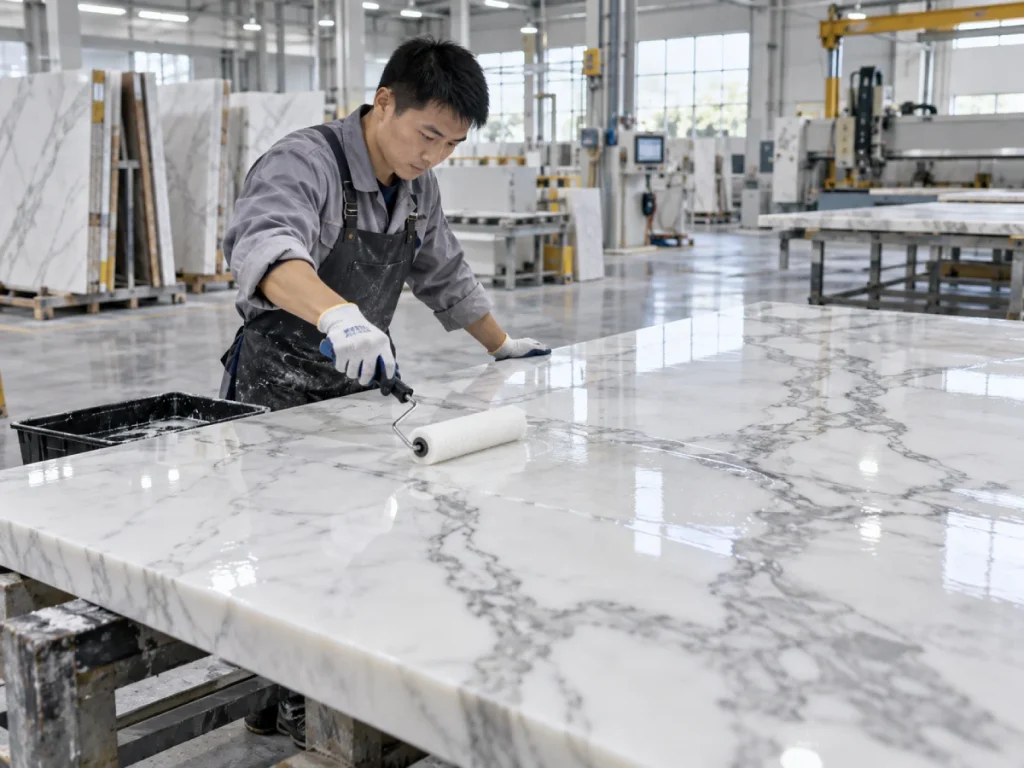
Step 1: Select representative slabs
Do not test only on the cleanest, densest sample.
Include typical production variation:
- dense slabs;
- more porous slabs;
- slabs with fine cracks;
- slabs with open pores;
- bright white areas; and
- strongly veined areas.
Step 2: Record the initial stone color
Photograph the slab under controlled lighting before application.
For more demanding production, use a colorimeter and record L*, a*, and b* values at defined locations.
Consistent measurement makes it easier to distinguish a real color shift from differences in photography or lighting.
Step 3: Mix exactly according to specification
Use the specified A: B ratio.
Do not adjust hardener quantity to control cure speed or viscosity.
Record:
- resin batch number;
- hardener batch number;
- mix ratio;
- ambient temperature;
- stone temperature;
- batch size; and
- mixing time.
Step 4: Apply a controlled quantity
Excess material creates a misleading comparison.
Use the same application quantity and technique for each candidate resin.
Step 5: Inspect penetration boundaries
Before cure is complete, observe how far the resin moves beyond the crack or treatment zone.
On soft marble, excessive penetration is an immediate warning sign.
Step 6: Allow complete cure
Do not judge the resin immediately after application.
The color of a freshly mixed epoxy can differ from the final cured state.
Step 7: Polish the slab
Run the test slab through the same abrasive sequence used in production.
Then compare:
- overall brightness;
- crack visibility;
- dark halos;
- yellow tone;
- surface residue;
- gloss difference; and
- repair boundaries.
Step 8: Perform aging tests when the project justifies them
For premium projects, export programs, or applications with significant light exposure, consider controlled accelerated aging or comparative UV testing.
The purpose is not to predict an exact number of service years from a short laboratory test. It is to compare candidate formulations under the same exposure conditions and identify which system changes color more rapidly.
White Marble Epoxy Qualification Checklist
| Test Item | What to Evaluate | Why It Matters |
|---|---|---|
| Initial resin color | Clarity and amber tone after mixing | Visible resin color can immediately affect white stone |
| Penetration width | Distance beyond crack or pore | Excess penetration can create dark halos |
| Cured color | Appearance after complete cure | Wet resin appearance may not represent final color |
| Polished appearance | Gloss, repair visibility, and shadowing | Final acceptance happens after finishing |
| Heat stability | Color change under actual processing temperature | Important for warm or heated production lines |
| UV / aging comparison | Relative yellowing after controlled exposure | Useful for long-term color-sensitive projects |
| Batch consistency | Repeat results across multiple lots | One perfect sample does not guarantee stable production |
| Stone compatibility | Results on actual marble variety | Different marbles absorb resin differently |
Common Mistakes That Cause Visible Problems on White Marble
Choosing epoxy only because it looks clear in the container
Initial transparency is not the same as long-term yellowing resistance.
The buyer needs to evaluate the mixed and cured system, not just Component A.
Using the same epoxy for hard and soft white marble
This can work on some stones and fail badly on others.
Soft marble may require substantially tighter penetration control.
Assuming every dark mark is yellowing
A gray or wet-looking halo around a repair is often an absorption or optical problem rather than chemical yellowing.
Correct the diagnosis before changing products.
Choosing the lowest viscosity available
Low viscosity helps micro-crack penetration but can increase shadowing in highly absorbent white stone.
Ignoring workshop temperature
Temperature changes viscosity, reaction speed, working time, and penetration behavior.
A resin qualified in winter should not automatically be accepted for peak summer production without confirmation.
Leaving excess resin on the surface
Thick surface residue is more visible and receives more direct light exposure than resin located inside a crack.
Control scraping, leveling, and polishing rather than allowing unnecessary resin film to remain.
Changing the mixing ratio
Do not attempt to reduce yellowing, increase clarity, or control cure speed by changing the specified A:B ratio.
Use a formulation designed for the required condition.
Skipping aging evaluation for premium projects
A sample that looks good after one day may not represent long-term performance.
For high-value white marble, accelerated comparison testing can be a sensible part of supplier qualification.
How to Match the Epoxy System to Different White Marble Conditions
| Production Situation | What to Prioritize | Why |
|---|---|---|
| Dense hard white marble | Very low yellowing plus controlled penetration | Color stability is critical while fine cracks still need reinforcement |
| Soft porous white marble | Non-staining performance and limited penetration | Reduces shadowing and water-mark effects |
| High-end polished slab | Extra-clear cured appearance and polishing compatibility | Minor visual defects become obvious after finishing |
| Warm production environment | Stable curing chemistry at actual workshop temperature | Heat changes working time and penetration behavior |
| UV-exposed project | Verified aging and color-stability performance | UV accelerates surface degradation in many epoxy systems |
| Deep structural crack | Enough penetration without excessive halo formation | Structural reinforcement and appearance must be balanced |
| Surface pore filling | Controlled flow and minimal residual film | Reduces visible color and gloss differences |
What Buyers Should Ask an Epoxy Supplier
A white-marble purchasing specification should go beyond “Is it non-yellowing?”
Ask:
- Is the system designed for hard or soft white marble?
- What is the mixed viscosity?
- At what temperature was viscosity measured?
- What is the resin-to-hardener ratio?
- What is the recommended working temperature?
- What is the working time and cure time?
- How is yellowing resistance evaluated?
- Does the system control penetration on porous marble?
- Can the supplier provide samples for testing on our stone?
- Is performance consistent between production batches?
Veropoxy’s broader stone epoxy product range separates different marble-processing requirements instead of positioning one universal epoxy for every stone condition. That is the right general direction for professional purchasing: start from the application problem and stone structure, then select the resin system.
Recommendation: Control Color Stability and Penetration Together
Preventing visible defects on white marble requires two different controls at the same time.
The first is chemical color stability.
The epoxy should use resin and hardener chemistry appropriate for color-sensitive stone, with verified low-yellowing performance under the intended processing and service conditions.
The second is physical penetration control.
The resin must enter cracks and pores sufficiently to reinforce without spreading so far into the marble that it creates dark halos or wet-looking zones.
If the marble is hard and dense, a very-low-yellowing penetration system may be the better direction.
If the marble is soft and absorbent, prioritize non-staining performance and controlled penetration.
If the installation will receive substantial UV or heat exposure, do not rely only on initial clarity. Request relevant aging information or conduct comparative testing.
And if a repair looks dark but the epoxy itself remains clear, investigate penetration and stone optics before blaming polymer yellowing.
Frequently Asked Questions About Epoxy Yellowing on White Marble
1. Why does epoxy turn yellow on white marble?
Epoxy can yellow because of polymer aging associated with UV exposure, heat, oxidation, resin and hardener chemistry, and other environmental conditions. White marble makes relatively small color changes highly visible. However, not every dark or discolored area is true epoxy yellowing; excessive penetration, staining, and optical shadowing can create similar-looking defects.
2. Is there a completely non-yellowing epoxy resin?
Commercial products may be described as non-yellowing or very low yellowing, but buyers should interpret these terms as improved color stability under defined conditions rather than proof that no change can ever occur. For demanding projects, compare aging performance and test the complete resin-hardener system on the actual white marble.
3. What epoxy should be used for hard white marble?
Hard white marble generally benefits from a very-low-yellowing epoxy with controlled penetration, high clarity, and enough flow to reinforce fine cracks. Veropoxy’s 5090 / D30M-BS system is specifically positioned for hard white marble and lists very low yellowing, 400–600 CPS viscosity, a 100:30 ratio, and approximately 80-minute curing at around 24°C.
4. Why does clear epoxy create a dark mark on soft white marble?
The problem may be over-penetration rather than chemical yellowing. Resin can change how light travels through porous marble, creating a wet-looking or darker halo around the treated zone. For soft white marble, use a system designed for controlled penetration and non-staining behavior.
5. How should a factory test epoxy before using it on white marble?
Test the epoxy on representative production slabs at realistic factory temperatures. Record the mixing ratio and application quantity, inspect penetration boundaries, allow complete cure, polish the slab using the normal process, and compare color, brightness, yellow tone, shadowing, repair visibility, and gloss. For high-value projects, add comparative heat or UV aging tests before bulk approval.
How to Keep White Marble Repairs Visually Stable Over Time
Long-term visual stability on white marble depends on more than resin transparency. A successful epoxy system must combine low-yellowing chemistry, controlled penetration, correct curing, consistent mixing, and compatibility with the specific marble structure. Buyers should judge the finished and aged stone—not only the appearance of liquid epoxy in a container.
First identify the real defect
A yellow repair zone may indicate polymer discoloration, but a darker halo can come from excessive penetration, surface residue, moisture-related optical change, or staining. Treating every visual problem as “yellowing” can lead a factory to change the wrong variable.
Match the resin to the marble structure
Hard, dense white marble:
prioritize very-low-yellowing chemistry, transparency, and enough controlled penetration to reinforce micro-cracks.
Soft or porous white marble:
prioritize non-staining behavior and penetration control so the repair does not create dark halos or water-mark effects.
High-temperature production:
verify color stability and curing behavior at the actual stone and workshop temperature.
UV-exposed projects:
ask for relevant aging performance or conduct controlled comparison tests rather than judging only initial clarity.
Premium polished surfaces:
inspect the resin after full curing and final polishing because wet appearance alone cannot predict the finished slab.
Why sample testing matters more on white marble
White marble varieties differ in porosity, translucency, veining, crack structure, and absorption behavior. A resin that is visually acceptable on one slab may produce shadowing on another. Supplier data should therefore be used to shortlist products, while real-stone testing should make the final approval decision.
What is changing in professional white-marble processing?
Professional processors are gradually moving away from generic “clear epoxy” toward application-specific systems. Dense white marble, porous white marble, warm-climate production, high-visibility architectural surfaces, and UV-exposed installations each place different demands on resin chemistry and penetration behavior. This makes application data, aging performance, and sample qualification increasingly important parts of supplier evaluation.
Practical Recommendation
If the epoxy itself becomes amber, prioritize a more color-stable resin and hardener system. If the marble develops a dark halo while the cured resin remains clear, reduce penetration and investigate stone absorbency. If temperature or UV exposure is high, qualify the system under those actual conditions. If visual purity is critical, test on the real marble, complete the normal curing and polishing process, and compare the finished slab before approving bulk supply. The best white-marble epoxy is not simply the clearest liquid—it is the formulation that remains structurally effective and visually unobtrusive throughout processing and service.
Need to Test an Epoxy System on Your White Marble?
White marble varies significantly in density, porosity, translucency, and crack structure. Before bulk purchasing, test the epoxy on your actual Carrara, Calacatta, Statuario, or other white marble and evaluate penetration, yellowing, shadowing, curing behavior, and polished appearance under real factory conditions.
Request a White Marble Epoxy Sample
References
- Charles Selwitz.
Epoxy Resins in Stone Conservation.
Getty Conservation Institute.
Research in Conservation Series, Getty Publications, 1992. - William S. Ginell and Richard Coffman.
Epoxy Resin-Consolidated Stone: Appearance Change on Aging.
Getty Conservation Institute.
Studies in Conservation, Vol. 43, No. 4, 1998, pp. 242–248. - Elena Tesser, Lorenzo Lazzarini and Susanna Bracci.
Investigation on the Chemical Structure and Ageing Transformations of the Cycloaliphatic Epoxy Resin EP2101 Used as Stone Consolidant.
Università Iuav di Venezia and National Research Council of Italy.
Journal of Cultural Heritage, 2018. - Chao Wu, Bing Chen Meng, Lik-ho Tam and Li He.
Yellowing Mechanisms of Epoxy and Vinyl Ester Resins under Thermal, UV and Natural Aging Conditions and Protection Methods.
Research institutions including Beihang University.
Polymer Testing, Vol. 114, 2022, Article 107708. - Seungyeon Lee, Seung Jun Oh and Koang-Chul Wi.
Preparation and Physical Properties of Epoxy with Improved Yellowing Resistance for the Preservation of Stone Cultural Heritage.
Hanseo University.
Conservation Science in Museum, National Museum of Korea, Vol. 26, 2021, pp. 1–12. - Shengzong Ci, Baoming Wang, Chengrui Di, Mingyu Wang, Bo Zhu and Kun Qiao.
Effect of Ultraviolet Aging on Properties of Epoxy Resin and Its Pultruded Fiber-Reinforced Composite.
Shandong University and Weihai Research Institute of Industrial Technology.
Polymers, Vol. 17, No. 3, 2025, Article 294. - WEST SYSTEM Technical Staff.
WEST SYSTEM User Manual & Product Guide.
Gougeon Brothers, Inc.
WEST SYSTEM Technical Publications. - Bruce Burton.
Strategies for Reducing Amine-Cured Epoxy Yellowing in Decoupage and Decorative Coatings.
Huntsman Corporation.
Thermoset Resin Formulators Association Technical Paper, 2019.