

Quick Summary:
Epoxy resin curing time is strongly influenced by temperature, but buyers should not treat temperature as the only variable. Pot life, working time, gel time, handling strength, polishing readiness, and full cure describe different stages of the curing process. Warmer conditions generally accelerate epoxy reactions and shorten the usable working window, while colder conditions slow reaction and can delay strength development or leave standard systems under-cured. For stone factories, the best epoxy is therefore not simply the fastest-curing product. It is the formulation whose working time, penetration, application temperature, handling time, and final cure match the actual production line. If your workshop runs near 10°C, use a system formulated for low-temperature curing. If the plant regularly operates above 28°C or even 38–45°C, use a temperature-specific formulation designed to maintain controlled reactivity under those conditions.
“How long does epoxy take to cure?” sounds like a straightforward question. In a stone factory, it rarely has a straightforward answer.
A technical data sheet may state 50 minutes, 60 minutes, or 80 minutes. Yet a production manager may find that the same resin becomes noticeably thicker after 20 minutes, a slab still feels too soft to move after the stated time, or a product that works perfectly in spring becomes difficult to control during summer.
The reason is simple: epoxy curing is a chemical reaction, not a timer built into the bucket.
Temperature, resin-hardener chemistry, batch size, mixing ratio, film thickness, stone temperature, application method, and the amount of heat retained by the mixed resin all affect how quickly the system progresses from a workable liquid to a gel and finally to a hardened network.
For professional stone processors, the practical question is therefore not just “What is the epoxy resin curing time?” It is:
How much usable working time do we have, when can the slab safely move to the next process, and will the resin reach the required final properties under our actual factory temperature?
Veropoxy’s current stone epoxy product range shows why this distinction matters. Different formulations are positioned for winter mesh backing, high-temperature mesh backing, warm-climate marble repair, and marble processing at temperatures as high as 38–45°C. Similar-looking A/B systems can therefore have very different curing strategies.
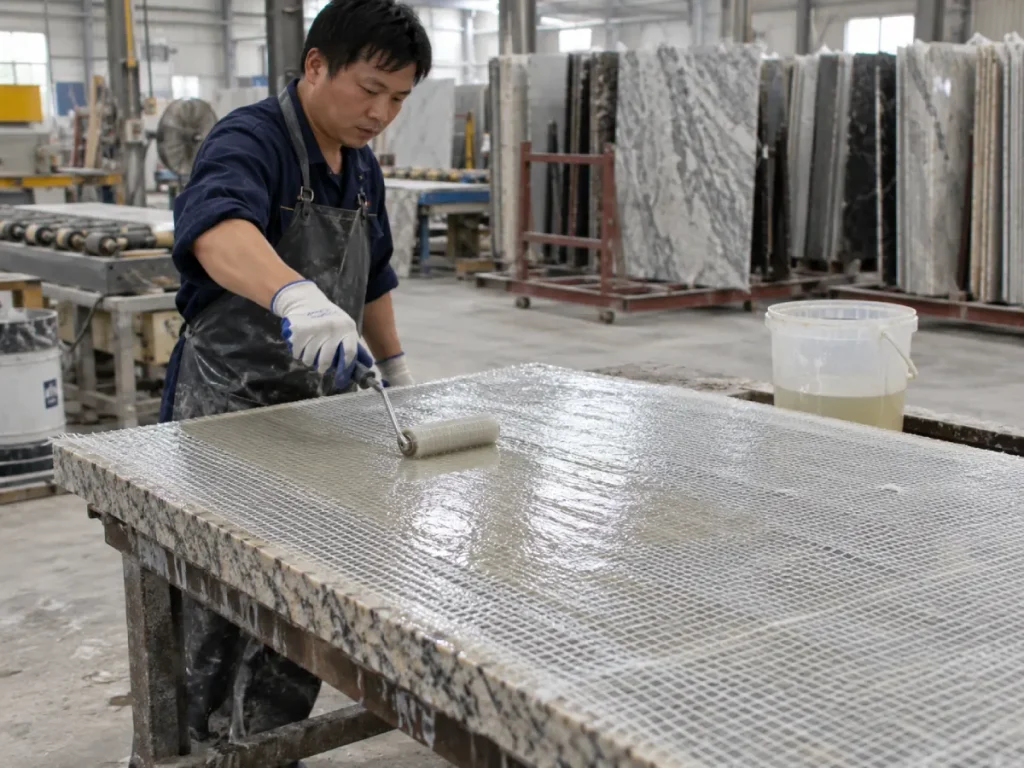
What Does Epoxy Resin Curing Time Actually Mean?
One of the biggest sources of confusion in epoxy purchasing is that several different time terms are often treated as if they mean the same thing.
They do not.
Pot life
Pot life describes how long a defined mass of mixed resin and hardener remains usable in a container under specified conditions.
This is particularly important because a larger mass of epoxy can retain more reaction heat. As the reaction accelerates, the material heats further, which may accelerate the reaction again. This exothermic behavior means epoxy sitting in a deep mixing bucket can lose usability significantly faster than the same material spread in a thin film over a stone slab.
For this reason, a published pot life must be read together with the test temperature, batch mass, and container geometry.
Working time or open time
Working time is the practical period available for mixing, spreading, scraping, rolling, mesh impregnation, crack penetration, vacuum treatment, adjustment, or assembly.
This is often more useful to a stone factory than pot life.
An epoxy may still be technically liquid in the mixing container but may already have increased enough in viscosity that it no longer penetrates fine marble or granite cracks effectively.
For a vacuum process, the relevant working window ends when resin flow becomes too slow for reliable infusion, not necessarily when the material finally gels.
Gel time
Gel time describes the transition from a mobile liquid toward a gelled state. Once the system reaches this stage, meaningful penetration or leveling is normally over.
A stone processor should therefore not confuse gel time with available application time.
Handling cure
This is the point at which the bonded or reinforced slab has developed enough integrity for a defined handling step.
Depending on the process, that might mean moving the slab, removing it from a backing station, placing it on a cart, or transferring it to another production stage.
Handling cure is not necessarily full cure.
Polishing or machining readiness
Stone plants often care more about this stage than about a laboratory definition of “cure.”
If the epoxy is too soft when grinding begins, abrasive action can pull material from repaired cracks, smear the resin, expose pinholes, or produce uneven polish around treated areas.
The useful production question is therefore: when can the slab safely enter calibration, grinding, polishing, cutting, or transport without damaging the repair?
Full cure
Full cure refers to the stage when the resin system has progressed sufficiently toward its intended final properties.
Depending on formulation, the time required to reach final mechanical, chemical, thermal, or dimensional performance may be considerably longer than the initial handling time stated on a product sheet.
Buyer takeaway: Never ask a supplier only for “curing time.” Ask what that number actually represents: gel time, handling time, polishing readiness, or full cure.
Why Temperature Changes Epoxy Curing Time
Epoxy curing normally involves a reaction between resin and hardener. As temperature increases within the formulation’s acceptable range, molecular movement and reaction rate generally increase. The resin therefore progresses through its liquid, gel, and solid stages more quickly.
When temperature falls, the opposite usually happens. Reaction slows, viscosity increases, spreading becomes more difficult, and the system may require much longer to develop sufficient strength.
This is why the same standard formulation can behave acceptably in a 25°C workshop but become impractically slow at 10°C.
Warmer conditions usually shorten working time
Higher temperature can be useful when a production line needs a faster turnaround, but it also creates risks.
The operator has less time to mix and distribute resin. Vacuum penetration may be interrupted too early. Mesh backing teams may struggle to maintain uniform wetting across large slabs. Resin left in a bucket may heat up rapidly.
WEST SYSTEM technical guidance, for example, notes that temperature has a strong effect on pot life and gives an approximate example in which a 10°C increase can cut pot life roughly in half for its system.
That is useful as a reminder of how sensitive epoxy chemistry can be, but it should not be treated as a universal formula for every industrial epoxy. Each resin-hardener combination has its own reaction profile.
Cold conditions can cause more than slow production
Cold weather is not merely inconvenient.
If the selected system is not designed for low-temperature cure, the practical consequences can include:
- very long waiting times before slab handling;
- poor mesh-backing productivity;
- higher uncured resin viscosity;
- reduced penetration into micro-cracks;
- soft or tacky surfaces;
- delayed strength development;
- unpredictable polishing readiness; and
- greater variation between morning, afternoon, and night shifts.
This is why a dedicated winter-grade formulation may be more effective than simply waiting longer for a standard summer resin.
Pot Life, Working Time and Cure Time: Why Buyers Should Separate Them
| Term | What It Describes | Why It Matters in Stone Processing | Common Buyer Mistake |
|---|---|---|---|
| Pot Life | Usable life of a defined mixed mass in a container | Helps estimate how quickly a mixed batch must be consumed | Assuming pot life equals the full application window |
| Working / Open Time | Period when the epoxy can still be effectively applied | Critical for spreading, penetration, mesh wetting and infusion | Continuing application after flow has already deteriorated |
| Gel Time | Transition toward a non-flowing gel | Marks the end of meaningful penetration or leveling | Treating gel time as the moment the slab is ready to polish |
| Handling Cure | Stage when the part can tolerate a defined handling step | Determines when slabs can move to carts or the next station | Assuming handling strength means final strength |
| Polishing Readiness | Stage when cured resin can tolerate grinding or polishing | Critical for repair quality and surface consistency | Polishing too early because the surface feels dry |
| Full Cure | Development toward intended final properties | Relevant to long-term bonding and service performance | Assuming a short “cure time” means all properties are fully developed |
A professional TDS should ideally make these distinctions clear. If it does not, purchasing teams should ask the supplier before running a production-scale trial.
How Temperature Affects Epoxy on a Real Stone Production Line
Resin viscosity changes before curing even begins
Cold resin is normally thicker. This can reduce its ability to wet mesh fibers, enter fine cracks, spread across a large slab, or flow through a vacuum-assisted system.
Warmer resin normally flows more easily, but the faster reaction rate can reduce the time available to take advantage of that improved flow.
This creates an important trade-off:
A high-temperature shop may give excellent initial flow but too little working time. A cold shop may provide a long theoretical working window while the resin is physically too thick to penetrate efficiently.
This connection between temperature and viscosity is why the previous Veropoxy technical knowledge content should be considered together with application-specific curing requirements rather than as separate topics.
The stone temperature matters too
Factory air temperature is not the only temperature that matters.
Stone slabs can remain significantly colder or warmer than ambient air, especially when they have just come from outdoor storage, a heated drying line, direct sunlight, or a cold warehouse.
Applying epoxy to a cold slab can locally increase viscosity and slow reaction near the interface. Applying it to a very warm slab can reduce working time unexpectedly.
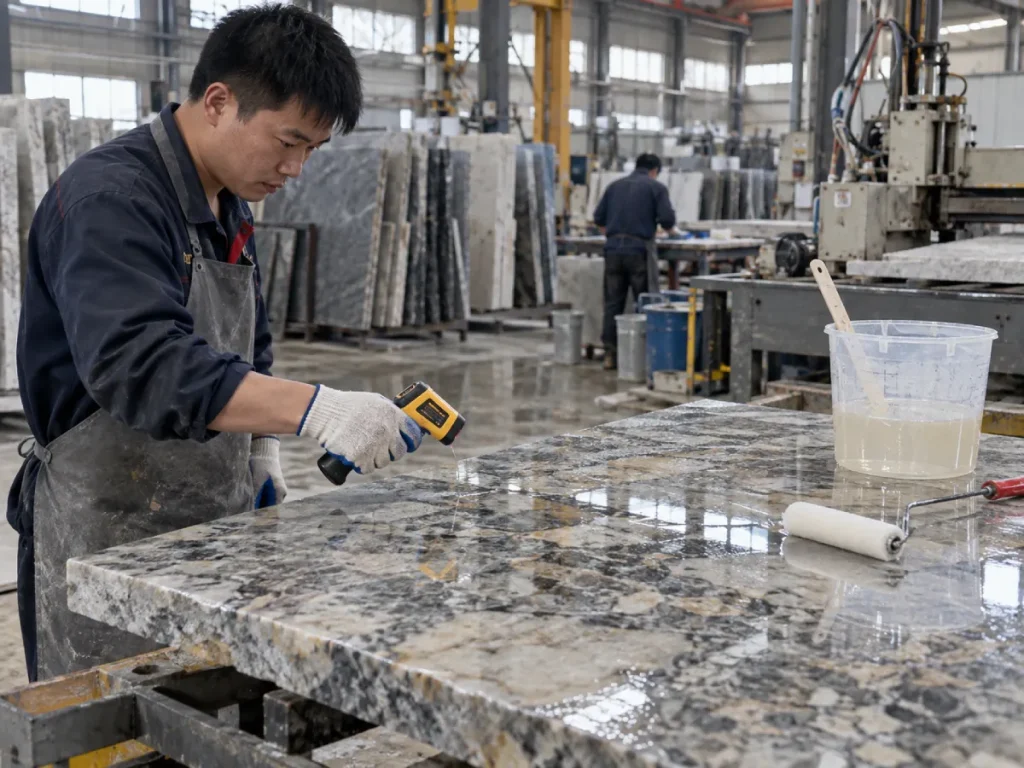
For consistent results, record both workshop temperature and stone surface temperature during trials.
Batch size changes the heat balance
Epoxy curing is exothermic. A large quantity sitting in a deep container tends to retain more heat than a thin layer spread over a stone slab.
This means a 5 kg mixed batch may not behave like a 200 g laboratory sample.
If a factory increases batch size without adjusting workflow, the epoxy may begin to react noticeably faster before operators finish applying it.
Cold, Moderate and Hot Workshops Need Different Curing Strategies
There is no single temperature table that applies to every epoxy formulation. The useful approach is to select a system specifically designed and tested around the factory’s production conditions.
| Production Condition | Main Risk | Preferred Formulation Strategy | Production Check |
|---|---|---|---|
| Cold workshop around 10°C | Slow reaction, high viscosity, delayed handling | Use a formulation designed for low-temperature curing | Verify mesh adhesion and handling time at actual winter temperature |
| Moderate workshop | Variation between shifts or slab temperatures | Use a system with a practical working window and stable cure profile | Track resin, slab and ambient temperature |
| Warm workshop around 28–38°C | Shorter working time and accelerated reaction | Use a warm-climate formulation with controlled reactivity | Confirm penetration and polishing readiness before line approval |
| Very hot processing around 38–45°C | Premature viscosity rise and short application window | Use high-temperature-specific resin and hardener chemistry | Measure time from mixing to the end of useful flow |
| Heated or drying line | Rapid heat build-up and uneven reaction | Use a system intended for elevated-temperature line curing | Validate line speed, slab temperature and transfer timing |
Real Veropoxy Examples: Why Similar Viscosity Does Not Mean Similar Cure Behavior
Veropoxy’s current product range provides a useful example of why buyers should evaluate viscosity, curing time, and temperature together.
Several products publish a viscosity around 400–600 CPS and a resin-to-hardener ratio of 100:25, yet their recommended temperature conditions and curing profiles differ.
| System | Published Temperature | Published Cure Time | Published Viscosity | Primary Application |
|---|---|---|---|---|
| 4090 / WBA25Q | Approximately 10°C | Approximately 50 minutes | 400–600 CPS | Low-temperature stone mesh backing |
| 4090 / BCO25Q-14 | 28°C+ / heated-line conditions | Approximately 60 minutes | 400–600 CPS | High-temperature stone mesh backing |
| 5099 / B25Q-KG | 28–38°C | Approximately 80 minutes | 400–600 CPS | Marble repair and color enhancement |
| 5089 / BCO25Q | 38–45°C | Approximately 80 minutes | 400–600 CPS | High-penetration colored marble processing |
These values should not be read as a head-to-head ranking because the products are designed for different stone applications and curing environments.
The point is more important: even when viscosity and mixing ratio appear similar, the hardener package and complete formulation can be engineered for very different production temperatures.
For cold mesh-backing operations, Veropoxy offers a Low Temperature Epoxy for Stone Mesh Backing formulated around approximately 10°C conditions.
For factories running in warmer workshops or drying-line environments, the High Temperature Odorless Epoxy for Stone Mesh Backing uses controlled high-temperature reactivity for 28°C+ conditions.
For warm-climate marble repair, the Epoxy Resin for Marble Repair & Color Enhancement is positioned for approximately 28–38°C processing, while the High Penetration Epoxy for Marble Slabs is designed for colored marble at approximately 38–45°C.
How Curing Time Changes Stone Production Efficiency
Fast cure sounds attractive because it can shorten cycle time. But the fastest formulation is not automatically the most productive one.
Too slow creates bottlenecks
If slabs must remain on racks or carts for hours longer than planned, a factory needs more storage space, more work-in-process inventory, and more production scheduling buffer.
For mesh backing, slow cure can delay slab turning, stacking, transport, or entry into the next operation.
For repair before polishing, the polishing line may sit idle or require extra slab buffering.
Too fast creates quality problems
A very fast reaction can reduce the usable application window before operators finish distributing the material.
Possible consequences include:
- uneven resin coverage;
- incomplete mesh wetting;
- shallow crack penetration;
- visible application boundaries;
- higher waste from epoxy gelling in containers;
- more frequent mixing of small emergency batches; and
- inconsistent quality between the first and last sections of a slab.
The correct target is process synchronization
The ideal cure profile allows enough time to complete the application properly and then develops handling strength quickly enough to keep the next production stage moving.
That means a factory should match epoxy kinetics to:
- slab dimensions;
- number of operators;
- manual versus automatic application;
- conveyor speed;
- vacuum-cycle duration;
- mesh application time;
- buffer capacity;
- polishing schedule; and
- seasonal temperature changes.
How Curing Time Affects Mesh Backing
Mesh backing is especially sensitive to the balance between flow and cure.
The resin needs enough open time to wet the reinforcing mesh and contact the stone surface uniformly. If it reacts too quickly, dry areas or incomplete fiber impregnation may remain. If it reacts too slowly, slabs occupy the backing station longer and may not be ready for transport when expected.
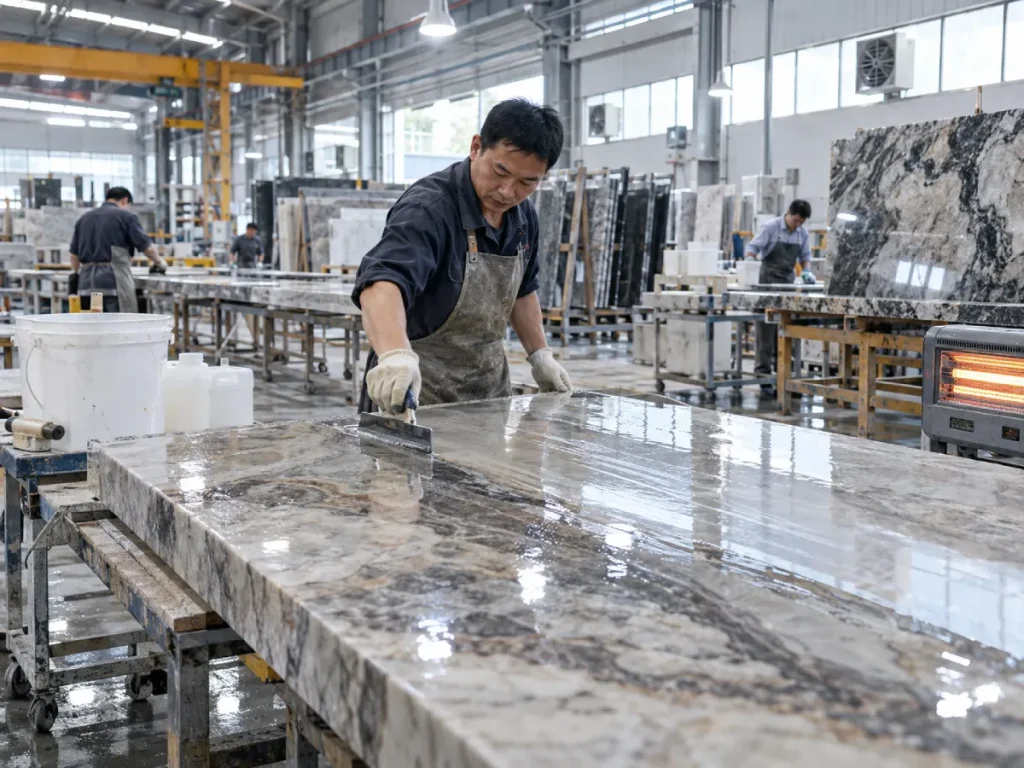
Winter mesh backing
In a cold workshop, using a standard formulation may lead to an apparently endless cure.
Operators sometimes respond by increasing the hardener quantity, applying uncontrolled external heat, or moving the slab too early. These shortcuts can create more variability than they solve.
A better solution is to use chemistry developed for the actual temperature range. Veropoxy’s winter-grade 4090 / WBA25Q mesh-backing system is specifically positioned for curing around 10°C.
Summer and heated-line mesh backing
At high temperature, the challenge reverses.
The resin may flow easily at first but begin reacting faster than operators expect. Large mixed batches can become especially problematic because exothermic heat builds in the container.
For these conditions, a controlled high-temperature formulation such as Veropoxy’s 4090 / BCO25Q-14 system is designed around elevated-temperature production and drying-line environments.
How Curing Time Affects Marble Crack Repair and Penetration
Marble repair introduces a different requirement. The resin often needs to flow into cracks or surface defects before the reaction advances too far.
A system that cures quickly but loses penetration ability halfway through the application can leave internal defects untreated.
In high-temperature marble processing, this becomes especially important because the stone itself may already be warm.
Warm-climate marble repair
Veropoxy’s 5099 / B25Q-KG marble repair and color-enhancement system is published for approximately 28–38°C conditions with an approximately 80-minute cure specification.
The important point is not the number “80” by itself. It is that the system is formulated around a warm-temperature application where the resin still needs enough useful flow for crack repair and surface treatment.
Very hot marble processing
For colored marble processed around 38–45°C, Veropoxy’s 5089 / BCO25Q high-penetration system is positioned for stable performance in much hotter conditions.
That illustrates a key buyer lesson: a high workshop temperature does not automatically mean you should accept an extremely short working window. A properly formulated high-temperature system can be designed to control the reaction instead of allowing it to run away.
How Curing Time Affects Vacuum Infusion
Vacuum-assisted stone treatment needs a different balance again.
The resin must remain mobile long enough to move through pores, cracks, and internal pathways while vacuum conditions draw it into the stone.
If gelation begins too early, penetration depth may become uneven. The area closest to the resin source may receive adequate material while more distant zones remain insufficiently treated.
This is why cure behavior should be evaluated together with viscosity and vacuum-cycle duration.
Veropoxy’s Vacuum Infusion Solutions focus on resin penetration into stone micro-pores and structural defects, while the company also offers a dedicated Low-Viscosity Epoxy Resin for Stone Vacuum Infusion.
For this application, selecting a resin solely because it “cures fast” can be exactly the wrong decision.
How to Match Epoxy Cure Behavior to Different Production Conditions
| If Your Production Situation Is… | Prioritize… | Reason |
|---|---|---|
| Workshop around 10°C | Low-temperature curing formulation | Standard systems may become too viscous and develop strength too slowly |
| Workshop above 28°C | Controlled high-temperature reactivity | Prevents the useful working window from becoming too short |
| Marble at 38–45°C | High-temperature penetration system | Maintains useful flow and controlled cure in hot stone-processing conditions |
| Large slabs applied manually | Longer usable open time | Operators need enough time to spread material consistently across the whole slab |
| Automated continuous line | Repeatable cure profile | Cycle consistency matters more than maximum speed |
| Vacuum infusion | Low viscosity plus adequate working time | The resin must remain mobile throughout the infusion cycle |
| Mesh backing | Wetting time plus predictable handling cure | Mesh must be impregnated before slabs can be safely moved |
| Repair immediately before polishing | Reliable polishing readiness | Premature grinding can expose or damage incompletely cured repair zones |
Why Epoxy Sometimes Cures Too Fast
The workshop is hotter than the trial condition
A resin approved during spring testing can behave very differently during peak summer temperatures.
If purchasing qualification never includes high-temperature testing, the production line may discover the problem only after bulk material arrives.
The mixed batch is too large
Large masses retain exothermic heat and can accelerate rapidly inside the mixing container.
Instead of mixing one oversized batch, production may need several smaller controlled batches, depending on supplier instructions and line requirements.
The resin remains in a deep container too long
Even when the total batch quantity is reasonable, container geometry matters. A deep narrow bucket retains reaction heat differently from a shallow tray or thin coating.
The stone is hotter than the air
Slabs arriving from a heated line, outdoor sun exposure, or warm storage can shorten the local working time at the stone-resin interface.
Why Epoxy Sometimes Cures Too Slowly
The substrate and resin are too cold
Cold ambient air is only part of the problem. Resin drums and stone slabs stored overnight in a cold environment may remain cold even after the workshop warms up.
The formulation is outside its recommended temperature range
A high-temperature or standard hardener may simply not provide practical curing at winter temperatures.
The mixing ratio is incorrect
Adding extra hardener is not a reliable way to make an epoxy cure faster.
Two-component epoxy systems are formulated around specific resin-to-hardener ratios. Moving away from that ratio can leave unreacted components, inconsistent hardness, surface tack, brittleness, or poor long-term performance.
Mixing is incomplete
Correct weighing does not help if the two components are not thoroughly blended.
Unmixed material at the sides or bottom of a container may remain soft even while the main batch appears to cure correctly.
Common Epoxy Curing Mistakes in Stone Factories
Choosing epoxy only by the shortest cure time
A shorter cycle is attractive until it reduces penetration, wetting, or application consistency.
Production efficiency should be measured as acceptable slabs per shift, not merely minutes printed on a TDS.
Assuming one hardener works equally well all year
A factory with a 10°C winter and a 35°C summer may need different curing strategies.
Trying to force one formulation across all seasons can create recurring quality adjustments.
Ignoring stone temperature
Air temperature may be 25°C while stone coming from outdoor winter storage is much colder. The reverse is possible after heated drying.
Changing the A:B ratio to control speed
This is a serious process-control mistake.
If cure speed is unsuitable, change the formulation or approved hardener system—not the specified stoichiometric ratio without technical validation.
Testing tiny samples but producing huge batches
Laboratory cup tests are useful, but exothermic behavior changes with mass.
A production trial should use realistic batch sizes, mixing equipment, slab dimensions, line speed, and application thickness.
Polishing as soon as the surface feels hard
Surface touch alone does not prove that the repair zone has reached sufficient machining strength.
The proper acceptance criterion should be based on actual grinding, polishing, or handling trials.
How to Test Epoxy Curing Time Before Bulk Ordering
Step 1: Record realistic factory temperatures
Do not test at an arbitrary laboratory room temperature if the factory normally operates much colder or hotter.
Record:
- morning workshop temperature;
- afternoon peak temperature;
- winter low temperature;
- summer high temperature;
- stone surface temperature; and
- resin component temperature.
Step 2: Use the specified mixing ratio
Measure resin and hardener accurately by the method stated in the TDS.
Step 3: Record pot behavior
Observe the mixed resin in the production container.
Record when temperature begins to rise, when viscosity noticeably increases, and when the batch becomes unsuitable for normal use.
Step 4: Measure useful application time on real stone
For crack repair, record when penetration becomes inadequate.
For mesh backing, record how long the resin remains easy to spread and fully wet the fibers.
For vacuum infusion, record whether useful flow remains available through the complete vacuum cycle.
Step 5: Determine handling readiness
Do not simply copy the supplier’s published time into your SOP.
Test when your own slabs can safely be moved, stacked, or transferred without disturbing the bonded or repaired area.
Step 6: Test polishing or machining readiness
Run the slab through the real finishing process.
Watch for:
- soft resin pull-out;
- smearing;
- pinholes;
- crack reopening;
- surface depression;
- uneven gloss; and
- visible repair boundaries.
Step 7: Repeat at both seasonal extremes
A product tested only at 23–25°C may tell you very little about January or August production.
If the factory experiences major seasonal variation, repeat trials under representative cold and hot conditions before approving annual supply.
Stone Factory Cure-Time Qualification Checklist
| Check | What to Record | Why It Matters |
|---|---|---|
| Ambient temperature | Actual workshop temperature during test | Provides context for all cure-time measurements |
| Stone temperature | Surface temperature before application | The slab may differ significantly from room temperature |
| A:B ratio | Actual weighed ratio | Prevents cure variation caused by dosing errors |
| Batch size | Total mixed mass | Larger masses can develop more exothermic heat |
| Container type | Depth and geometry | Affects heat retention and practical pot life |
| Useful working time | Minutes of acceptable spreading or penetration | More practical than gel time alone |
| Handling time | Time until slab can safely move | Determines real line throughput |
| Polishing readiness | Time until successful finishing | Prevents premature machining defects |
| Final appearance | Gloss, color, cracks and surface defects | Confirms cure speed did not sacrifice quality |
| Seasonal repeatability | Results under cold and hot conditions | Reduces production surprises after bulk purchase |
Recommendation: Choose a Cure Profile, Not Just a Cure-Time Number
The best epoxy for a stone factory is not necessarily the one that reaches an arbitrary cure milestone fastest.
The better system is the one that gives operators enough time to perform the process correctly and then develops handling and finishing strength at a predictable rate.
If the workshop is cold, use a formulation engineered to react reliably in the cold instead of changing the mixing ratio or accepting extremely long waiting times.
If the workshop is hot, choose controlled high-temperature chemistry that preserves enough useful working time for penetration, spreading, mesh wetting, or vacuum treatment.
If the process involves a continuous production line, evaluate repeatability from batch to batch and shift to shift rather than focusing on one successful sample.
If your application is vacuum infusion, prioritize useful flow duration over a headline “fast cure.”
And if a supplier provides one cure-time number without defining the test temperature or cure stage, ask for clarification before comparing the product with another system.
Frequently Asked Questions About Epoxy Resin Curing Time
1. How long does epoxy resin take to cure?
There is no universal epoxy curing time. The answer depends on the resin-hardener formulation, temperature, batch size, application thickness, substrate temperature, and what “cured” means for the process. Pot life, handling cure, polishing readiness, and full cure can all occur at different times.
2. Does epoxy cure faster at higher temperatures?
Generally, yes. Within an appropriate formulation range, warmer conditions accelerate the chemical reaction between resin and hardener. However, this also shortens working time and can increase exothermic heat. Industrial stone processors should use formulations designed for their actual temperature rather than simply trying to make a standard epoxy hotter.
3. Can epoxy cure properly at 10°C?
Some epoxy systems can, but the formulation must be designed or validated for low-temperature use. Veropoxy, for example, offers a 4090 / WBA25Q mesh-backing system specifically positioned for approximately 10°C winter production. A conventional room-temperature system should not automatically be assumed to perform the same way.
4. Why does epoxy sometimes get hot in the mixing bucket?
Epoxy curing is exothermic, meaning the chemical reaction releases heat. A larger or deeper mass can retain more heat, which accelerates the reaction and generates still more heat. This is why pot life in a container can be shorter than the usable time of the same resin spread as a thin film.
5. Should I add more hardener if epoxy is curing too slowly?
No. Do not change the specified resin-to-hardener ratio simply to accelerate curing. Incorrect proportions can produce incomplete cure, tackiness, brittleness, inconsistent hardness, or poor long-term performance. If cure speed is unsuitable, use a formulation or approved hardener designed for the required temperature and production cycle.
How to Match Epoxy Curing Time to Real Stone Production
Epoxy curing time should be treated as a production window, not as one isolated number. The correct system must provide enough liquid working time for application, enough controlled reaction for predictable handling, and sufficient cure before polishing, cutting, transport, or further processing. Temperature changes every part of that sequence.
Start with the real factory temperature
A product qualified at 25°C cannot automatically be expected to behave the same at 10°C or 40°C. Record ambient temperature, stone temperature, resin temperature, batch size, and actual production cycle before selecting the hardener or epoxy system.
Faster cure is not always higher productivity
A very fast system can reduce waiting time but also shorten penetration, mesh wetting, spreading, or vacuum-infusion time. The fastest epoxy becomes a poor production choice when operators cannot complete the application consistently before the resin begins to gel.
Match the curing system to the process
Cold winter workshop:
use a low-temperature formulation designed to build strength reliably instead of forcing a standard system outside its working range.
Hot summer workshop:
use controlled high-temperature chemistry that preserves enough working time for complete application.
Mesh backing:
balance fiber wetting time with predictable handling strength so slabs can move through the line without disrupting the reinforcement layer.
Vacuum infusion:
prioritize useful flow duration and penetration time before gelation begins.
Marble repair before polishing:
validate polishing readiness rather than relying only on a generic cure-time figure.
What should buyers compare between suppliers?
Compare the recommended temperature range, pot life test condition, working time, handling time, cure definition, A:B ratio, batch-size sensitivity, viscosity change during application, and actual slab performance. Two products both described as “60-minute cure” may behave very differently if one number refers to handling strength and the other refers to a different cure milestone.
Where is stone epoxy processing moving?
Professional stone factories are increasingly moving toward temperature-specific and process-specific formulations rather than trying to use one universal epoxy throughout the year. Winter mesh backing, high-temperature drying lines, hot-climate marble repair, vacuum infusion, and deep-penetration processing each benefit from a curing profile designed around the actual production environment.
Practical Recommendation
If curing is too slow in winter, choose low-temperature chemistry rather than changing the mixing ratio. If working time becomes too short in summer, use a high-temperature system with controlled reactivity. If the process requires deep penetration or vacuum infusion, protect the useful liquid window before chasing a faster cure. If the line depends on rapid handling or polishing, validate those exact milestones on real slabs. The best cure time is the one that keeps application quality and production rhythm in balance.
Need an Epoxy Cure Profile That Matches Your Production Temperature?
Stone type, workshop temperature, slab temperature, application method, batch size, working time, and the next production step all affect the curing system you should use. Before bulk ordering, test the epoxy under the coldest and hottest conditions your factory is likely to experience and verify both application time and handling or polishing readiness on real slabs.
Explore Veropoxy Stone Epoxy Systems
References
- WEST SYSTEM Technical Staff.
WEST SYSTEM User Manual & Product Guide: Controlling Cure Time.
Gougeon Brothers, Inc.
WEST SYSTEM Technical Manual, 2020. - WEST SYSTEM Technical Staff.
Epoxy Chemistry Basics.
Gougeon Brothers, Inc.
WEST SYSTEM Epoxy Technical Resources. - WEST SYSTEM Technical Staff.
105 System Selection Guide: Hardener Cure Speed and Epoxy Temperature.
Gougeon Brothers, Inc.
WEST SYSTEM Product Selection & Technical Guide. - International Organization for Standardization.
ISO 11357-5:2025 — Plastics — Differential Scanning Calorimetry (DSC) — Part 5: Determination of Characteristic Reaction-Curve Temperatures and Times, Enthalpy of Reaction and Degree of Conversion.
ISO/TC 61/SC 5.
International Organization for Standardization, 2025. - Sergey Vyazovkin and Nicolas Sbirrazzuoli.
Mechanism and Kinetics of Epoxy–Amine Cure Studied by Differential Scanning Calorimetry.
University of Toledo and University of Nice-Sophia Antipolis.
Macromolecules, Vol. 29, No. 6, 1996, pp. 1867–1873. - Zhipeng Ran, Xiaobing Liu, Xiaolian Jiang, Yeping Wu, and Hong Liao.
Study on Curing Kinetics of Epoxy-Amine to Reduce Temperature Caused by the Exothermic Reaction.
Institute of Chemical Materials, China Academy of Engineering Physics.
Thermochimica Acta, Vol. 692, 2020, Article 178735. - Evrykleia Karagiannidou, Dimitris S. Achilias, and Irini D. Sideridou.
Cure Kinetics of Epoxy–Amine Resins Used in the Restoration of Works of Art from Glass or Ceramic.
Aristotle University of Thessaloniki.
European Polymer Journal, Vol. 42, No. 12, 2006, pp. 3311–3323. - Oleg I. Loban, Yulia V. Olikhova, Irina Yu. Gorbunova, and Natalya V. Kostromina.
Curing Rheokinetics of Epoxy-Amine Composition.
Materials and Polymer Research Authors.
Thermochimica Acta, Vol. 740, 2024, Article 179825.